
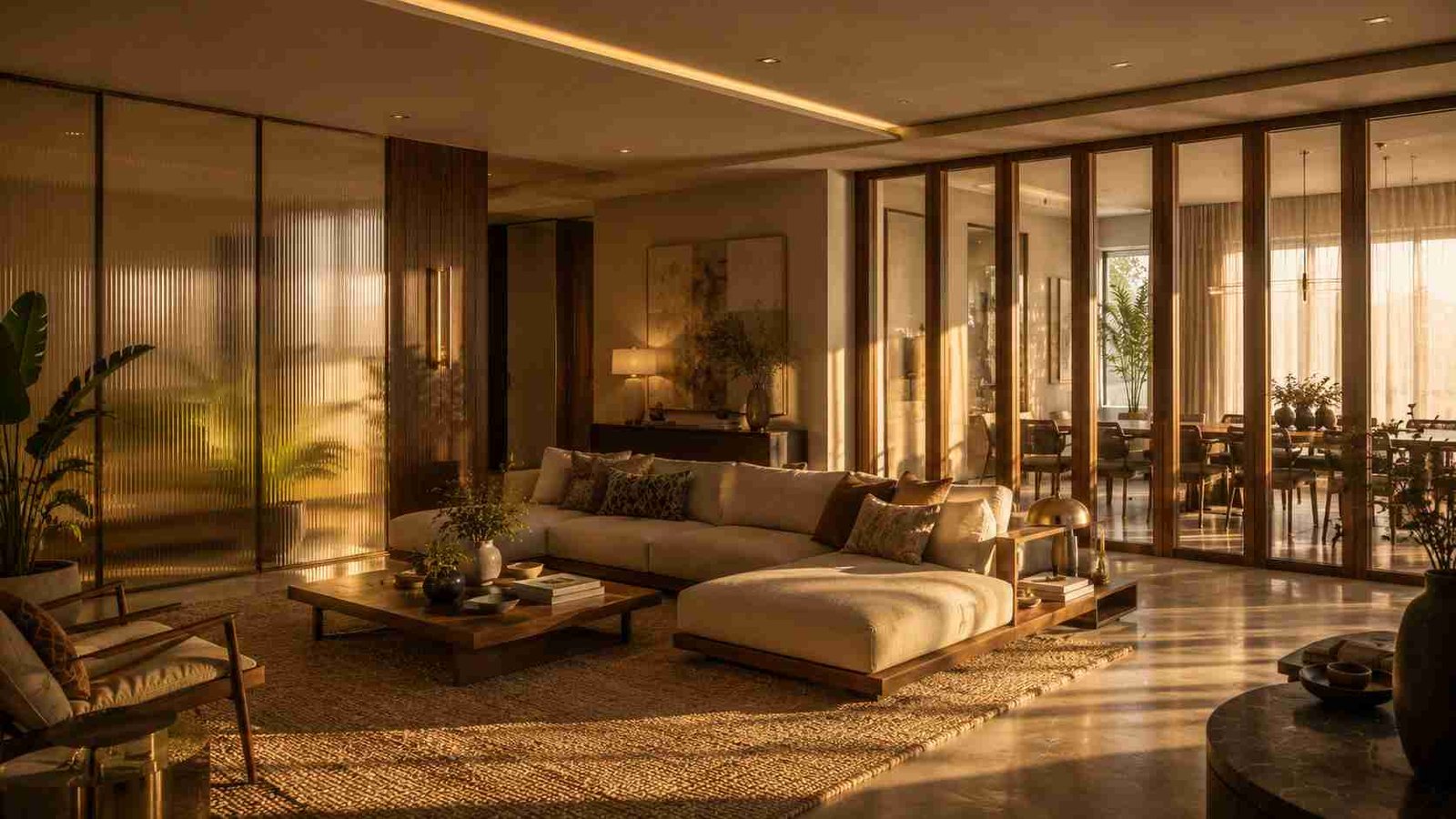
I still remember the first time a glass partition changed how a room felt for me.
It wasn’t in a showroom or a magazine spread- it was in a friend’s 2BHK, where the living room and the tiny study behind it were separated by nothing more than a fluted glass panel in a thin brass frame.
The flat was maybe 750 square feet, but the moment you walked in, it read as double that. No extra square footage had been added. Just glass, positioned well.
That’s the thing about glass wall panels that most people don’t realise until they’ve lived with one: they don’t just let light through; they change how the eye reads a space.
A solid wall tells your brain “the room ends here.” Glass tells your brain “the room keeps going, just differently.”
After years of picking apart rooms like this one for a living, I’ve come to think glass partitions are one of the most underused tools in homes, mostly because people assume they’re either purely commercial (think glass-walled offices) or prohibitively expensive.
Neither is fully true anymore. This piece is a walk-through of the glass panel ideas that actually work in a living room- not just ones that look nice in a render.
I’ve tried to flag where each style shines, where it struggles, and what to ask your fabricator before you commit, because glass is one of those materials that’s unforgiving if the detailing is off.
Why Glass Panels Work So Well in Living Rooms
Before getting into the list, it helps to understand the two or three reasons designers keep coming back to glass, because it explains why some of the ideas below will suit your home and others won’t.
Light travel. In most Indian apartments, only one or two walls actually face a window. Everything behind that first room sits in borrowed light at best. A glass panel lets daylight travel two or three rooms deep instead of stopping at the first doorway.
Visual continuity without visual noise. Open-plan living has its limits- you don’t always want to see the kitchen mess from the sofa, or hear every word from the home office during a call.
Glass gives you separation without commitment. You get privacy from clutter and sound (partially) while keeping the sense of one continuous space.
Perceived value. This one is less talked about, but it matters: glass, when detailed well, reads as expensive. It signals that a decision was made rather than a wall was just left standing.
That’s a big part of why it shows up so often in the kind of interiors I gravitate toward- warm-neutral, editorial, quietly luxurious spaces rather than anything overly rustic or heavy-handed.
With that context, here are the panel styles worth considering.
Check 13+ Glass Wall Panel Ideas For Living Room
1. Fluted (Reeded) Glass Partition
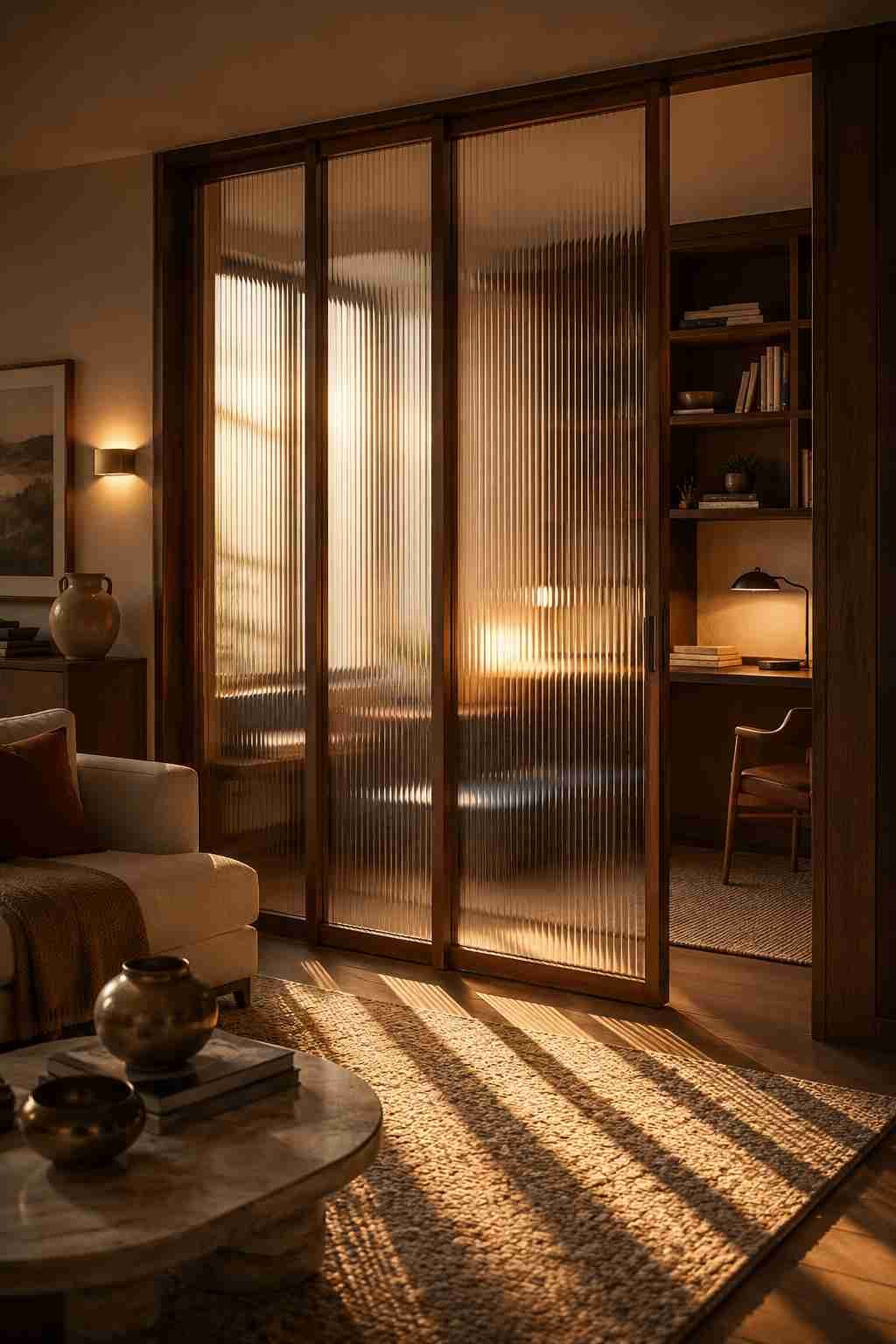
If I had to pick the single most requested glass treatment right now, it’s fluted glass, the kind with fine vertical ridges that soften whatever’s behind it into a blur rather than a clear image.
It gives you privacy without the flat, clinical look of frosted glass, and the ridges catch light beautifully in the evening, throwing thin vertical shadows across the floor.
It works particularly well as a divider between a living room and an adjoining study or prayer nook, where you want light and openness but not a direct line of sight.
Pair it with a slim oak or walnut frame rather than aluminium if you’re going for a warmer, more residential feel- the wood softens what could otherwise look like a shopfront.
2. Frosted or Acid-Etched Glass Panel
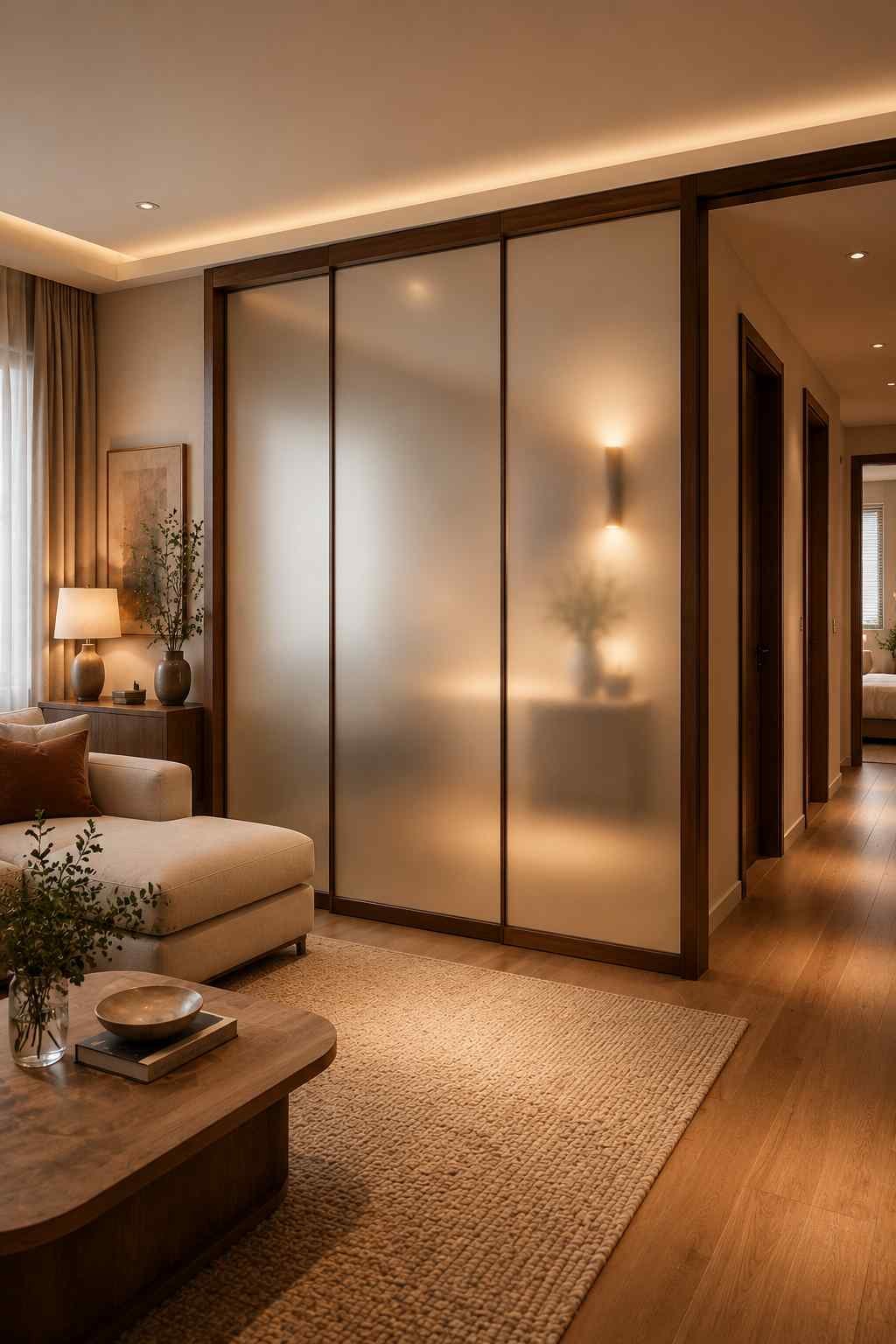
Frosted glass has been around long enough that some people write it off as dated, but the newer acid-etched finishes (as opposed to the old frosted film) look considerably more refined.
The etching is done into the glass itself, so there’s no film to peel or yellow over time, a real issue I’ve seen in a few older homes where the frosted film had started lifting at the edges after five or six years.
Use this where privacy matters more than pattern- say, a panel that separates the living room from a passage leading to bedrooms.
It blocks the direct view while still letting silhouettes and light through, which keeps the home from feeling closed off the way a full brick wall would.
3. Long Glass Wall Between Living and Dining
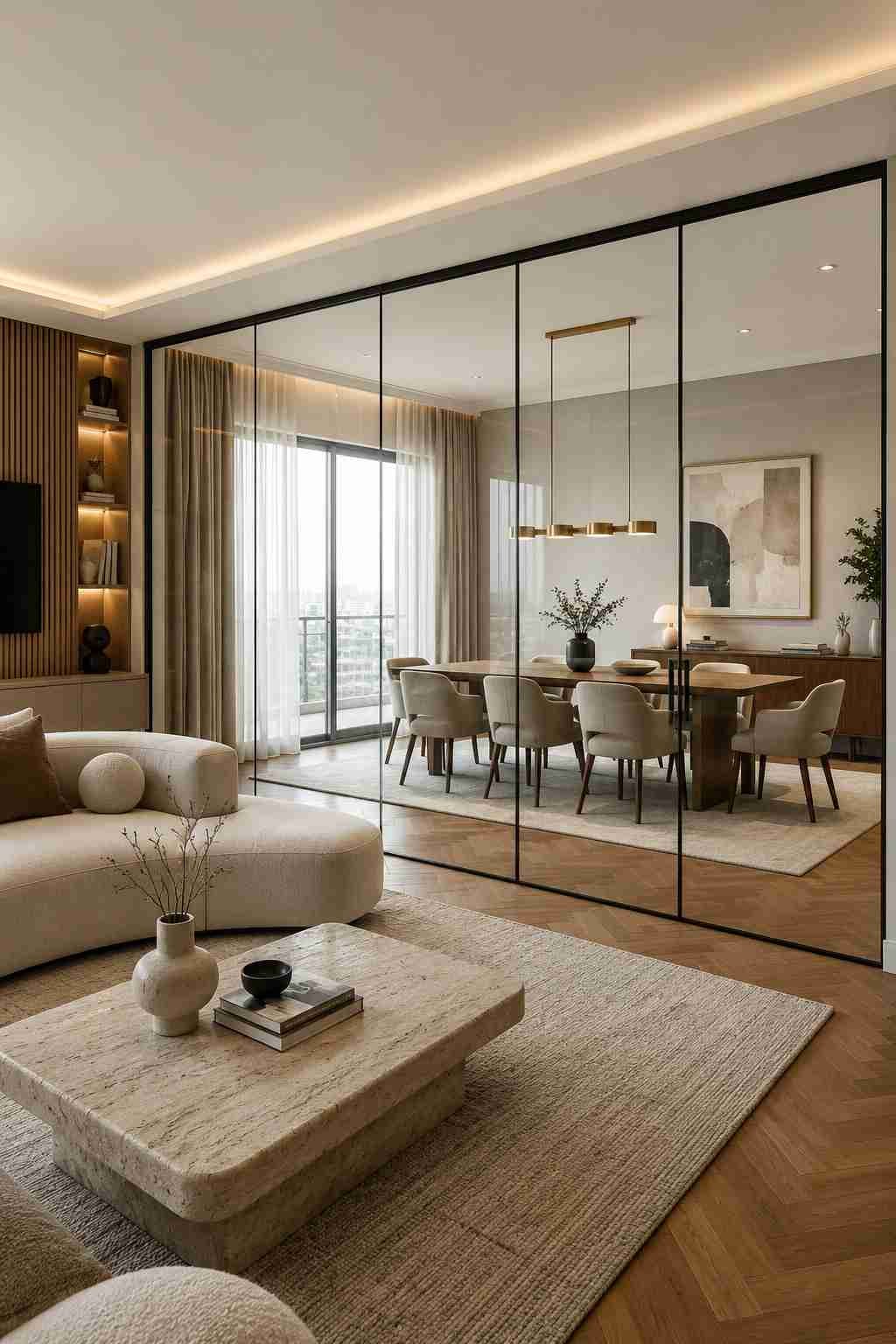
Instead of a partition panel, this is closer to replacing an entire non-load-bearing wall with glass, floor to ceiling, edge to edge.
It’s a bigger structural decision, so it’s not for every home, but in apartments where the living and dining areas were originally built as two separate boxy rooms, a full glass wall here can genuinely double the sense of space.
I’d recommend toughened glass of at least 10mm here, and a professional structural check if the wall was ever load-bearing (many “temporary” partition walls in Indian flats have secretly ended up carrying some load over renovations, so this is worth confirming before anyone starts breaking anything).
4. Brass-Framed Glass Partition
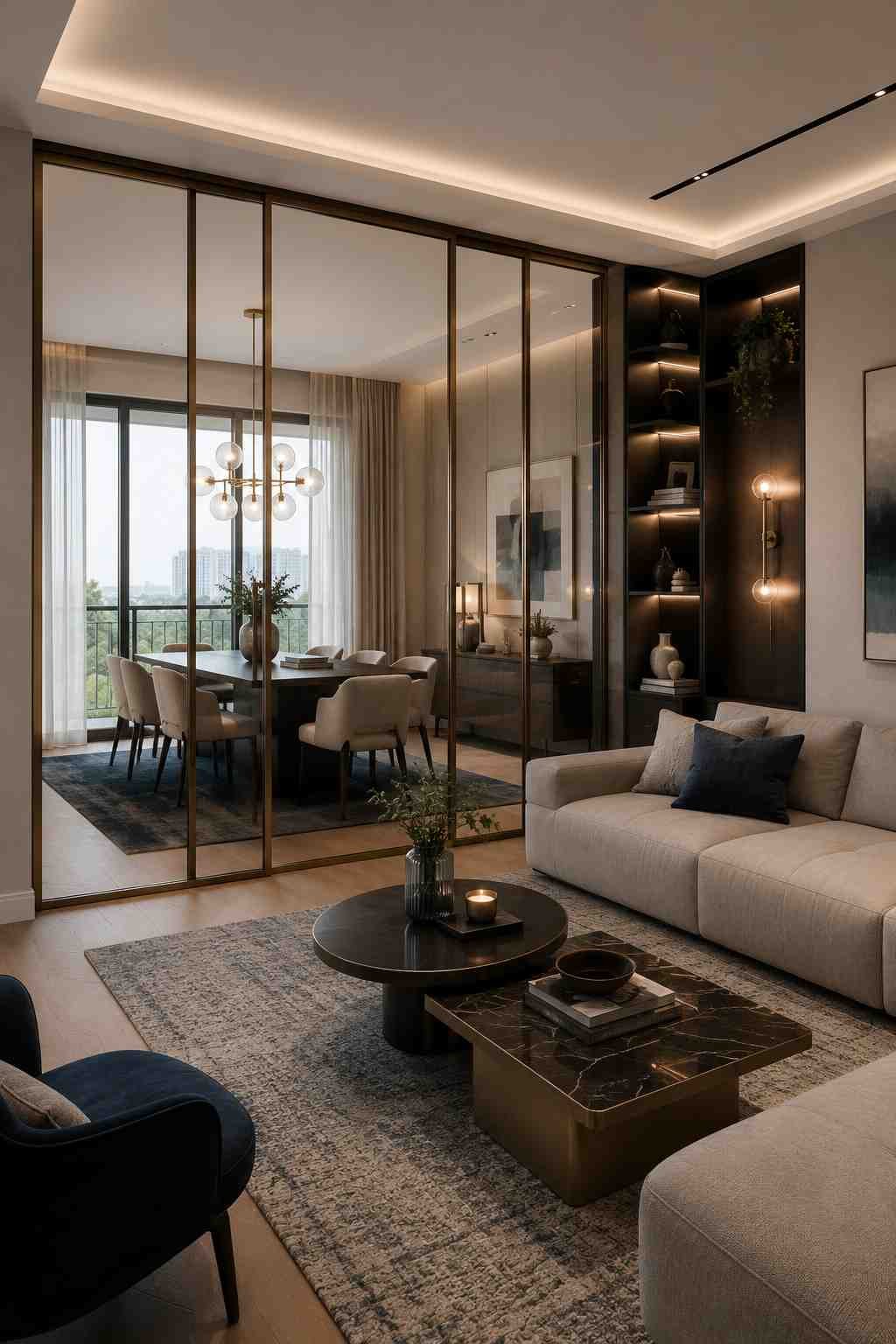
This is the one that consistently photographs the best, and it’s become something of a signature in higher-end Indian interiors over the last few years.
Thin brass, or brass-finish aluminium, which is far more budget-friendly and nearly indistinguishable once installed- framing clear or lightly tinted glass gives a partition an almost jewellery-like quality.
It pairs beautifully with the warm neutral palettes I tend to favour: travertine flooring, bouclé upholstery, linen drapery.
Where black-framed glass can feel a little stark or corporate, brass immediately reads as residential and considered.
If you’ve been looking through Brown Sofa Living Room Ideas for your own space, a brass-framed glass panel in the background does a lot to tie the warmth of the room together without competing with the sofa for attention.
5. Black-Framed Grid Glass Wall
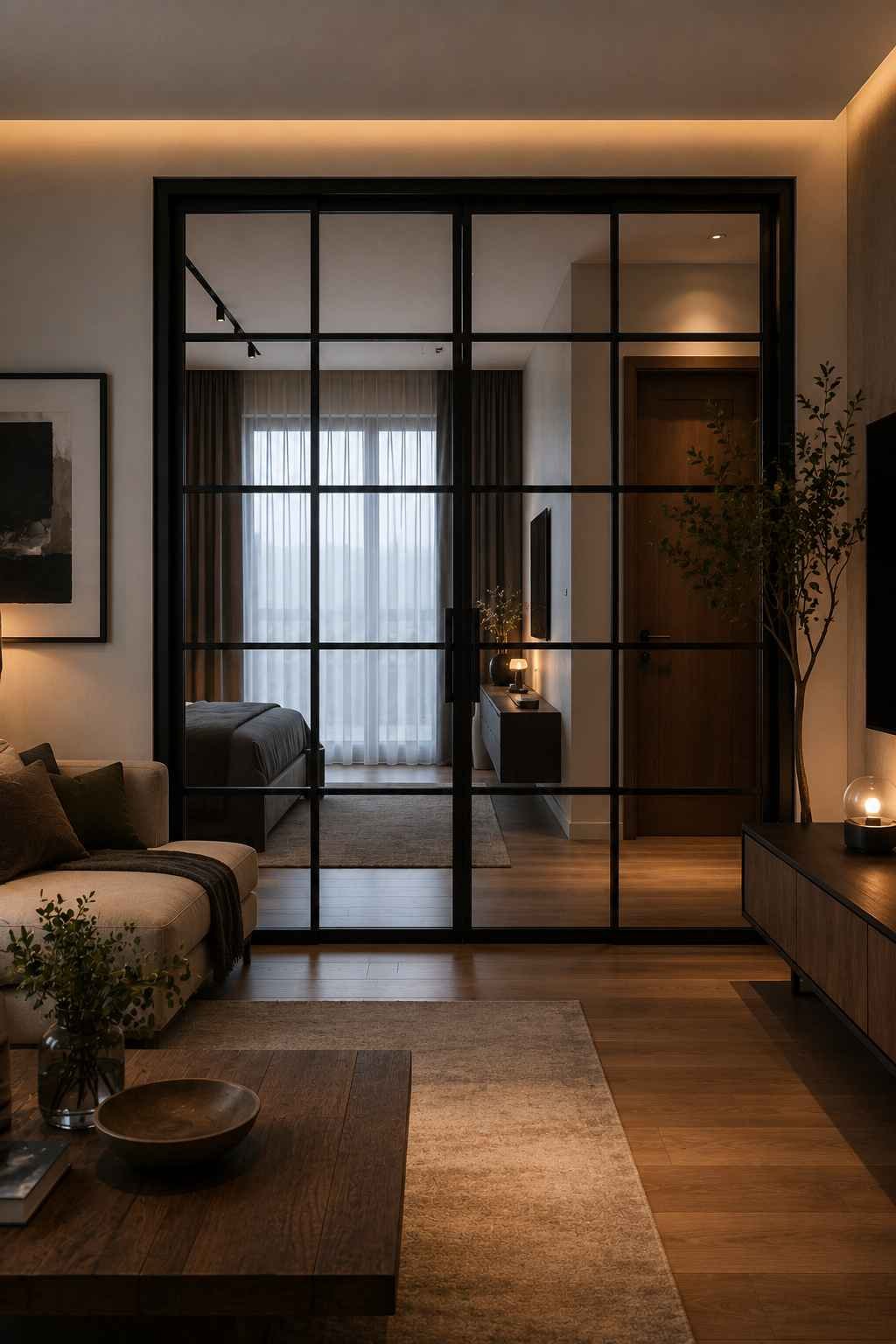
The black-grid glass wall, often compared to old factory windows, has become common enough that it risks looking generic if it’s not handled carefully.
Where it goes wrong is when the grid pattern is too busy, too industrial, and clashes with an otherwise soft interior.
Where it goes right is when the grid is kept restrained- three or four panes rather than a dozen, and the surrounding materials stay warm rather than raw.
Think of it less as an industrial statement and more as a graphic, almost art-deco linework against a soft backdrop.
Powder-coated matte black frames with warm wood flooring and soft furnishings keep this from tipping into a look that feels cold or overly utilitarian.
6. Sliding Glass Panel Room Divider
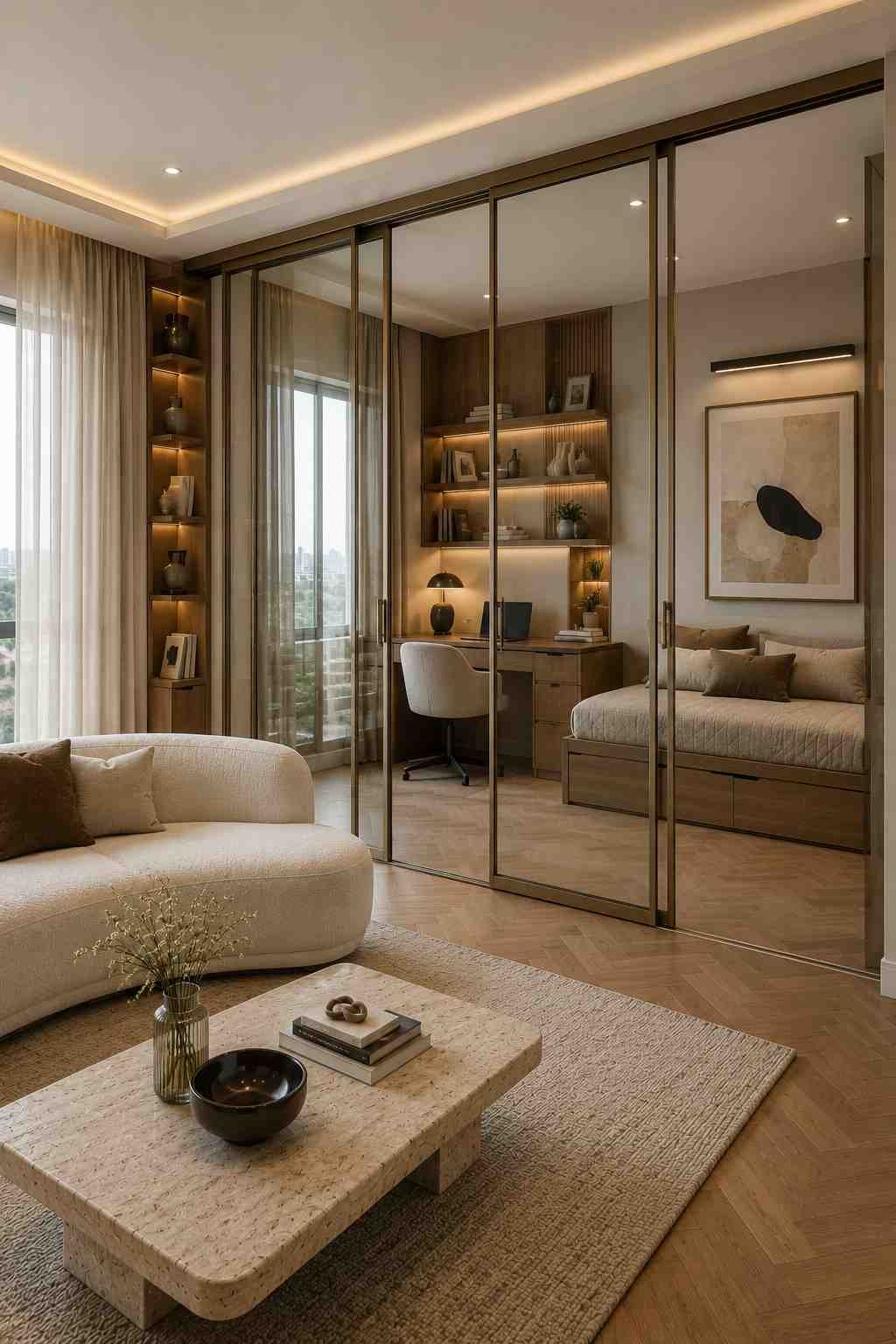
For homes where the living room needs to double as a guest bedroom or a work-from-home space during the day, a sliding glass panel system is worth the investment.
Unlike a fixed partition, it gives you the option to fully open the space up when you want it, and close it off when you need privacy or noise control.
Track-mounted sliding systems have improved a lot- modern soft-close hardware means they no longer bang shut the way older sliding doors used to.
If floor space is tight, look at top-hung systems that don’t need a floor track at all, which also keeps the sightline cleaner.
7. Smoked or Tinted Glass Panel
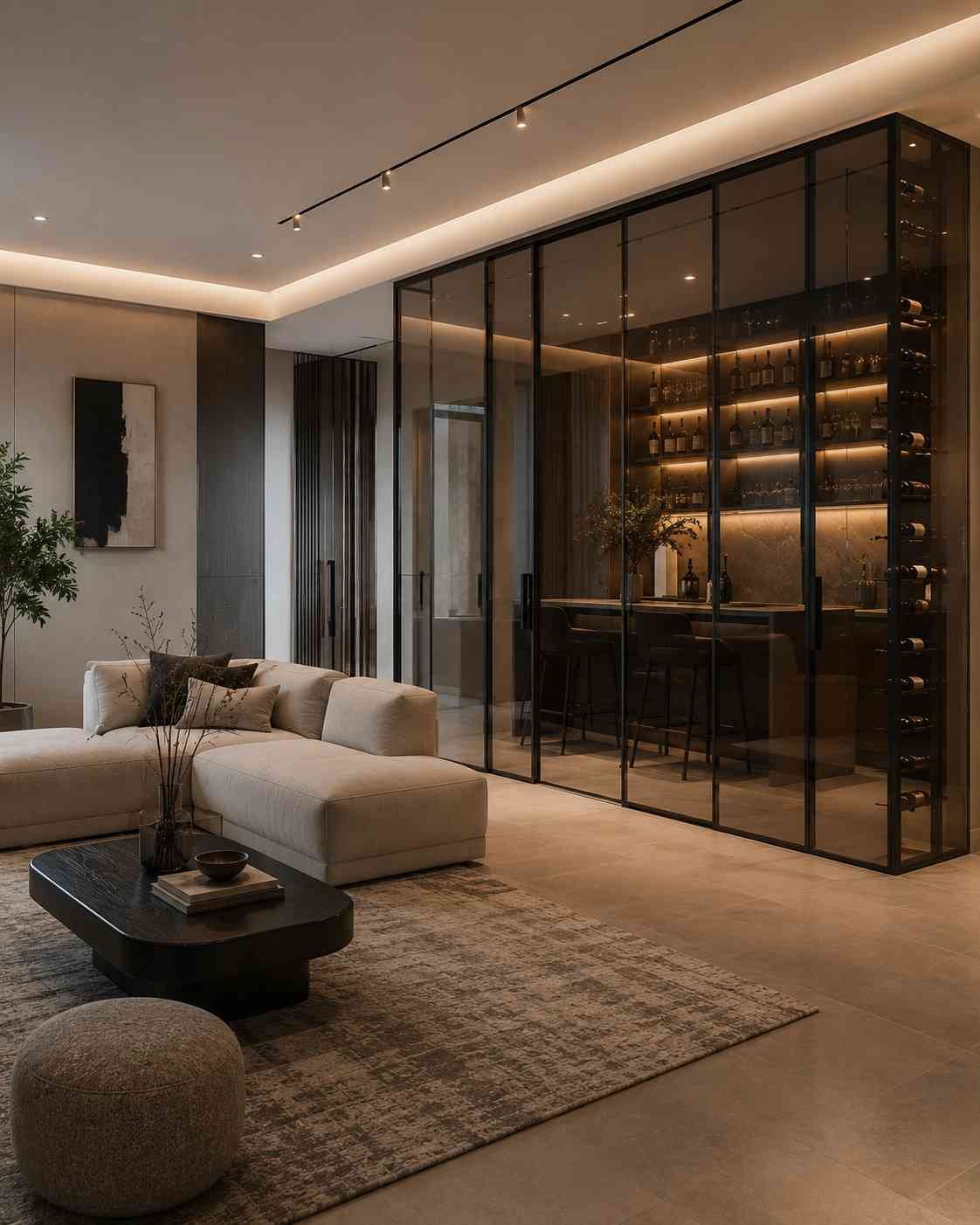
Smoked glass, a soft grey or bronze tint rather than fully opaque, is worth considering if your living room gets strong afternoon light and you want to soften the glare without blocking the view entirely.
It also does a quieter job of hiding what’s on the other side compared to clear glass, without the fully obscured look of frosted or fluted options.
I’ve used this most successfully as a backdrop for a home bar or display cabinet, where you want the objects behind the glass to feel slightly mysterious and layered rather than fully exposed.
8. Glass Block Wall
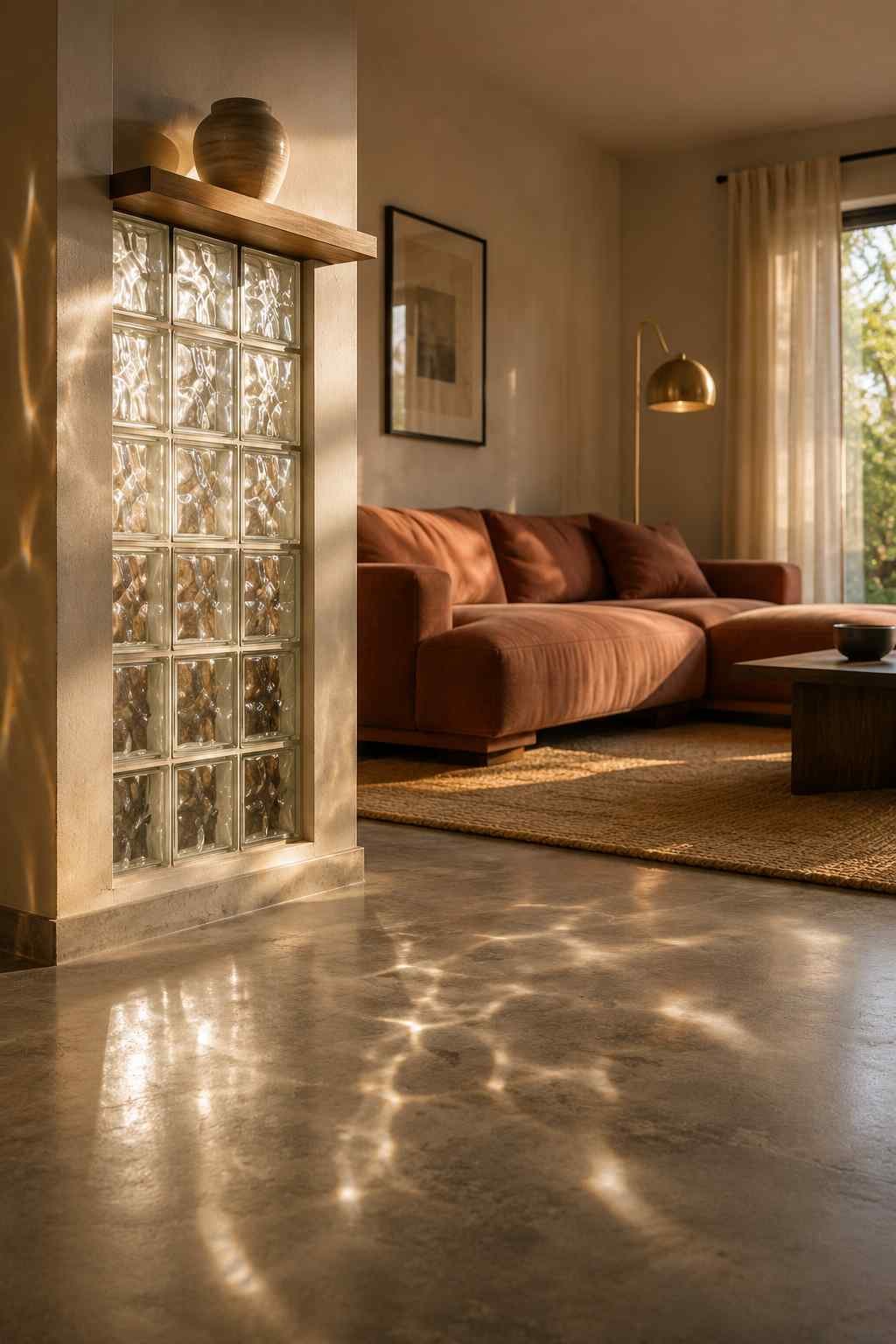
Glass blocks have had a real image problem for the last two decades, mostly thanks to their association with 1990s bathrooms.
But used sparingly, as a small feature section within a larger wall rather than the whole wall, they bring a texture that flat glass simply can’t.
Light passing through glass blocks scatters and refracts, which creates a soft, moving pattern on the floor as the day goes on.
This works best as an accent, not the main event: a metre-wide section beside a solid wall, or a low glass-block partition topped with a display shelf, rather than a full-height wall of blocks.
9. Mirrored Glass Panel Wall
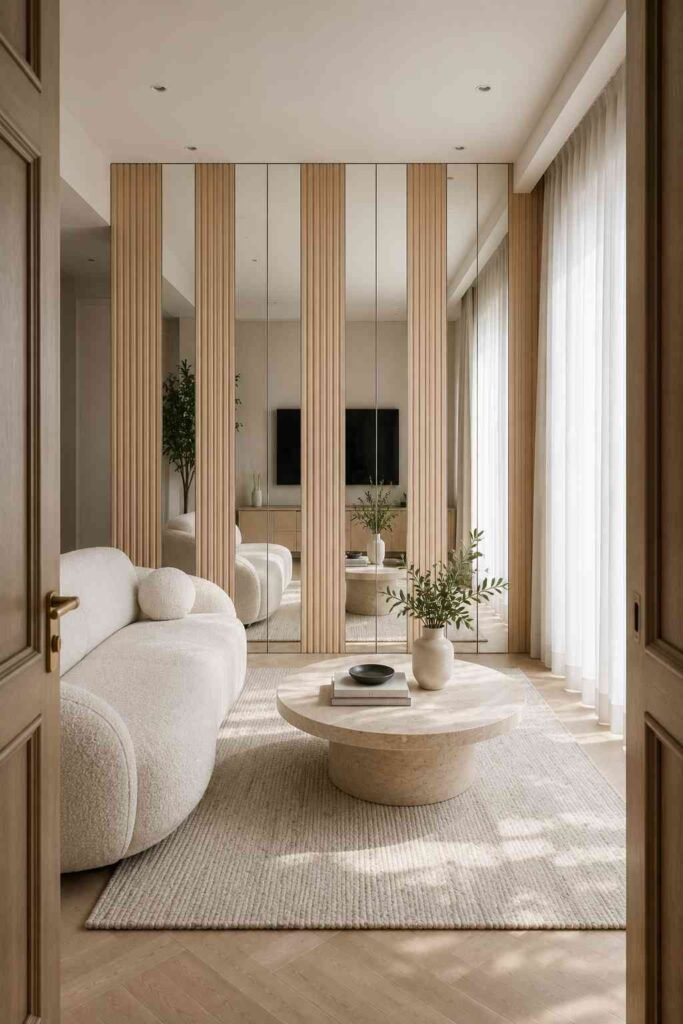
Not technically transparent, but it belongs on this list because it solves the same fundamental problem- a small living room that needs to feel bigger.
A mirrored glass panel, especially placed opposite a window, bounces daylight back into the room and visually doubles whatever’s reflected in it.
The trick is restraint. A full mirrored wall can feel like a dance studio if it’s not broken up.
I prefer mirrored glass in vertical strips alternating with a warm material like fluted wood or textured plaster, so the reflection reads as intentional detailing rather than an attempt to hide a small room’s limitations.
10. Glass Balustrade Bordering a Sunken or Split-Level Living Room
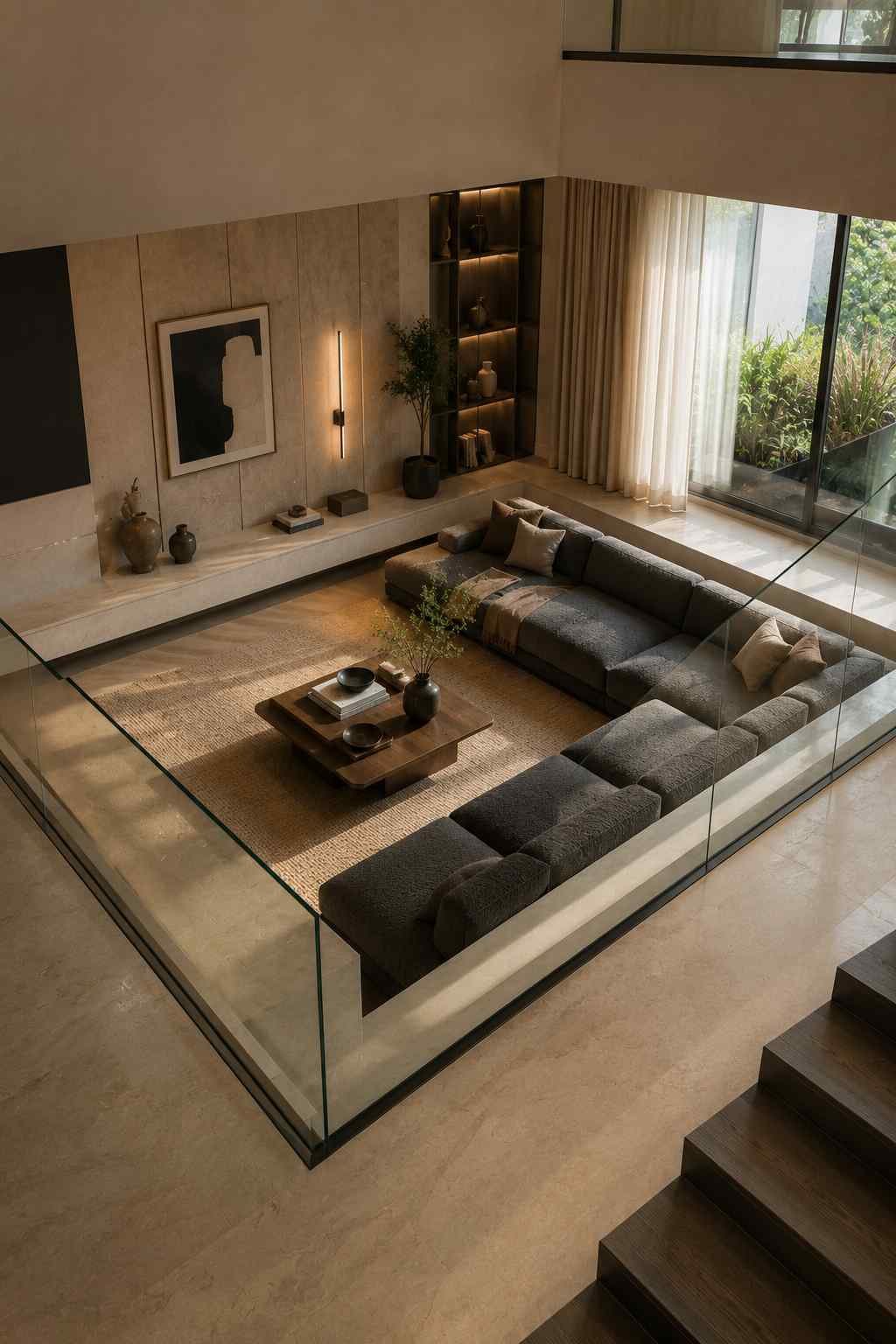
If your living room has a step-down section, a sunken seating pit, or borders a staircase, a glass balustrade panel keeps the sightlines completely open where a solid railing or heavy wooden balustrade would chop up the view.
It’s a small detail, but it changes how the whole room reads from the entry point- you see the full space in one glance instead of a room broken into segments.
Toughened, laminated glass is non-negotiable here for safety reasons, and local building codes in most Indian cities will specify a minimum thickness for balustrade applications; this is one detail worth confirming with your fabricator rather than assuming.
11. Glass Partition with Sheer Curtain Backing
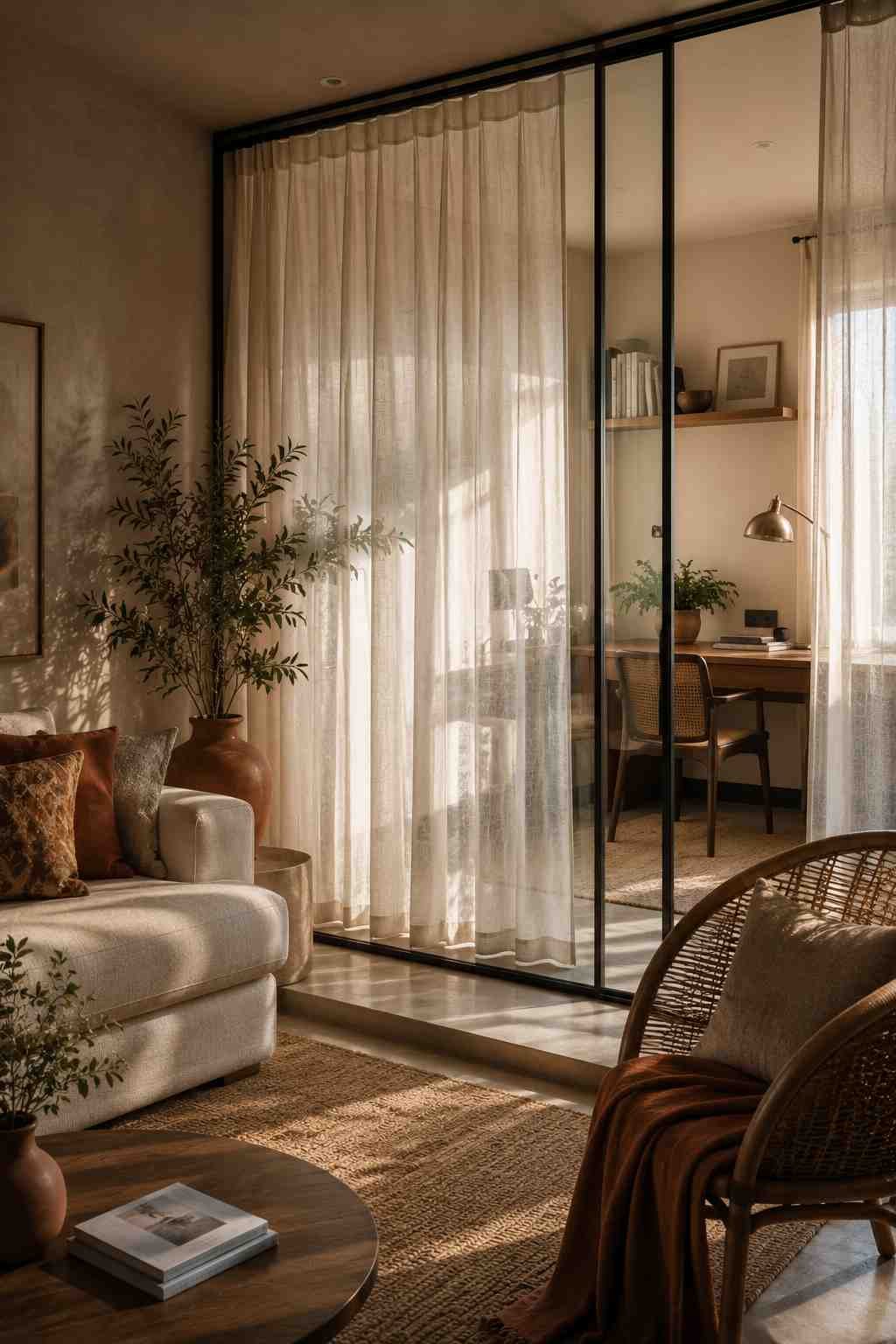
This is a softer, more textile-forward take on the glass partition idea, and it’s one I find myself recommending often for clients who want the openness of glass but worry it will feel too hard or too office-like.
A clear or lightly fluted glass panel backed with a sheer linen curtain gives you the best of both- structural transparency during the day, and a soft, diffused privacy option when the curtain is drawn.
It also solves a real practical issue: glass alone offers no acoustic buffer, and a curtain, even a sheer one, takes the edge off sound transfer between spaces.
12. Glass Wall with Integrated Display Shelving
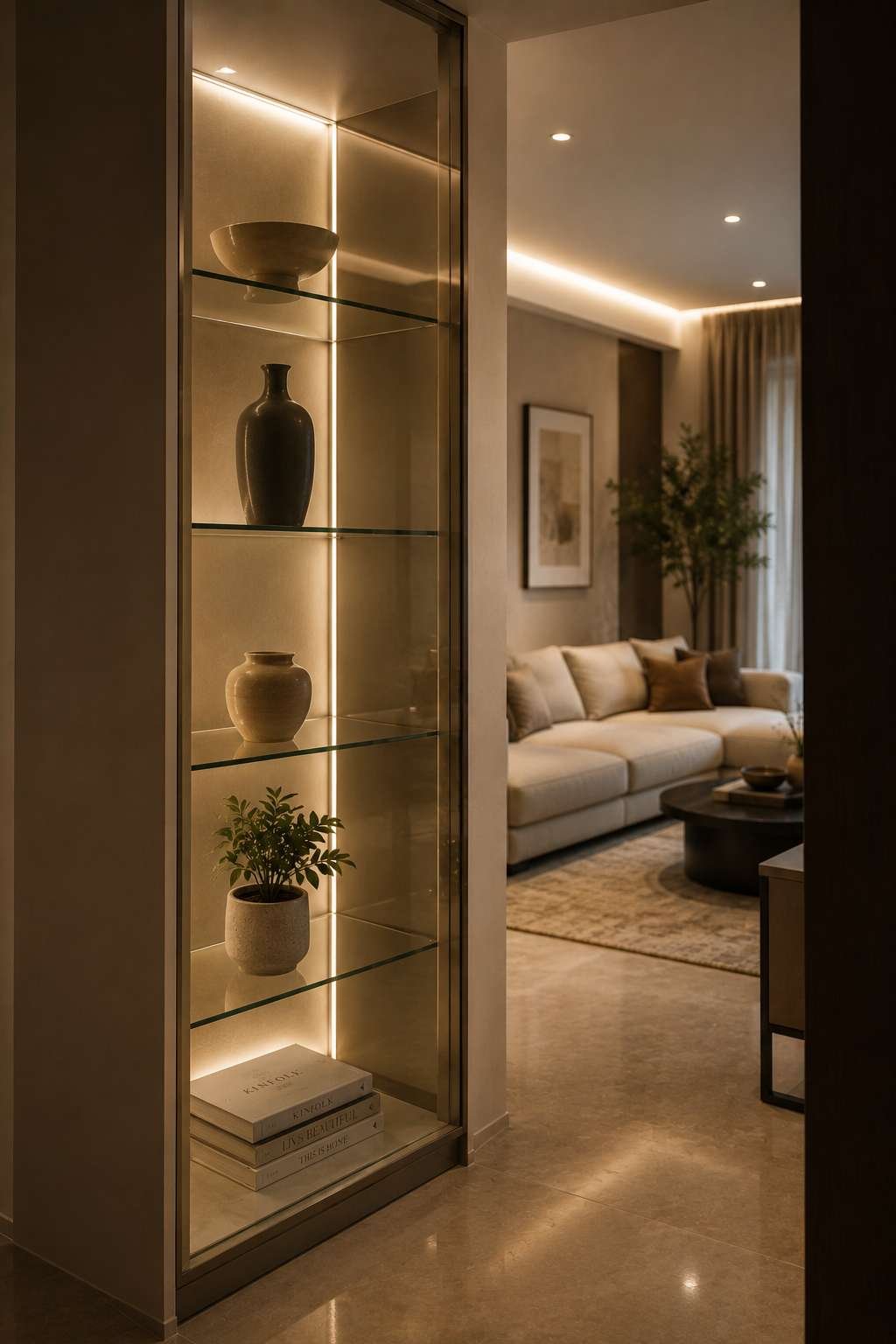
Rather than a flat panel, this treats the glass partition as a shallow display case- a slim cavity between two glass sheets, or glass shelving mounted within a partial partition, used to showcase books, ceramics, or plants.
It works particularly well between a living room and an entryway, giving arriving guests a curated first glimpse of the room rather than a blank wall.
Keep the objects on the shelves deliberately sparse. A partition like this reads as elegant with five well-chosen pieces and cluttered with fifteen.
13. Floor-to-Ceiling Glass Wall Opening to a Balcony or Garden
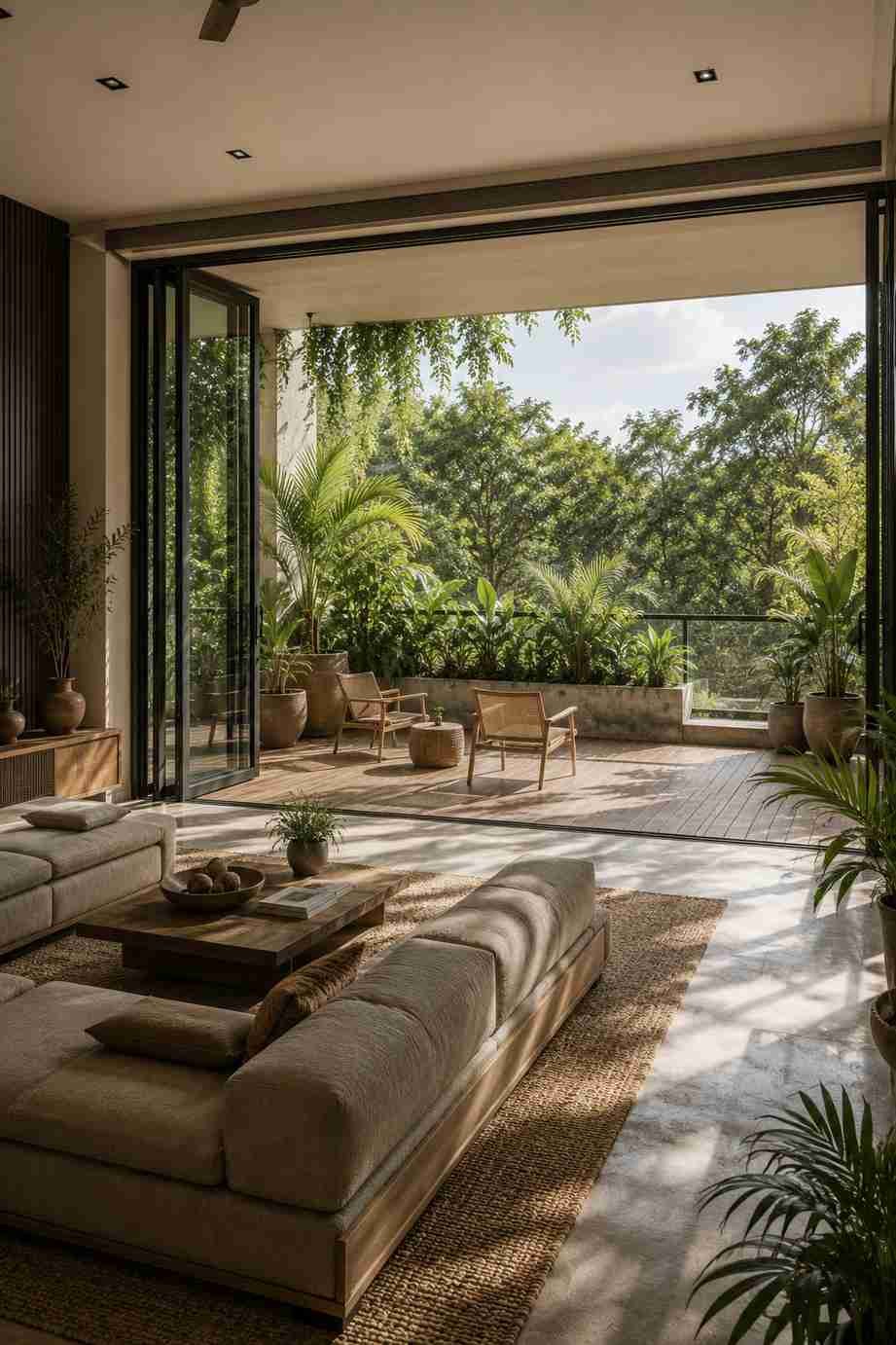
For homes lucky enough to have a balcony, terrace, or small garden adjoining the living room, a full glass wall, ideally with a slide-and-fold or slide-and-stack door system, essentially erases the boundary between indoors and outdoors.
This isn’t a partition in the traditional sense, but it belongs on this list because it’s the most dramatic application of the same underlying idea: glass as a tool for expanding how big a room feels.
The main consideration here is thermal performance.
In Indian climates, especially through summer, a large unshaded glass wall can turn a living room into a greenhouse by afternoon.
Double-glazed or low-E coated glass, paired with an external shade or a generous roof overhang, makes a real difference in keeping the room usable through the hottest months.
14. Glass and Wood Combination Partition
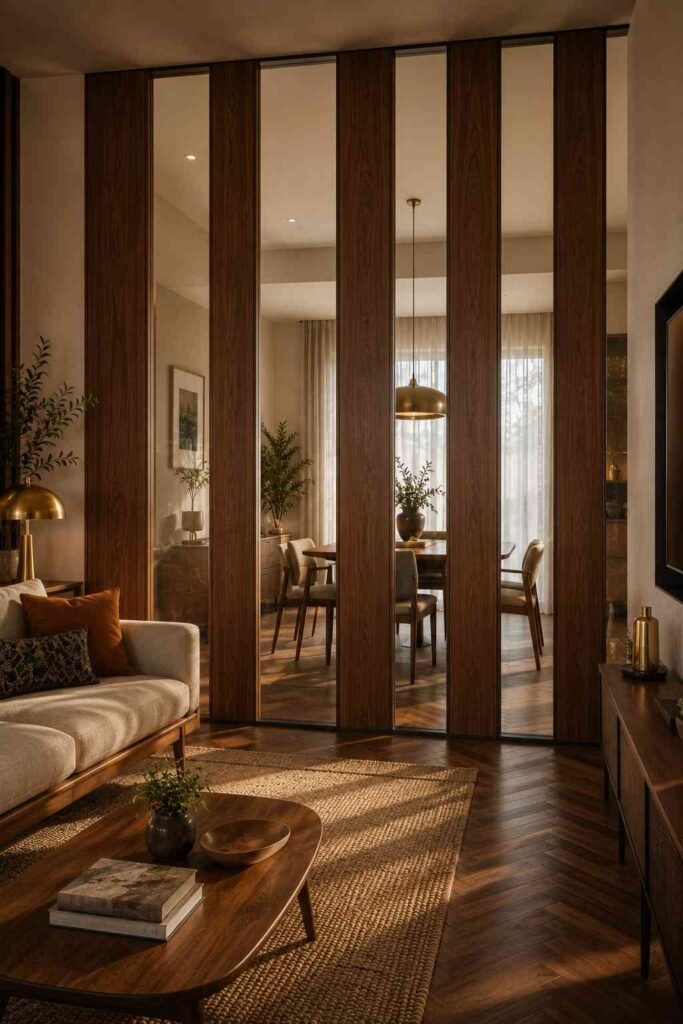
A partition that alternates clear or fluted glass panels with solid wood- oak or walnut, ideally matched to your existing flooring or furniture- softens the transition between rooms in a way that all-glass or all-wood can’t manage alone.
The wood sections provide visual weight and a place for the eye to rest, while the glass sections keep the light and openness intact.
This combination has become one of my personal favourites for anyone nervous about committing to a fully glass wall- it eases you into the idea without the room feeling like a display case.
15. Glass Panel with Backlit LED Edge
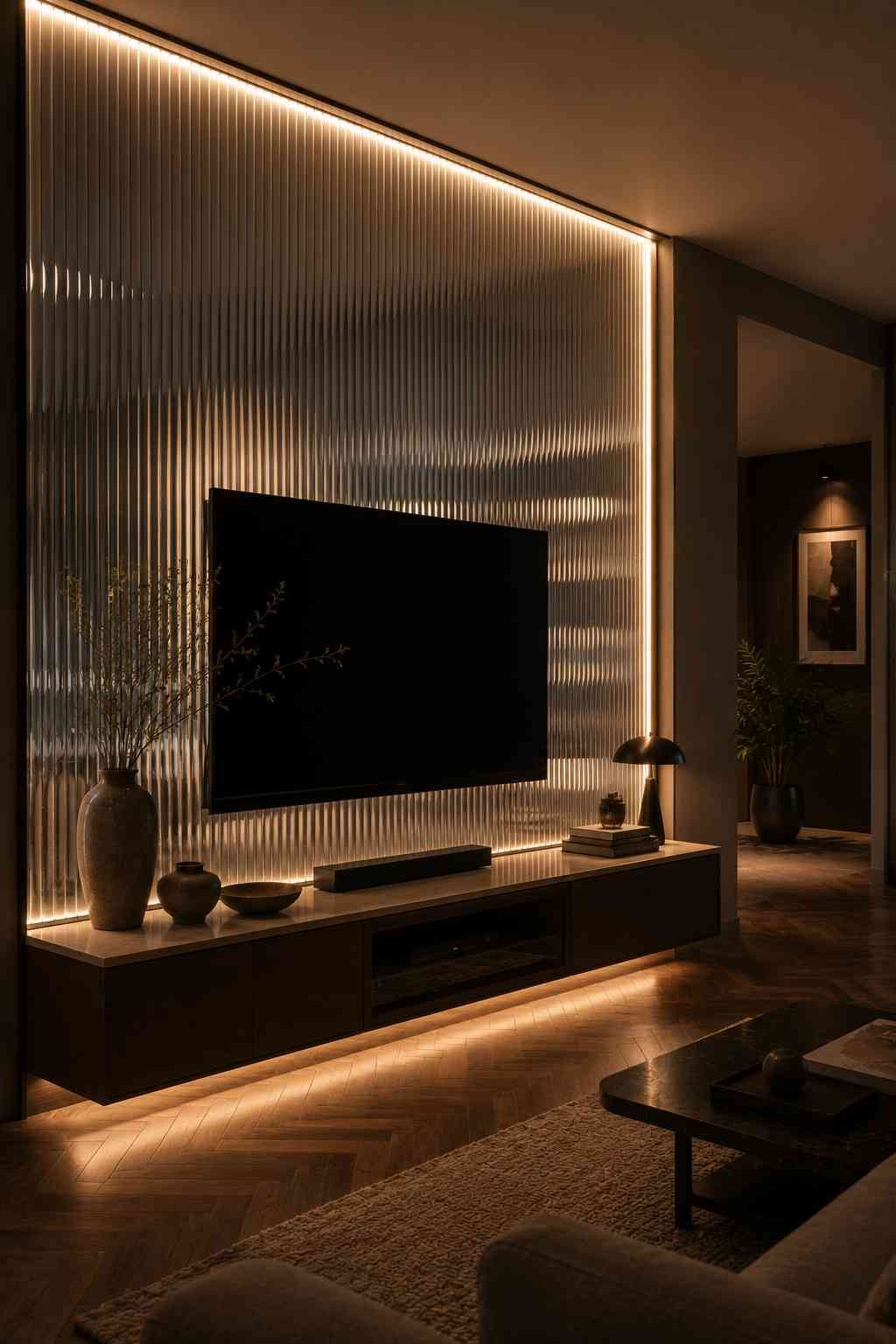
A relatively newer addition worth mentioning: fluted or fritted glass panels with a slim LED strip run along the edge or frame, so the panel itself glows softly after dark rather than needing a separate light fixture pointed at it.
It’s a subtle detail during the day and a genuinely striking one at night, particularly with warm white light (2700K–3000K) rather than the colder, bluer tones that can feel more commercial than residential.
This pairs well as a backdrop behind a TV unit or console; if you’ve already looked into Modern TV Unit Designs with backlighting, a glass partition with the same warm LED treatment nearby keeps the lighting language of the room consistent rather than competing.
What to Actually Check Before You Commit to a Glass Panel
A few practical notes I always pass on when someone’s about to sign off on a glass partition, because these are the details that separate a good installation from a regretted one.
Always specify toughened (tempered) glass, minimum 8–10mm, for anything at living-room scale. It breaks into small, blunt granules rather than sharp shards if it ever does crack- genuinely important with kids or pets in the house.
Ask about maintenance before you fall in love with a finish. Clear glass shows every fingerprint and smudge; fluted and frosted glass hide them far better and are much more forgiving for day-to-day living.
Factor in acoustic performance separately from visual privacy. Glass looks like a wall but doesn’t behave like one for sound. If noise control matters, a home office behind the partition, for instance- look at laminated acoustic glass or add a soft furnishing layer like the curtain option mentioned above.
Get the frame material right for your budget. Brass-finish aluminium framing gives you 80% of the look of solid brass at a fraction of the cost and with none of the tarnishing upkeep real brass needs over time.
Think about the room on both sides, not just the one you’re decorating. A glass partition is, by definition, visible from two rooms. If the space behind it is a utility area or storage room, that’s worth reconsidering before you glaze it.
Bringing It Together
Glass wall panels aren’t a trend that’s going to look dated in three years- they solve a genuine, ongoing problem in Indian homes, which is that most living rooms are smaller and more enclosed than we’d like them to be.
Used thoughtfully, with the right frame, finish, and glass type for your specific room, they do more for the sense of space and light than almost any other single design decision short of knocking down an actual wall.
If you’re planning a full living room refresh around a glass partition, it’s worth thinking about how the rest of the room’s materials play off it; the wall treatments and storage pieces you choose behind or beside the glass matter just as much as the panel itself.
I’ve written more on that in my piece on Modern Corporate Office Wall Design Ideas, which covers a lot of the same material-pairing logic even though it’s framed around a different room.
Start with one panel, one room, and see how the light changes before you commit to anything bigger. That’s usually the best way to know if it’s actually right for your home rather than just right in a photograph.
Frequently Asked Questions
Is a glass partition wall expensive compared to a regular brick wall?
Per square foot, yes- glass with a good frame usually costs more upfront than plastering and painting a brick wall. But it’s rarely a fair comparison, because a glass partition is also doing the job of a window, a light source, and a design feature all at once.
When I’ve had people compare the two side by side, factoring in what they’d otherwise spend on extra lighting fixtures for a dark inner room, the gap narrows considerably.
Does a glass partition make a room colder or hotter?
It depends entirely on which glass and where. A partition between two indoor rooms has almost no thermal impact either way.
It’s only the outward-facing applications, like a full glass wall opening onto a balcony, where heat gain becomes a genuine concern, and that’s manageable with the right glazing and shading, as covered above.
How do I clean fluted or textured glass without it looking streaky?
Textured glass actually hides streaks far better than plain glass does, which is one of its quieter advantages. A simple mix of water and a little vinegar, wiped with a microfibre cloth along the direction of the ridges, works fine- no need for specialised glass cleaners unless the panel is fully clear.
Will a glass partition make the room noisy?
A single pane of standard glass offers very little sound insulation on its own, so if the space behind it is meant to be quiet, a home office or a bedroom, for example, it’s worth asking your fabricator about laminated acoustic glass, or pairing the panel with a soft furnishing element like a curtain, which absorbs sound in a way a hard glass surface can’t.
Every one of these answers changes slightly depending on the specific layout of your home, which is really the honest takeaway here- there’s no single “correct” glass partition, only the one that fits how your particular living room is actually used day to day.
[…] covered this in more depth in my breakdown of glass wall panel ideas for living rooms, which looks at how partitioning with glass instead of solid walls keeps a tall, open room feeling […]