
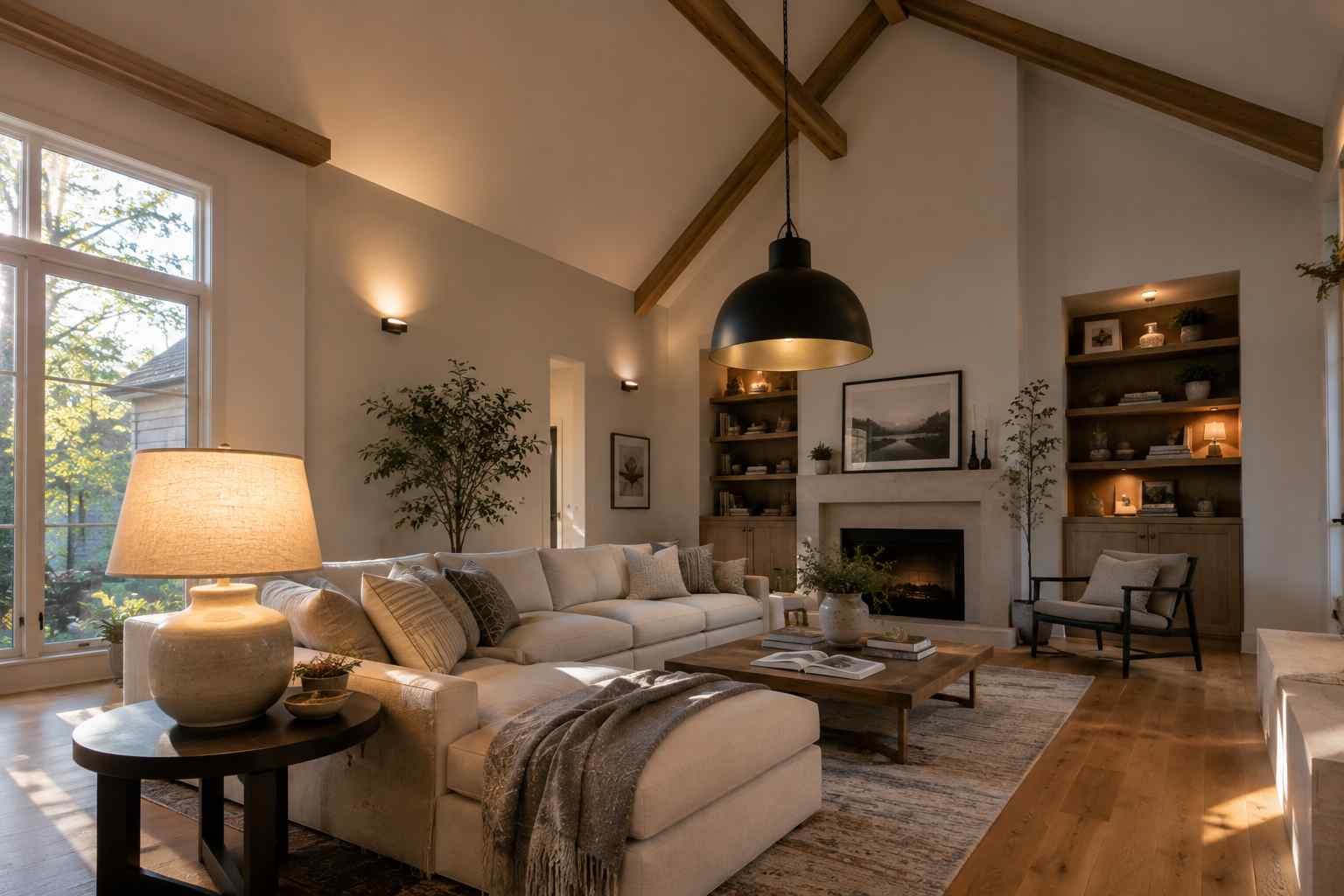
The first vaulted living room I ever worked in belonged to a couple who had just moved out of a standard suburban rental into a converted barn-style build with a ceiling that climbed almost fourteen feet at the peak.
They were thrilled with the space until the sun went down. One centered ceiling fan with a light kit was doing all the work, and the corners of that beautiful room sat in near-total darkness by eight in the evening.
That is the pattern I have seen over and over in homes with vaulted, cathedral, or A-frame ceilings: the architecture is stunning, but the lighting plan was never updated to match it.
A single fixture hung from the peak, sized for an eight-foot ceiling, simply cannot do the job of illuminating a room that is now twice as tall and often twice as open.
Vaulted ceilings change the physics of a room.
Light has farther to travel before it reaches a lamp table or a reading chair; warm air rises and pools at the peak while the seating area stays cooler, and there is rarely a flat central point to hang something from.
None of that means you are stuck with dim corners or an ugly track light bolted onto exposed beams as an afterthought.
Over the years of lighting rooms exactly like this, I have found that the fixtures that work best are almost never the ones marketed specifically as “vaulted ceiling lights.”
They are ordinary ideas applied with an unusual amount of attention to scale, layering, and where the light actually lands once it leaves the bulb.
This list is built around that idea.
Every entry below is meant to solve a different version of the vaulted-ceiling problem, because a converted New England barn, a 1970s A-frame in the Pacific Northwest, a new-build open-plan home outside Auckland, and a stone-and-timber lodge in the Scottish Highlands are not lit the same way, even though they share the same basic architectural challenge.
Pick the two or three that fit the bones of your own room rather than trying to force all of them in at once.
Why Vaulted Ceilings Are Genuinely Harder to Light Than a Standard Room
Before getting into specific fixtures, it helps to understand what you are actually working against, because it changes how you shop.
A standard eight- or nine-foot ceiling puts a light source close enough to the room that even a modest fixture bounces enough light off the walls and ceiling to feel bright.
Push that ceiling up to twelve, fifteen, or twenty feet and three things happen at once. Light intensity drops sharply with distance, so a fixture that would flood a normal room now reads as a dim glow far overhead.
Warm air and light both rise, so heat, and often the brightest part of a poorly aimed fixture, collects near the ridge instead of where people are actually sitting.
And the sloped ceiling planes reflect light at odd angles rather than straight back down, which is why a single flush-mount fixture at the peak so often leaves the perimeter of the room looking flat and shadowed.
The fix is rarely “one bigger light.” It is layering: a source that anchors the room visually, a source that pushes light down toward furniture height, and a source that washes the sloped planes so the architecture itself does not disappear into shadow after sunset.
Keep that three-layer idea in mind as you go through the list, because most of the ideas below are built to cover one of those jobs particularly well.
15+ Living Room Lighting Ideas for Vaulted Ceilings
1. An Oversized Single Chandelier, Sized for the Room and Not the Furniture
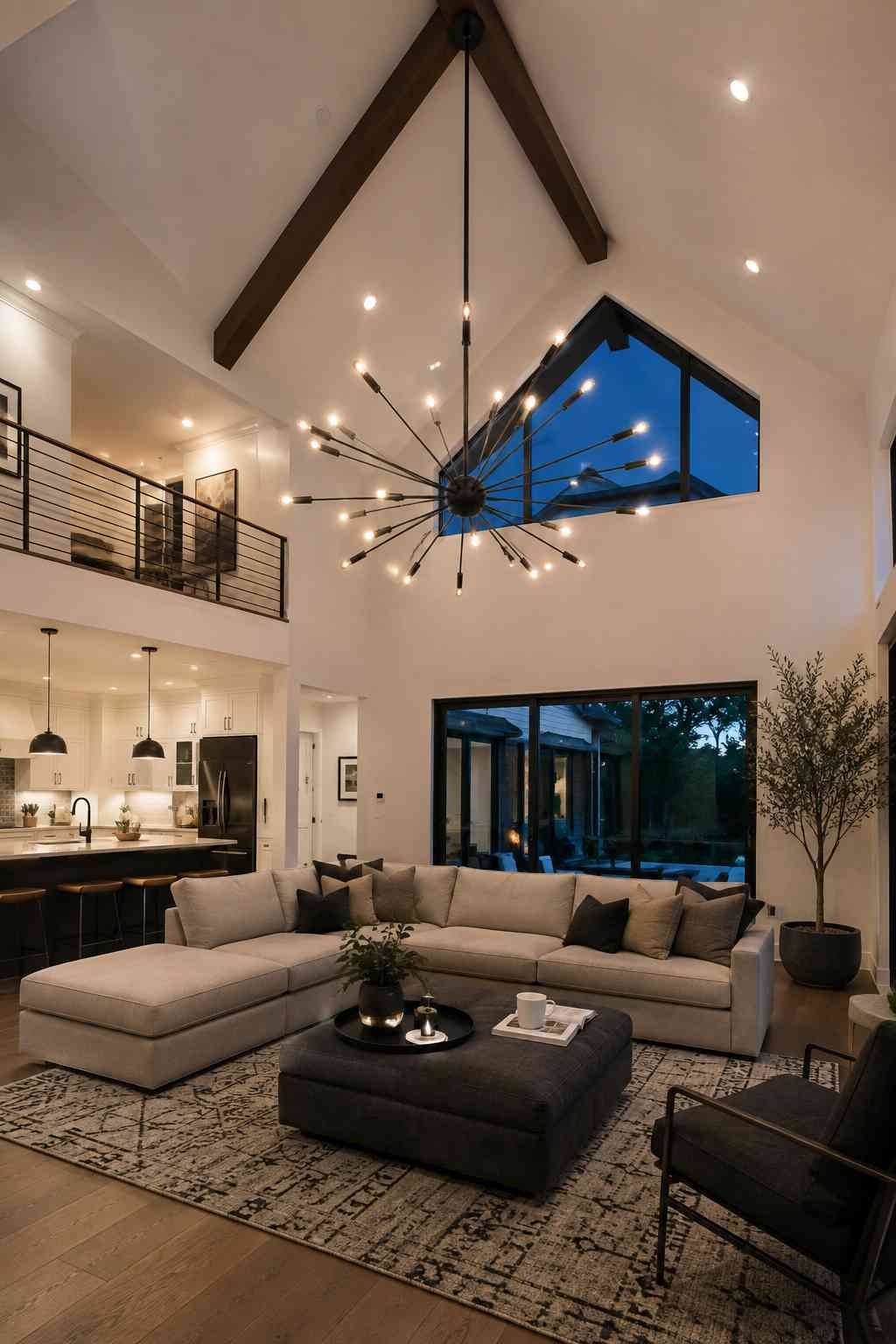
For an open-plan, contemporary living room where the vaulted ceiling is the main event, a single oversized chandelier centered over the seating area is still the most reliable move.
The mistake I see constantly is buying a chandelier scaled to fit an eight-foot ceiling and hanging it fourteen feet up, where it reads as a small dark speck against a huge expanse of white or timber.
A rough rule that has held up across dozens of rooms: add the ceiling height and the room width together in feet, and that sum in inches is close to the ideal chandelier diameter.
A twenty-foot-wide room with a sixteen-foot peak wants a fixture closer to thirty-six inches across, not the twenty-four-inch version that would suit a standard dining room.
Drop the fixture low enough that the bottom sits roughly seven feet off the finished floor, which keeps it out of the visual dead zone near the ceiling and brings actual usable light down to where people sit.
2. A Staggered Cluster of Pendants at Different Drop Heights
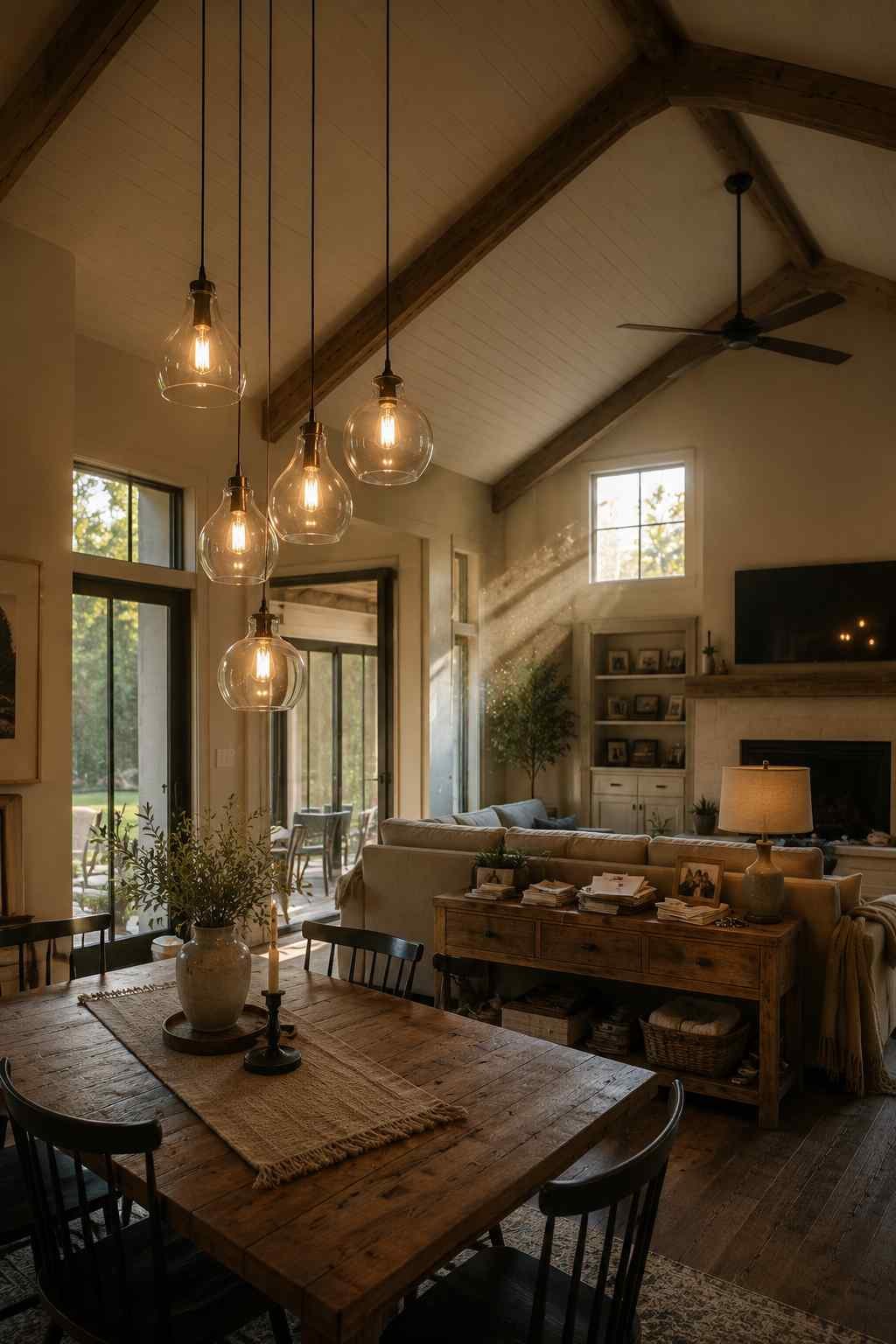
This is the idea I reach for most often in farmhouse and transitional living rooms, especially over a large sectional or a combined living and dining zone.
Instead of one big statement fixture, group three, five, or seven simple pendants and hang them at deliberately uneven lengths, some dropping to seven feet, others stopping short at ten or eleven.
The visual effect fills the vertical space in a way a single fixture cannot, because your eye reads movement across multiple heights rather than one static point far overhead.
It also solves the practical lighting problem better than a single chandelier, since you get several smaller light sources spread across the seating area instead of one concentrated glow at the center.
Linen or glass shades keep it from feeling busy; stick to one shade style repeated across every pendant so the cluster reads as one composition.
3. Track Lighting Run Along the Ridge Beam
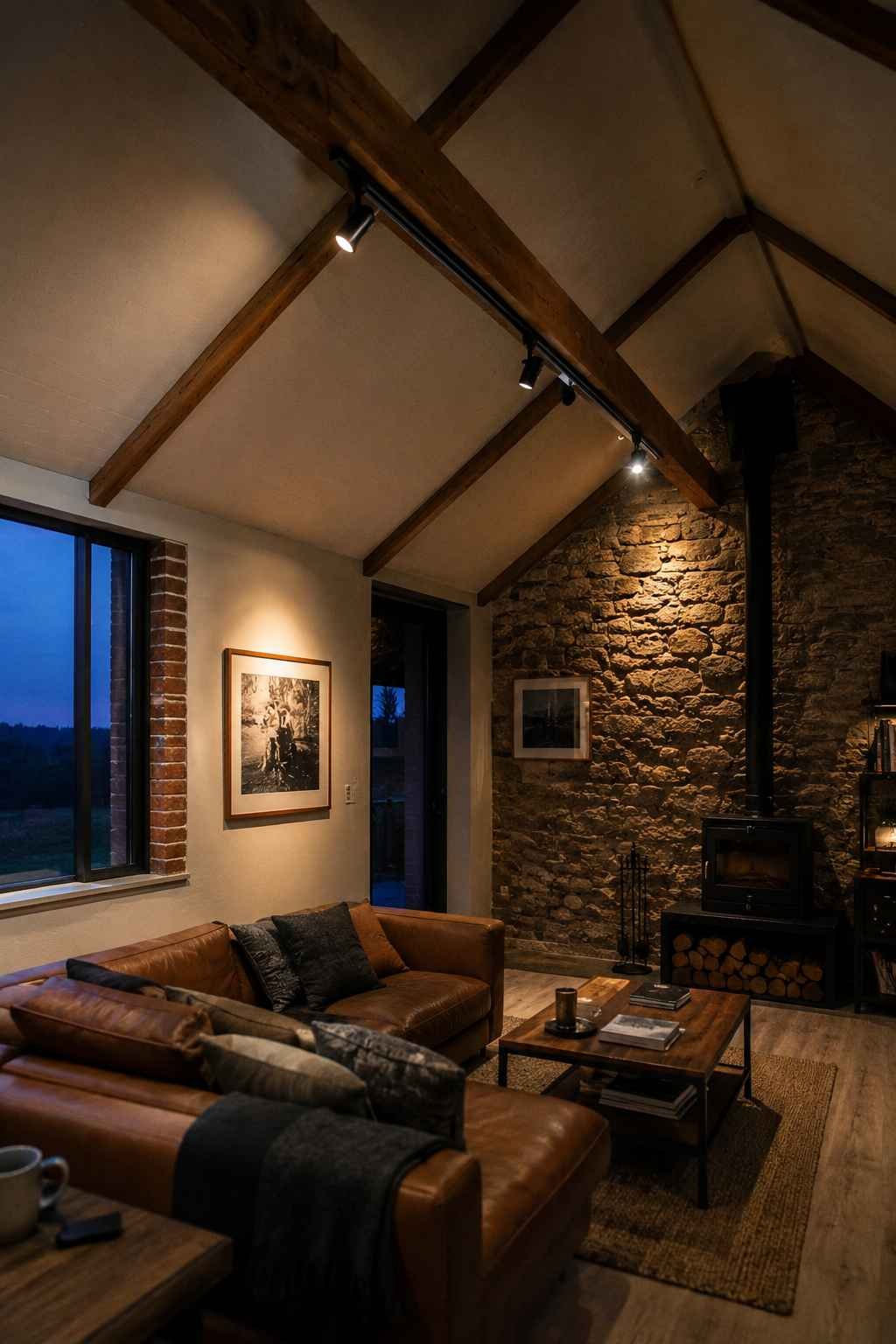
In a converted barn, loft, or industrial-style living room with exposed structural beams, track lighting mounted directly along the ridge beam is both practical and genuinely good-looking, which is not something I can say about track lighting in most other settings.
Running the track along the highest structural line means the fixtures themselves become part of the architecture rather than an add-on, and because each head pivots independently, you can aim individual lights down onto specific zones: one toward the reading chair, one washing the stone fireplace, one grazing across a textured accent wall.
Choose fixtures with a matte black or aged bronze finish that matches the beam hardware rather than bright brushed nickel, which tends to look like it was bolted on as an afterthought against raw wood.
4. Wall-Mounted Uplights That Wash the Sloped Ceiling Plane
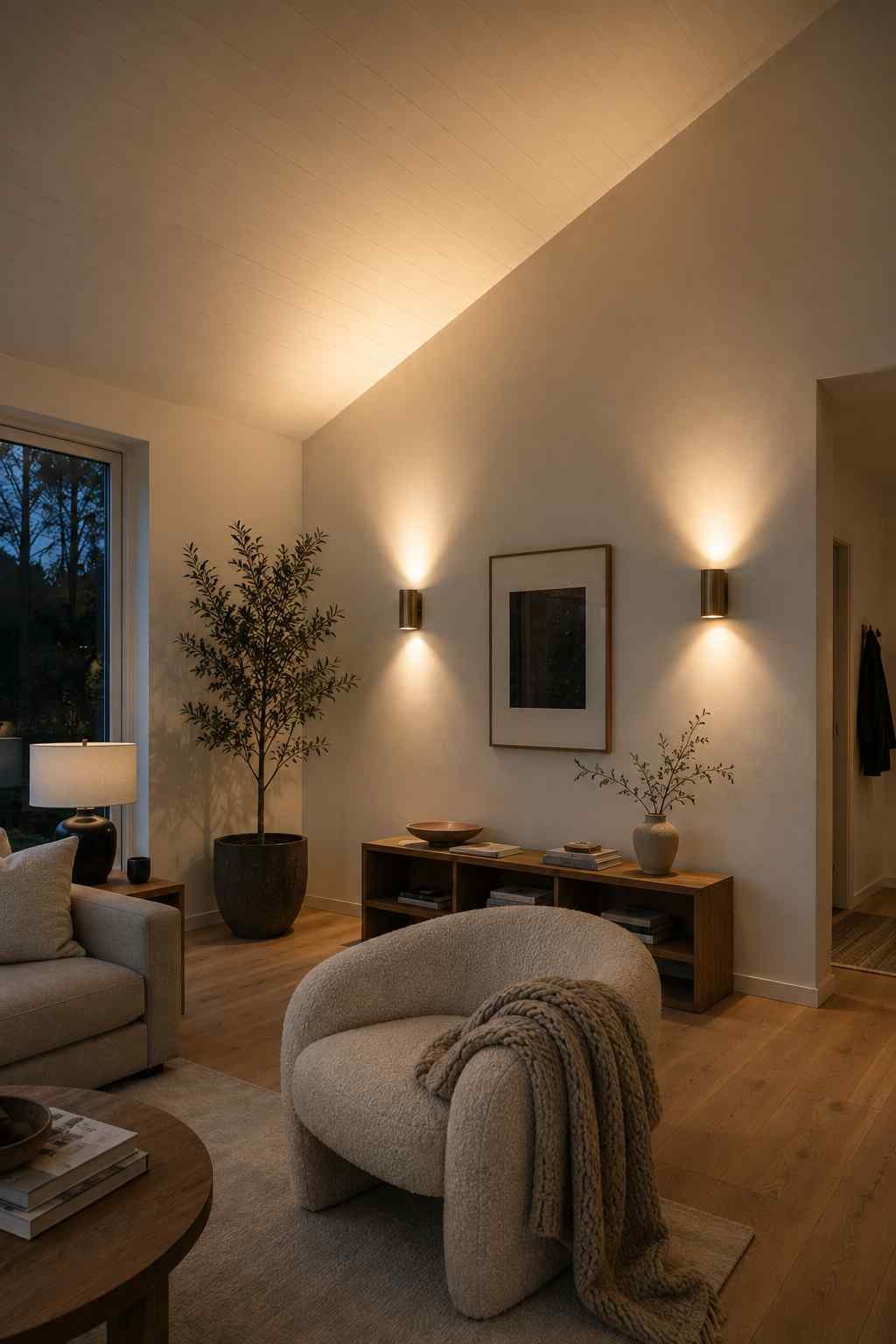
This is the idea most homeowners skip, and it is the one that makes the single biggest difference in a Scandinavian-style or minimalist living room where you want almost no visible fixtures at all.
Instead of trying to light the room from above, mount simple uplight sconces at eye level or slightly above on the vertical walls, angled so the beam grazes up across the sloped ceiling plane.
The light bounces off the angled surface and fills the upper half of the room with a soft, even glow, which effectively lowers the perceived ceiling height and makes the whole space feel warmer at night instead of cavernous.
Two or four sconces spaced evenly along the longest wall are usually enough for a mid-size room, and because they sit at a normal wall-outlet height, installation is far simpler than anything mounted near the peak.
5. Rope or Strip Lighting Recessed Into Exposed Beams
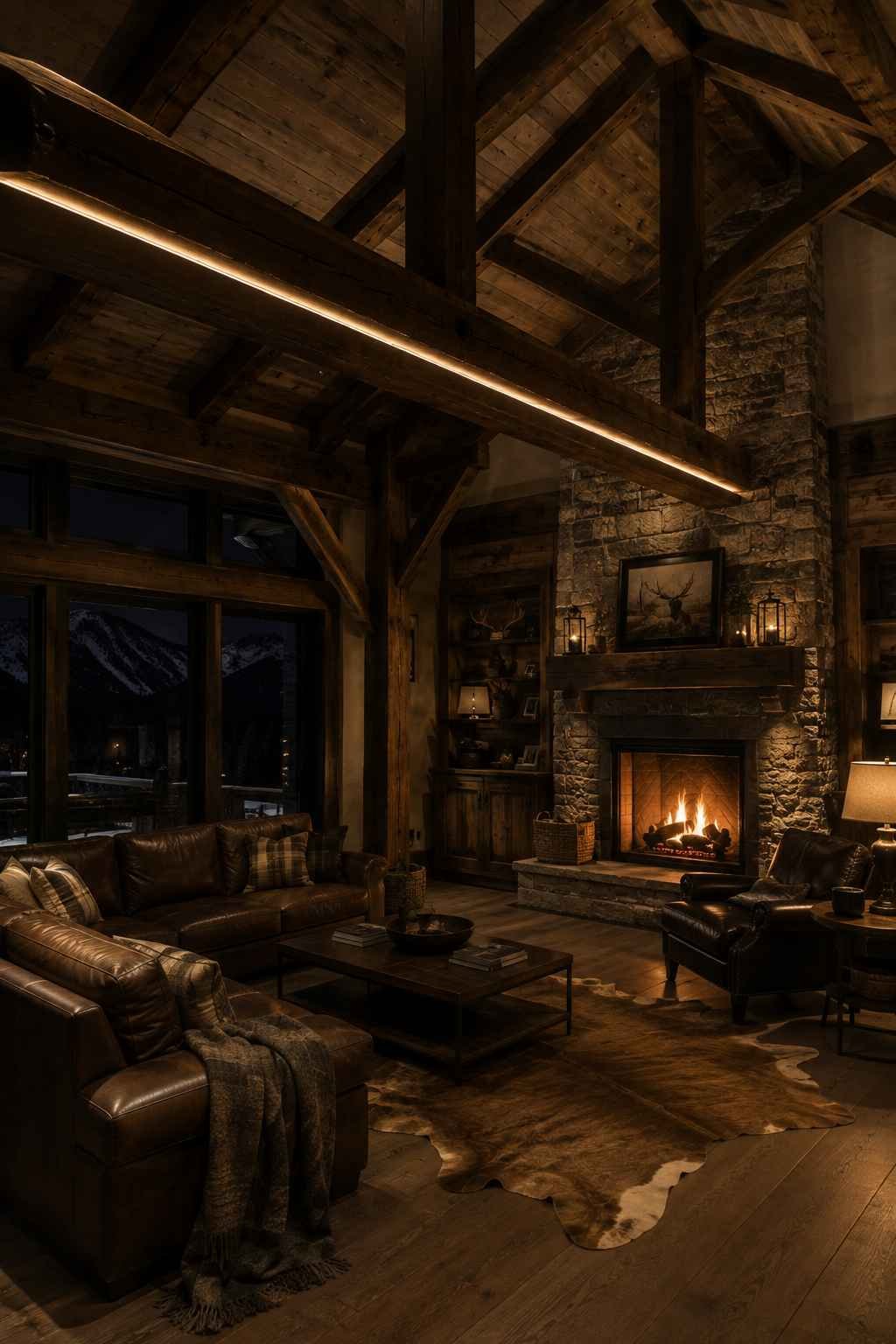
For a rustic cabin or mountain-lodge living room with heavy timber trusses, running a slim LED strip into a routed channel on the underside of each beam gives you a soft architectural glow without a single visible fixture.
This works because it uses the existing structure as the light source rather than fighting it.
The trick that separates this from looking like a dorm-room string-light project is committing to warm white LEDs in the 2700K to 3000K range, a dimmer, and a clean channel cut so the diffuser sits flush rather than proud of the wood.
It is not a primary light source on its own, but layered with floor and table lamps at seating height, it does an excellent job of softening the visual weight of heavy dark beams that would otherwise loom over the room after dark.
6. Daylighting Through a Skylight or Solar Tube, Paired With Recessed Cans
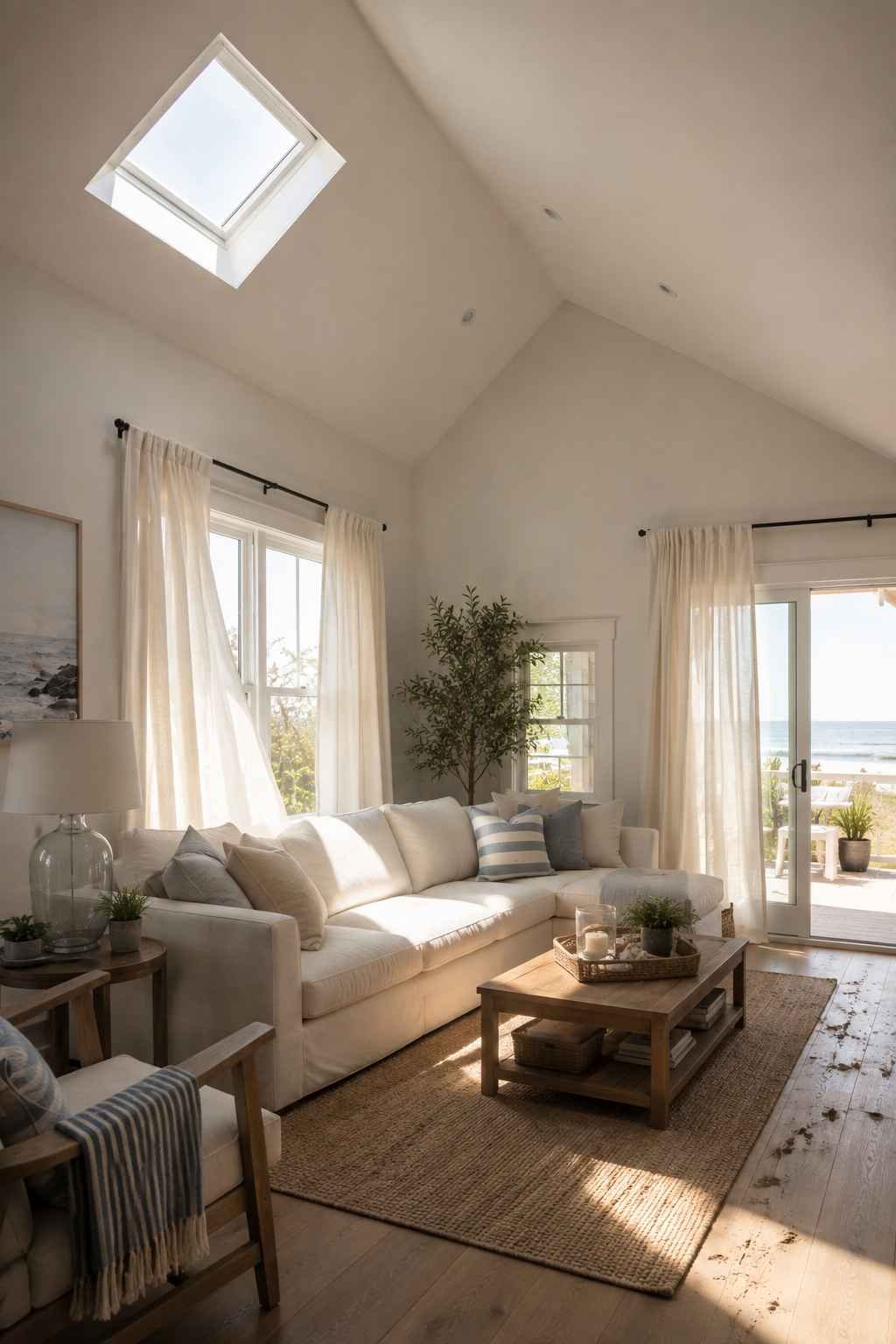
For coastal and sunroom-adjacent living rooms where natural light is part of the appeal, a fixed skylight or a smaller solar tube installed near the ceiling peak solves the daytime half of the vaulted-ceiling problem in a way no fixture can.
The peak of a vaulted ceiling is often the one part of a roof with enough pitch and clearance for this kind of installation, and it brings genuinely useful daylight down into a space that would otherwise rely entirely on side windows.
This only works as a full solution when it is paired with recessed can lighting on a dimmer for evenings, since a skylight obviously goes dark at night.
Budget for professional installation and proper flashing here; a poorly sealed roof penetration is the one lighting decision on this list that can turn into a genuine structural headache if it is done wrong.
7. A Drum Pendant Cluster With Fabric Shades, Grouped Off-Center
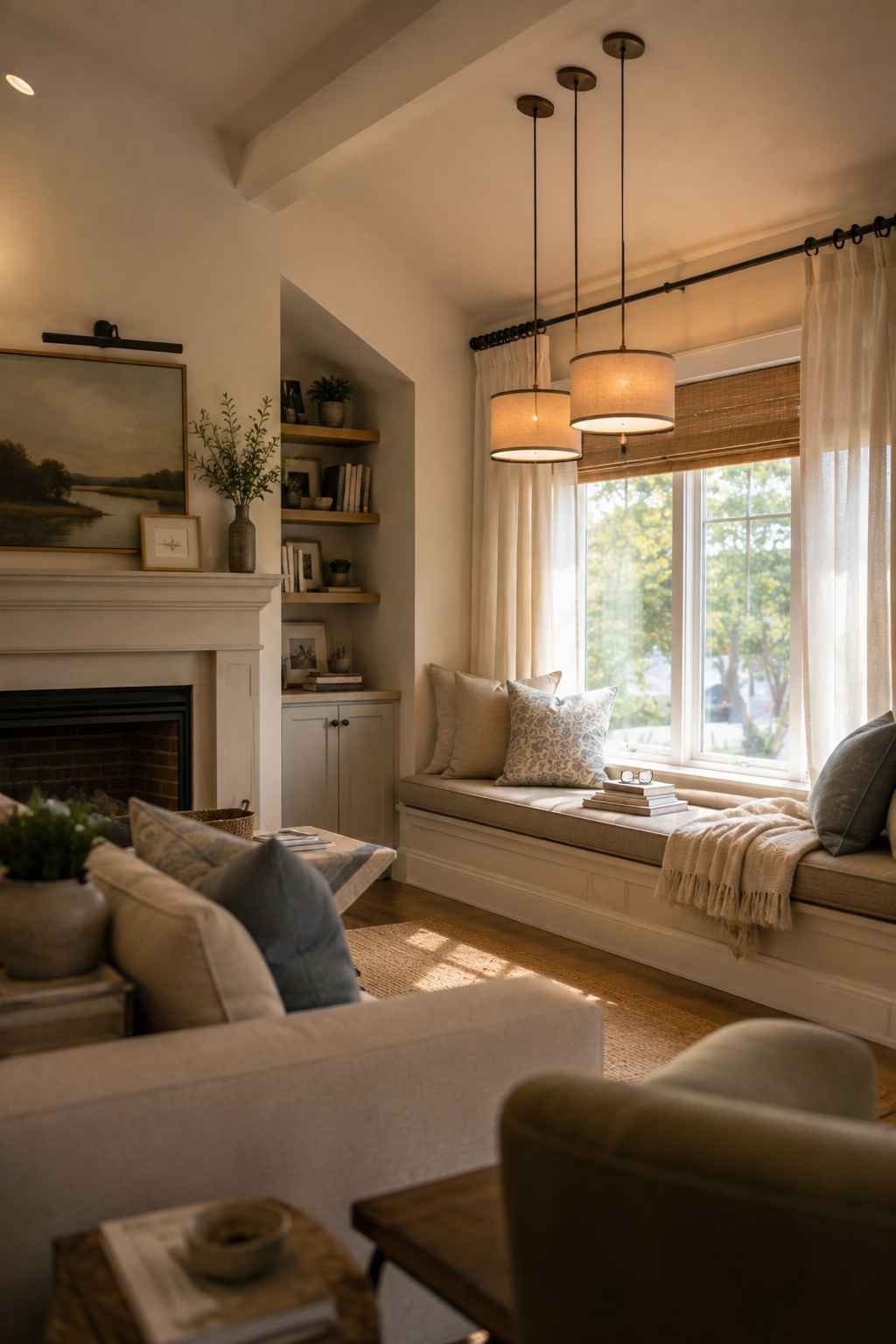
In a transitional or eclectic living room where you want warmth rather than a hard architectural statement, group three drum pendants with linen or woven shades slightly off-center, over a reading nook or a window seat rather than dead-center in the room.
Fabric shades diffuse light more gently than glass or metal, which suits a room already filled with soft furnishings, layered rugs, and mixed textures.
Off-centering the cluster also solves a real structural issue: many vaulted living rooms do not have a ceiling joist conveniently located at the room’s geometric center, and shifting the grouping toward an existing structural point can save a significant amount of the electrician’s time and your budget.
8. Torchiere Floor Lamps That Bounce Light Off the Ceiling
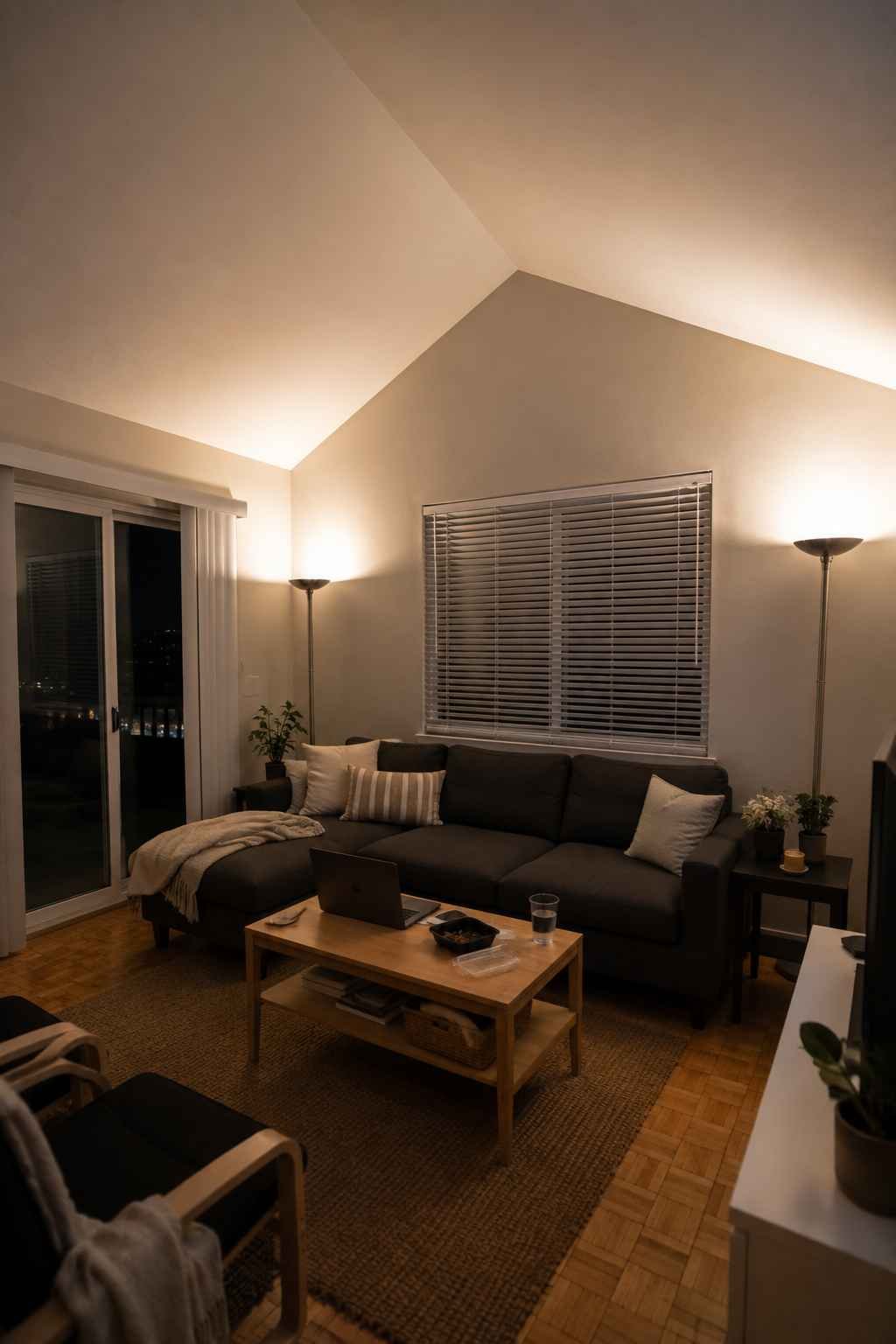
This is the idea I give to renters and anyone working with a strict budget, because it requires no electrical work at all.
A torchiere-style floor lamp, with an open top that throws light upward, uses the vaulted ceiling’s own surface as a giant reflector, bouncing a soft, even wash back down over the seating area.
Two placed at opposite corners of the room do more to fill a vaulted living room evenly than most people expect, and because they plug into a standard outlet, you can reposition them as furniture changes without ever touching the wiring.
Look for a wide, matte-finish top rather than a narrow glossy one; a matte finish scatters the light more evenly across the ceiling plane instead of throwing a single hot spot directly above the lamp.
9. A Grid of Recessed Cans on Separate Dimmer Zones
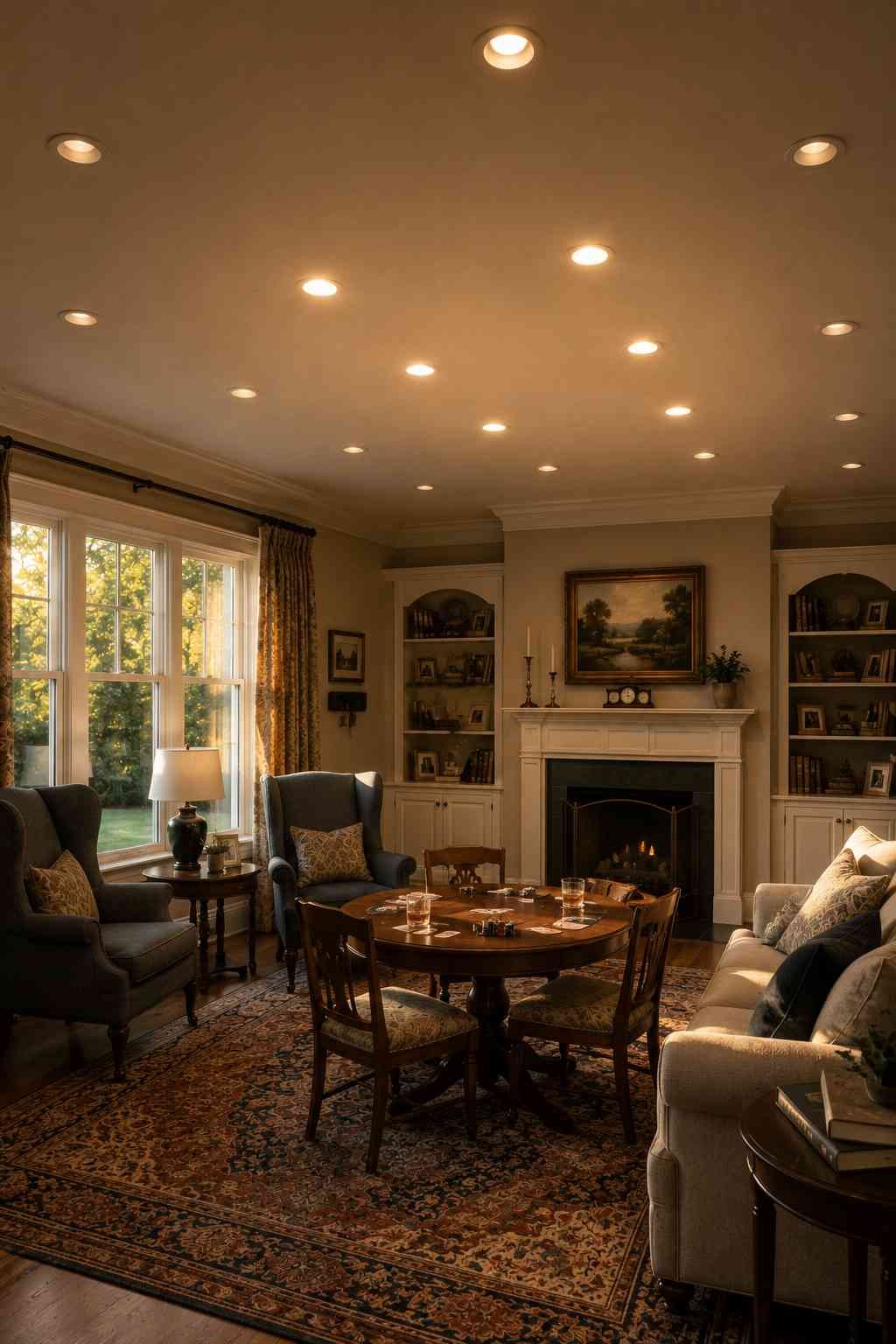
For a traditional or classically styled living room where a statement fixture would feel out of place, a well-planned grid of recessed can lights remains the safest, most flexible option, and it is the one an electrician will usually recommend by default.
The detail that actually matters is splitting the grid into at least two independent dimmer zones, one for the perimeter and one for the center, rather than wiring every can to a single switch.
That lets you dim the perimeter cans low for ambient evening light while keeping a brighter zone over a reading chair or game table.
Choose fixtures rated for the insulation type in your specific ceiling assembly, since vaulted ceilings often have less clearance above the drywall than a standard flat ceiling, and an electrician needs to confirm this before installation, not after.
10. A Long-Rod Lantern Fixture for Mediterranean and Spanish Revival Homes
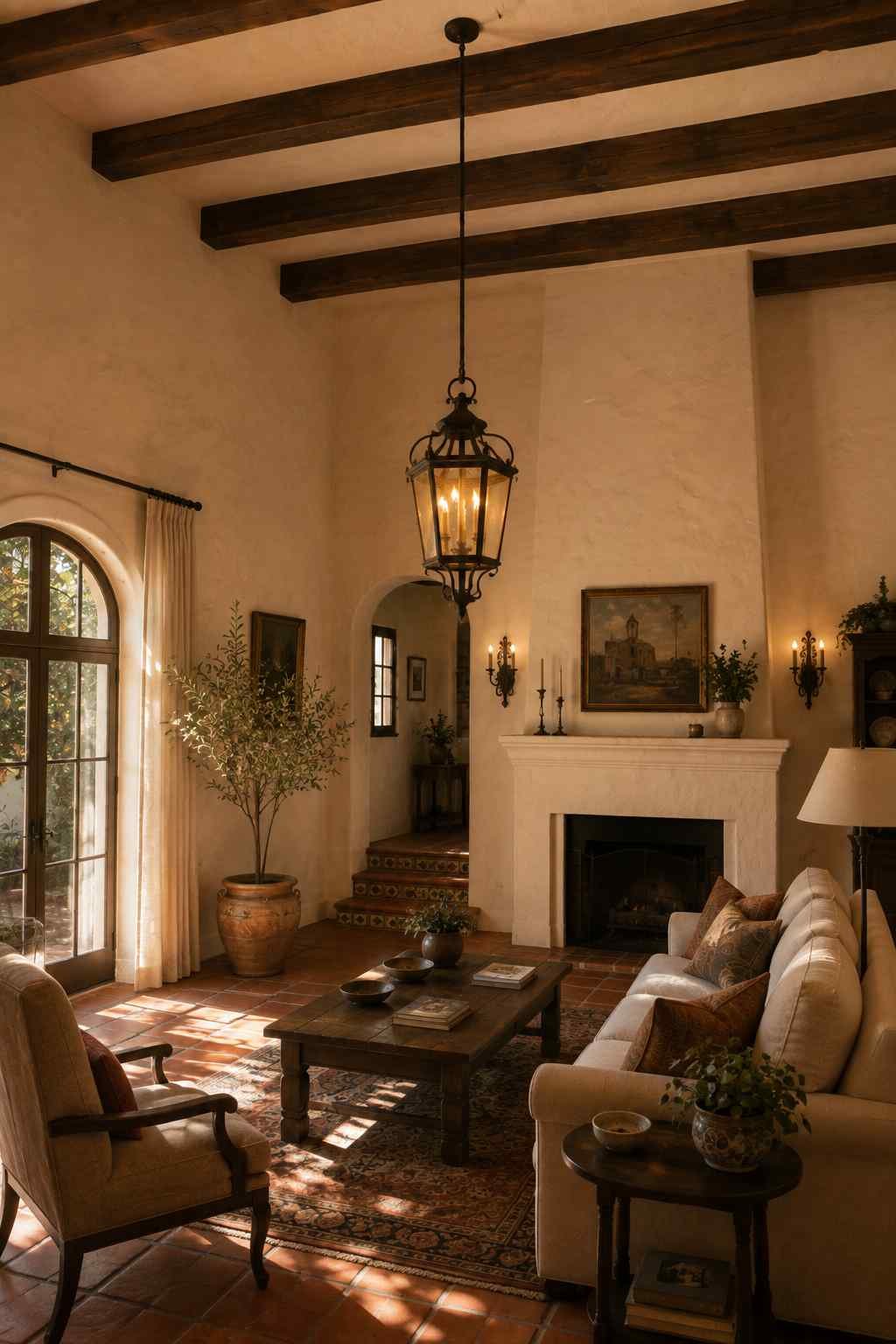
In a Mediterranean, Spanish Colonial, or Tuscan-influenced living room, a wrought-iron lantern fixture hung on an extra-long rod rather than a chain reads as far more authentic to the style than a crystal chandelier ever will.
The long, straight rod echoes the vertical lines already present in these homes, from arched doorways to exposed ceiling timbers, and it brings the light source down to a usable height without the visual clutter of a chain link disappearing into the shadows above.
Amber or seeded glass panes cast a warm, dappled light across the walls that suits the terracotta and plaster finishes typical of this style far better than a clean white LED chandelier would.
11. Hidden Cove Lighting Built Into a Lowered Soffit or Truss Detail
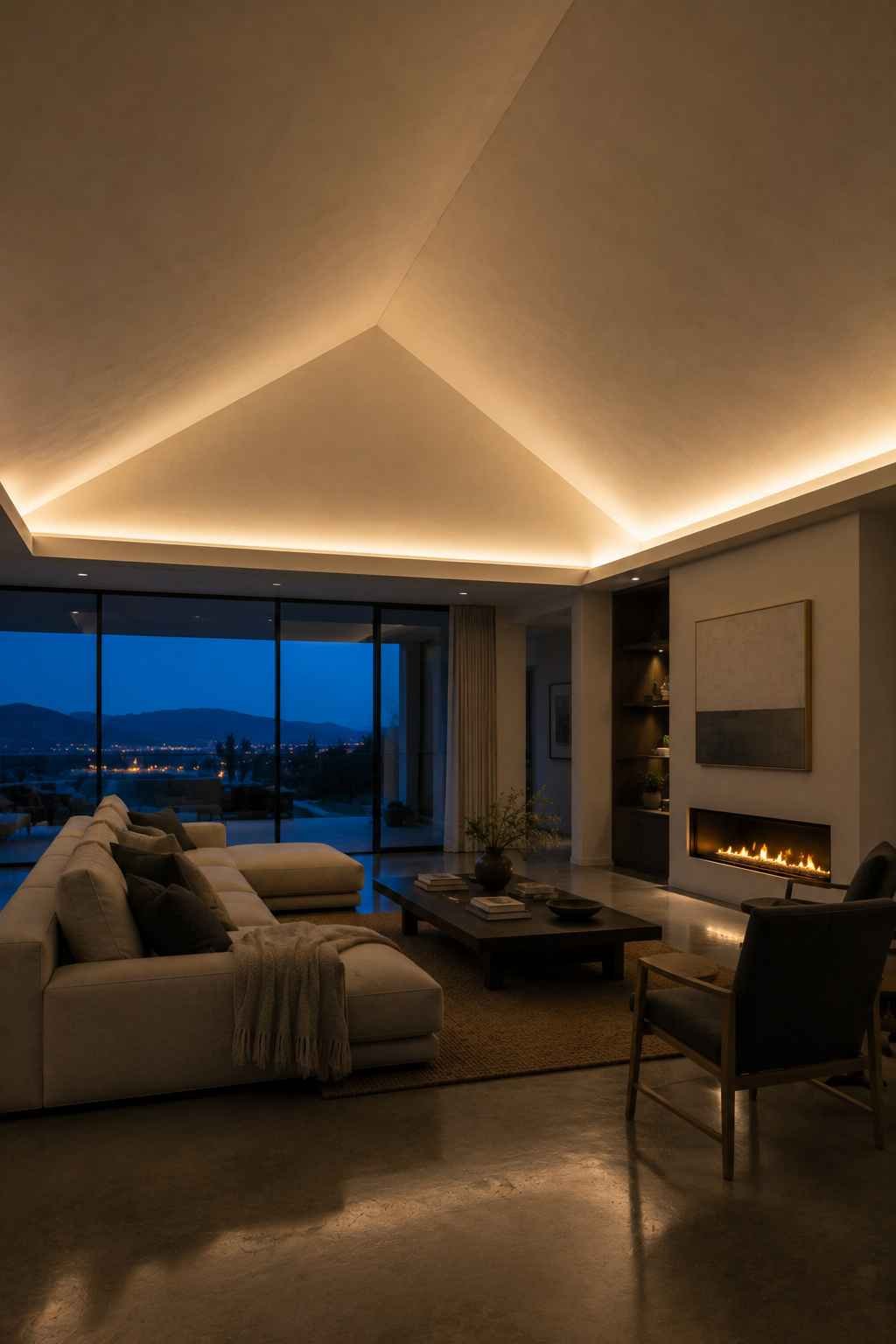
For a newer contemporary build where the architect has already included a lowered soffit, tray detail, or false beam near the base of the vault, running a continuous LED cove light along that edge creates an almost shadowless glow that outlines the ceiling’s shape rather than fighting it.
This is the most architecturally integrated option on this list, and it genuinely needs to be planned at the construction or renovation stage rather than retrofitted, since it relies on a recessed channel that is usually built into the framing.
If you already have a soffit or dropped beam detail from the original build, though, adding a cove light strip afterward is a relatively straightforward electrician job and one of the most elegant upgrades available for this kind of room.
12. Picture Lights and Wall Sconces That Pull the Eye Down to Human Height
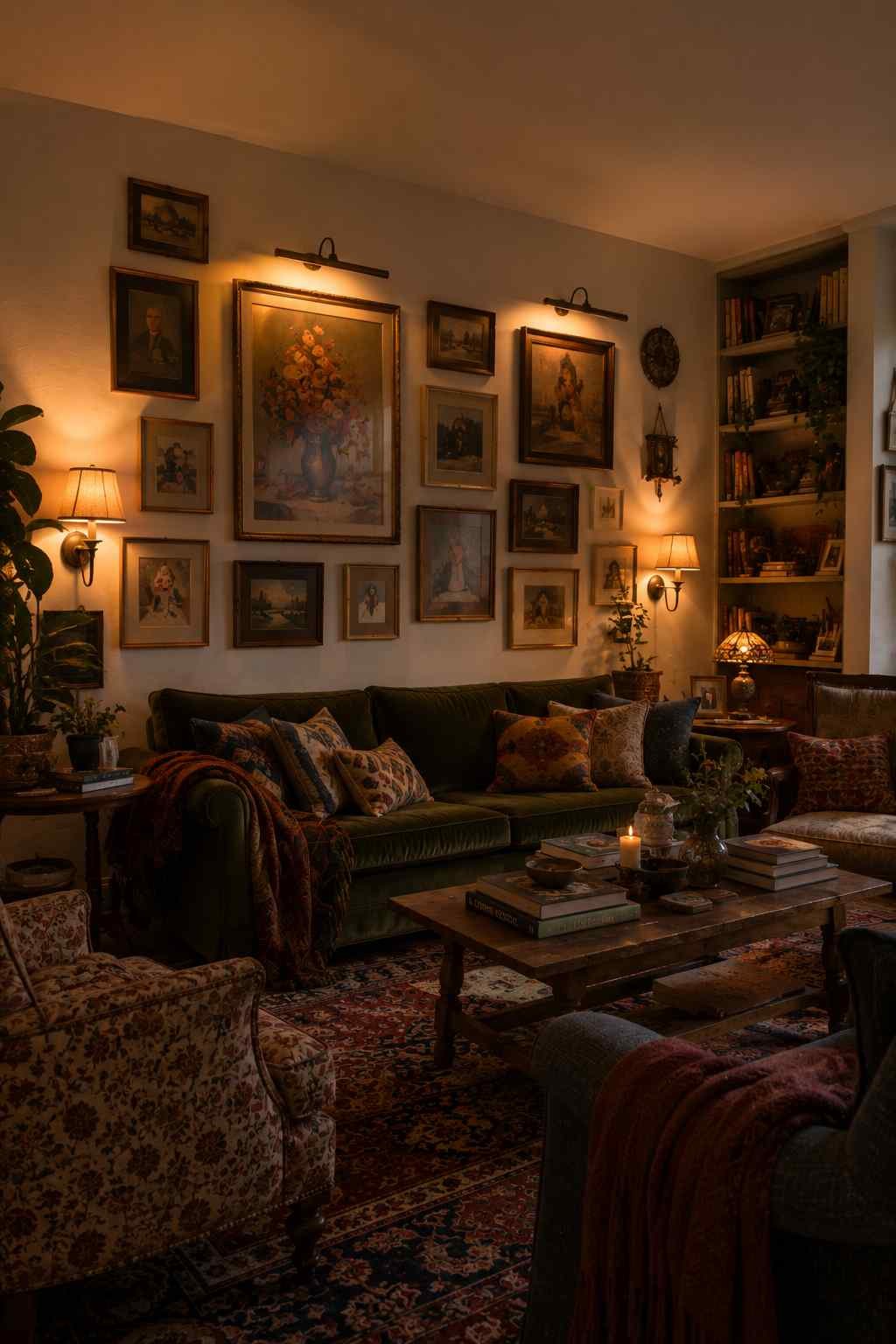
In a bohemian or gallery-style living room, the kind filled with layered art, textiles, and collected objects, often looks best when the lighting deliberately avoids drawing attention upward at all.
A combination of small picture lights mounted above framed art and a few wall sconces at roughly five and a half feet keeps every light source at or below eye level, which psychologically anchors the room at human scale even though the ceiling soars overhead.
This is less about brightness and more about where your eye is drawn after dark; a room lit entirely from a low, warm band around the walls feels intimate and layered rather than cavernous, no matter how tall the ceiling actually is.
13. A Multi-Zone Smart Lighting System Controlled by App or Voice
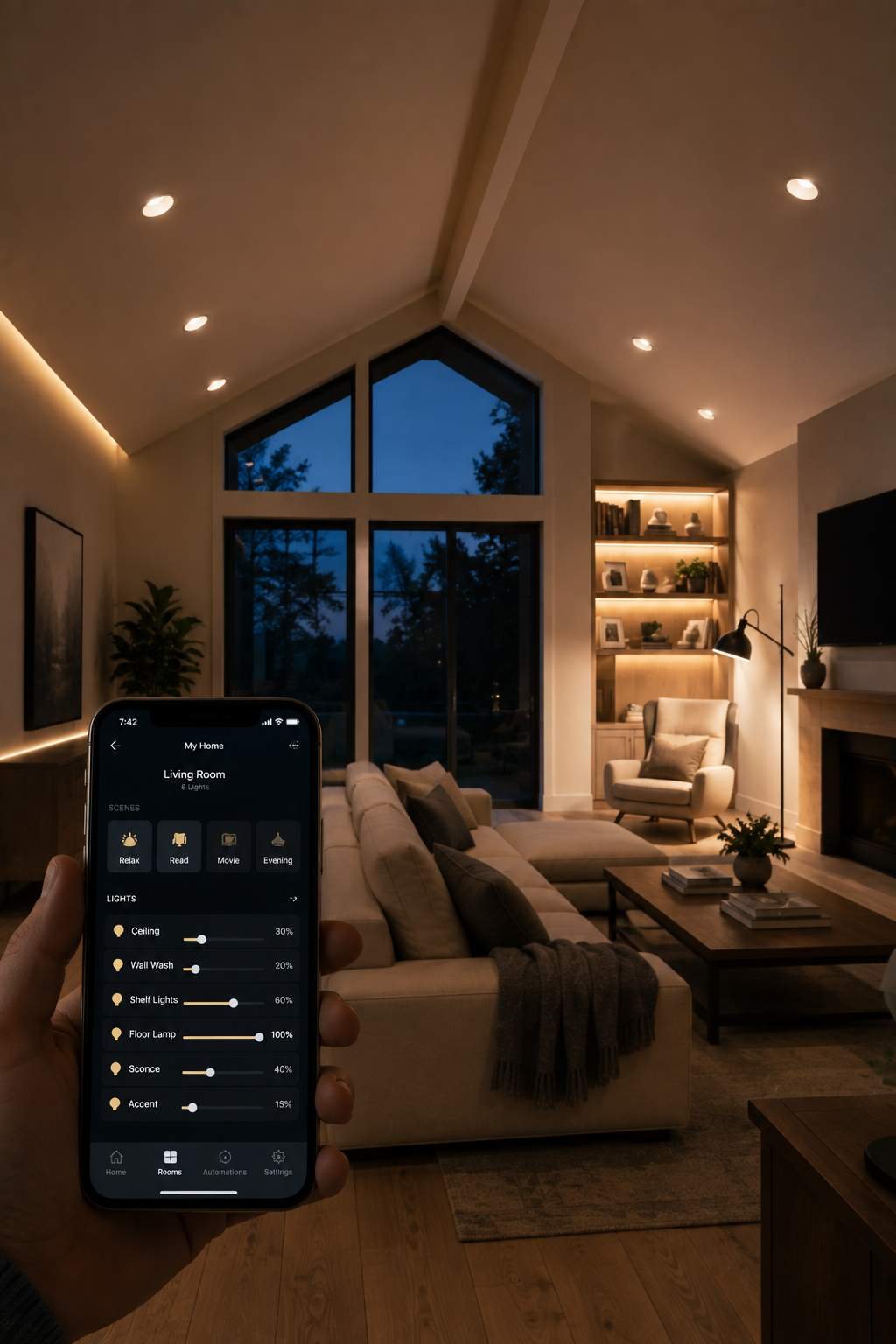
For a tech-forward modern home, the fixture matters less than the control system behind it.
Vaulted living rooms almost always end up with several separate light sources once you layer them properly: perimeter cans, a statement pendant, a few sconces, and smart bulbs or a smart switch let you group all of them into scenes rather than juggling four separate physical switches on the wall.
A “movie night” scene that dims everything but a low sconce glow, or a “daytime bright” scene that brings every zone to full output, does more to make a tall room feel genuinely livable than any single fixture choice on this list.
This is an upgrade you can add to almost any of the other twelve ideas above rather than a standalone fixture choice.
14. A Ceiling Fan With an Integrated Light Kit, Chosen for Downrod Length
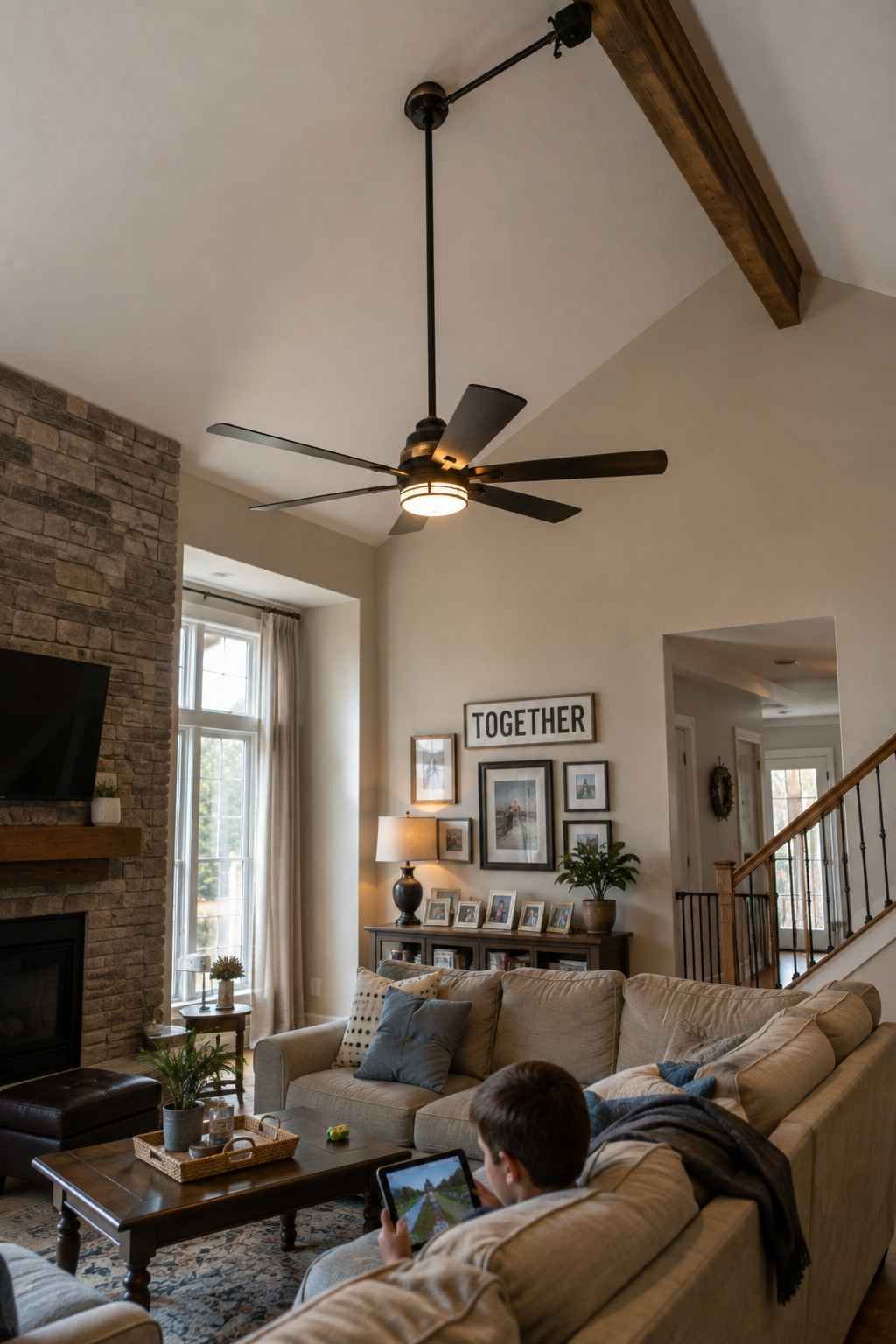
It is unfashionable to say so, but a genuinely well-chosen ceiling fan with a light kit still solves two vaulted-ceiling problems at once: the heat and stuffy air that collects at the peak, and the need for a central light source.
The difference between a fan that looks awkward and one that looks intentional almost always comes down to the downrod.
Vaulted ceiling fan kits use an angled mounting bracket paired with a downrod long enough to bring the fan blades down to a standard eight or nine feet above the floor, rather than leaving them spinning uselessly near the fourteen-foot peak where they barely move air through the room at all.
This is worth specifying by exact ceiling pitch when you order, since the wrong angled bracket simply will not sit flush.
15. Uplighting Placed Behind Tall Furniture or Bookcases
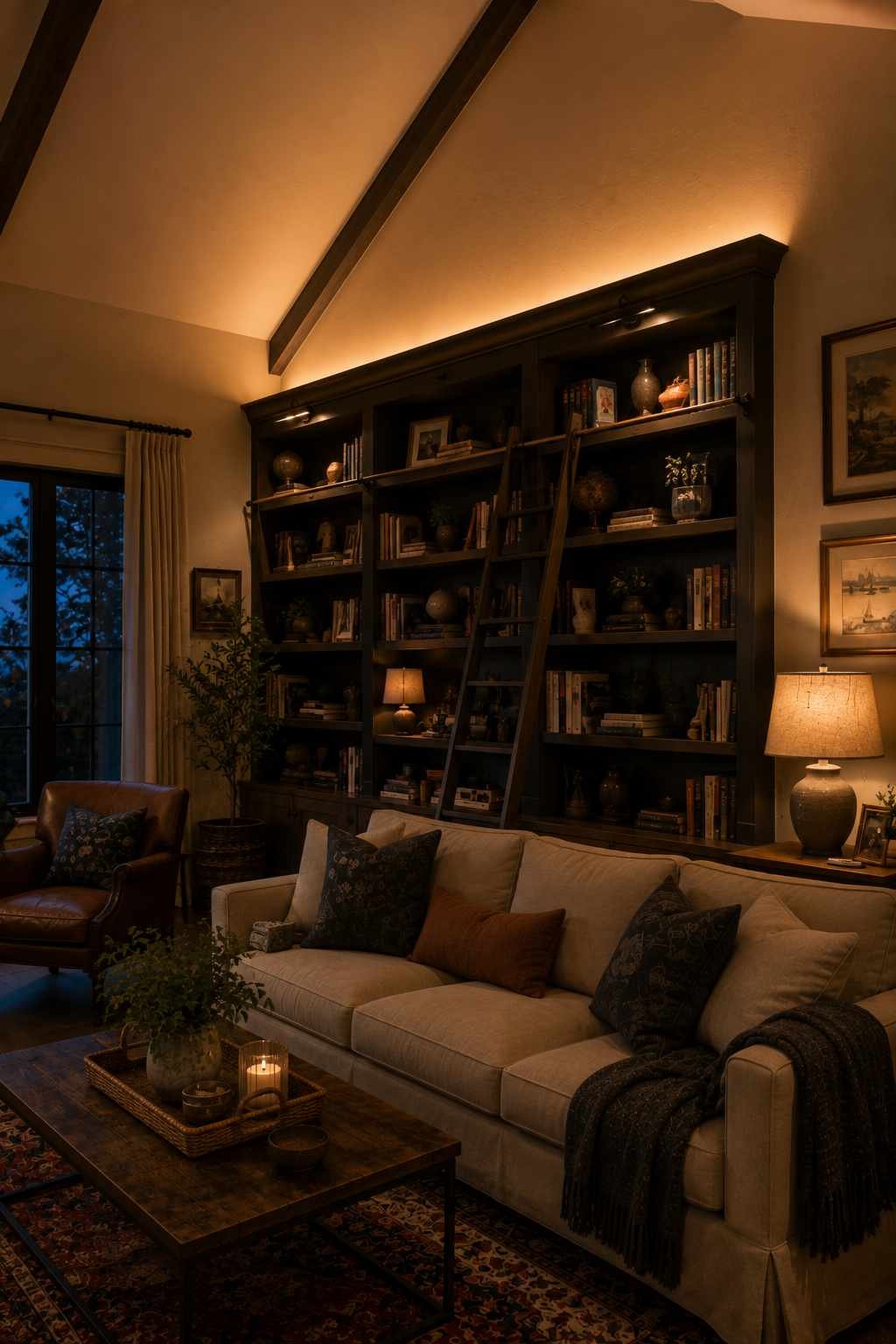
In a room with built-in bookcases or a tall media wall reaching partway up the vault, hidden uplights placed on top of that furniture, angled toward the ceiling, create a soft secondary glow that fills the upper portion of the room without adding any visible fixture at all.
This is one of the lowest-cost ideas on this list, since it often just requires a simple plug-in puck light or LED strip on top of existing furniture, and it works particularly well as a supplement to a dimmer-controlled primary fixture rather than as a stand-alone solution.
16. A Double-Height Window Wall Paired With Sheer, Light-Filtering Drapery
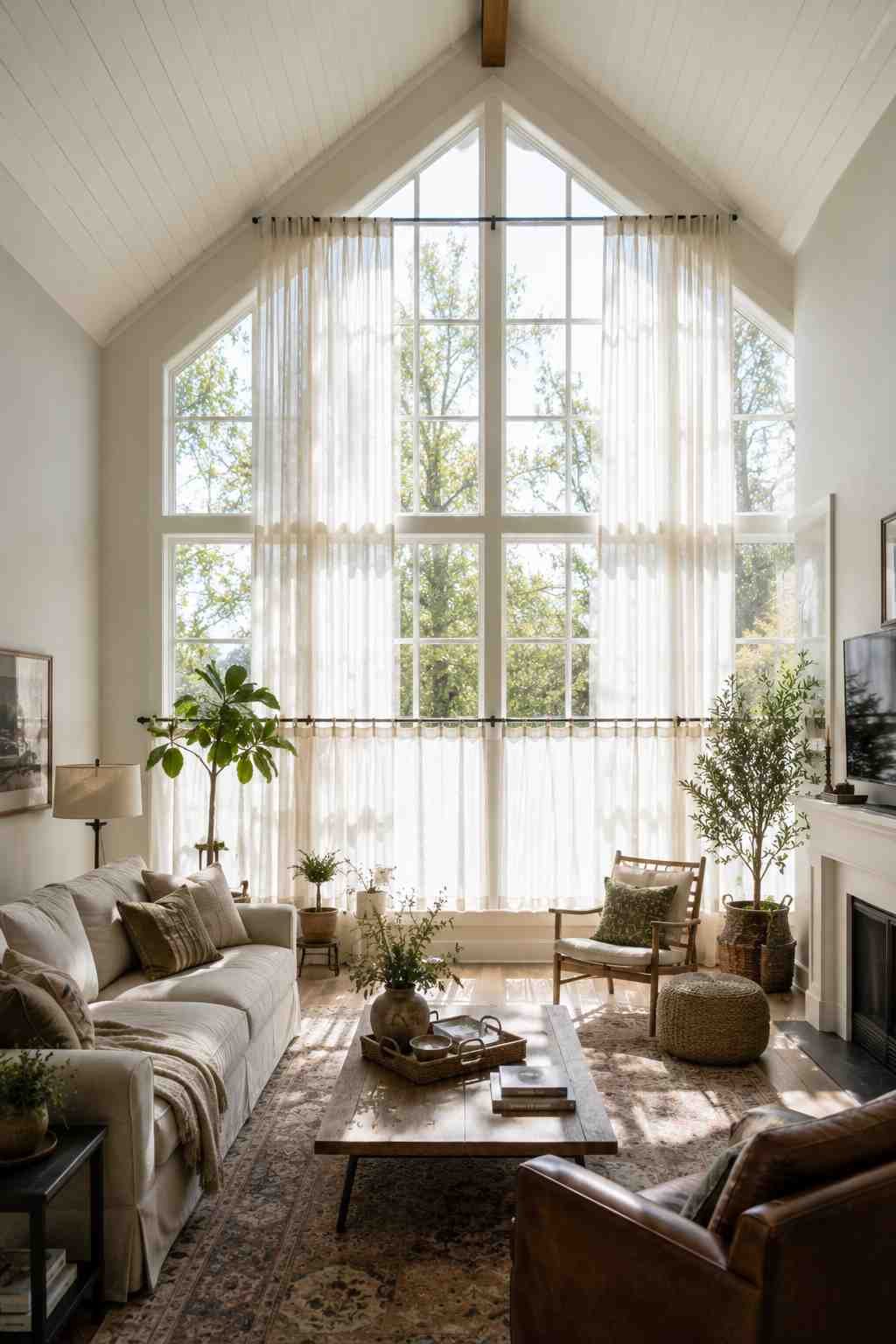
Many vaulted living rooms already include a double-height window or a full window wall on the gable end, and the lighting decision that matters most here happens during the day, not after dark.
Sheer, light-filtering drapery rather than heavy blackout curtains lets daylight continue to bounce off the sloped ceiling well into the afternoon, extending the hours before artificial light is needed at all.
If privacy is a concern lower down, layering a shorter café-style curtain across the bottom third of the window with sheers left open above it preserves the light-filling effect at the top while still screening the seating area from the street.
17. A Statement Fixture Suspended From an Exposed Ridge Beam Hook
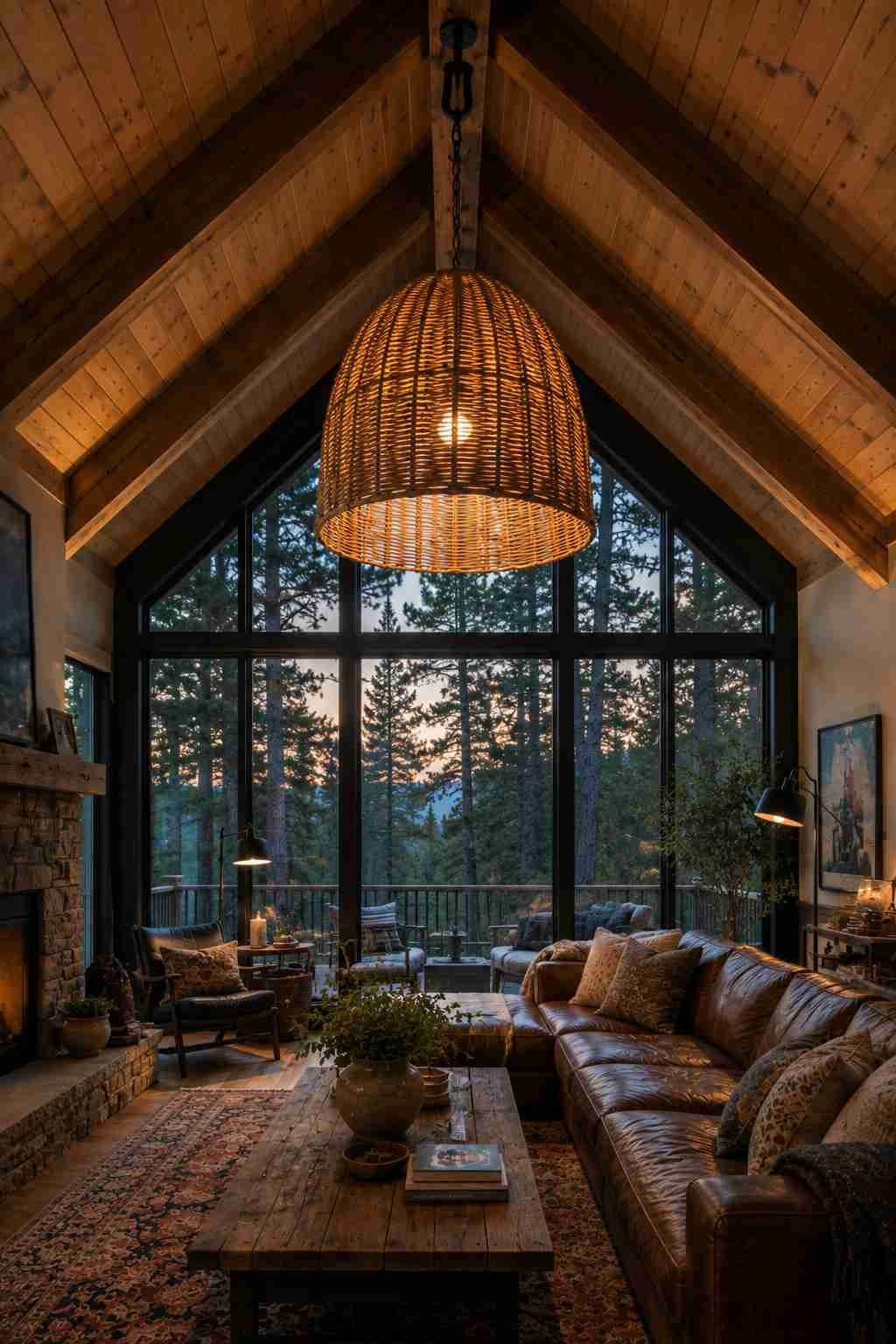
In an A-frame or heavily timbered vaulted room, mounting the electrical box and hook directly into the exposed ridge beam itself, rather than through drywall, gives a hanging fixture a rugged, load-bearing look that suits the style far better than a standard ceiling medallion would.
Wrought-iron, antler-style, or oversized woven rattan pendants all read particularly well against raw timber for this reason.
This does require an electrician comfortable running conduit along or through an exposed beam without compromising its structural finish, so it is worth confirming early with whoever is doing the installation rather than assuming any fixture will simply bolt on.
18. Layered Table and Floor Lamps as the Primary Evening Light Source
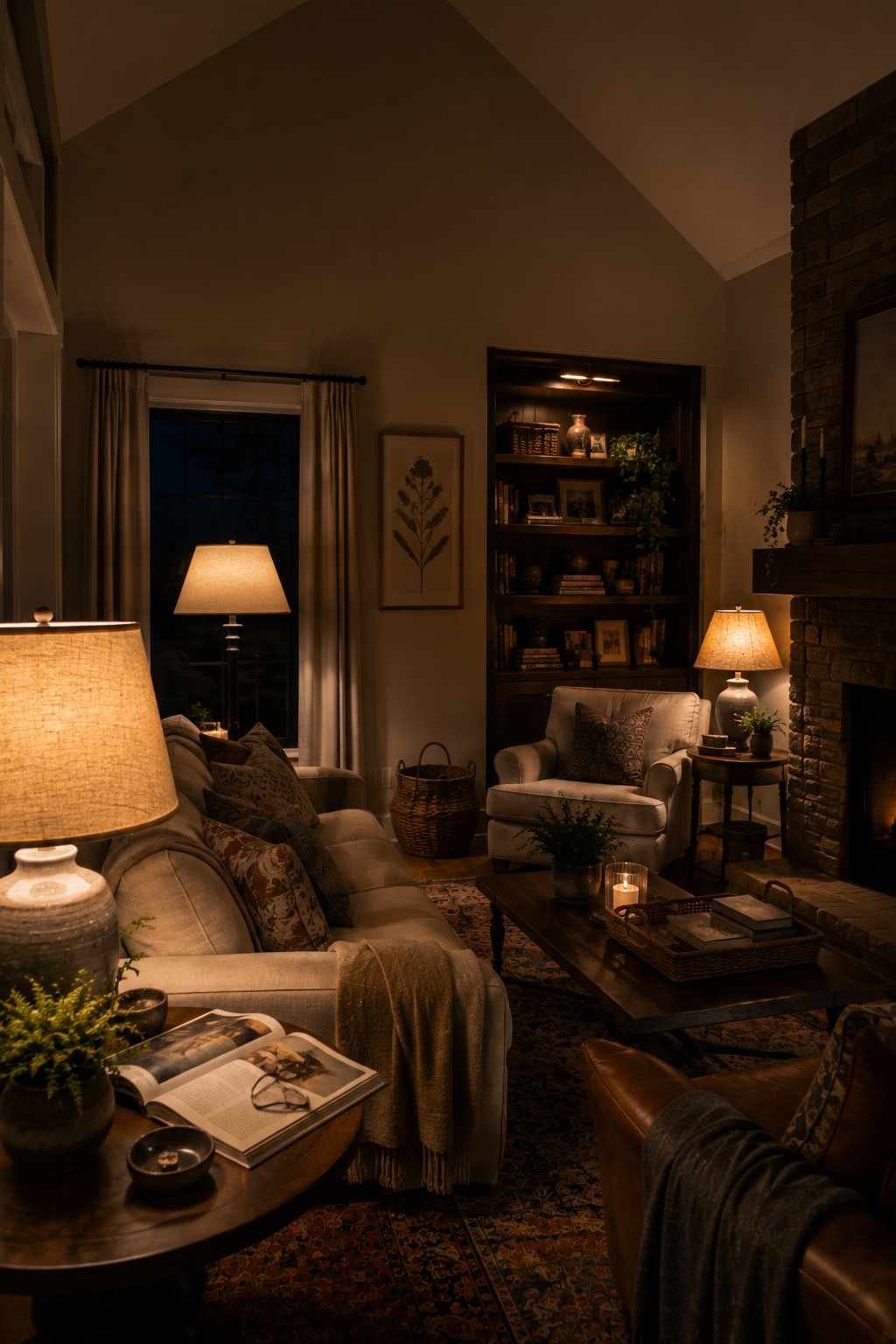
For anyone genuinely hesitant about ceiling-height electrical work, it is entirely possible to light a vaulted living room well using nothing but table and floor lamps placed at seating height, and honestly, this is the layer that gets neglected even in rooms with excellent overhead lighting.
Three or four lamps spread around the seating area, each around twenty-eight to thirty-two inches tall with a warm-toned shade, keep light concentrated exactly where people read, talk, and relax, rather than dissipating upward into a tall, largely unused volume of air.
This works as either the entire lighting plan for a rental, or as the essential finishing layer under any of the taller fixtures described above.
19. Clerestory Window Lighting Combined With Warm-Dimmed Perimeter Cans
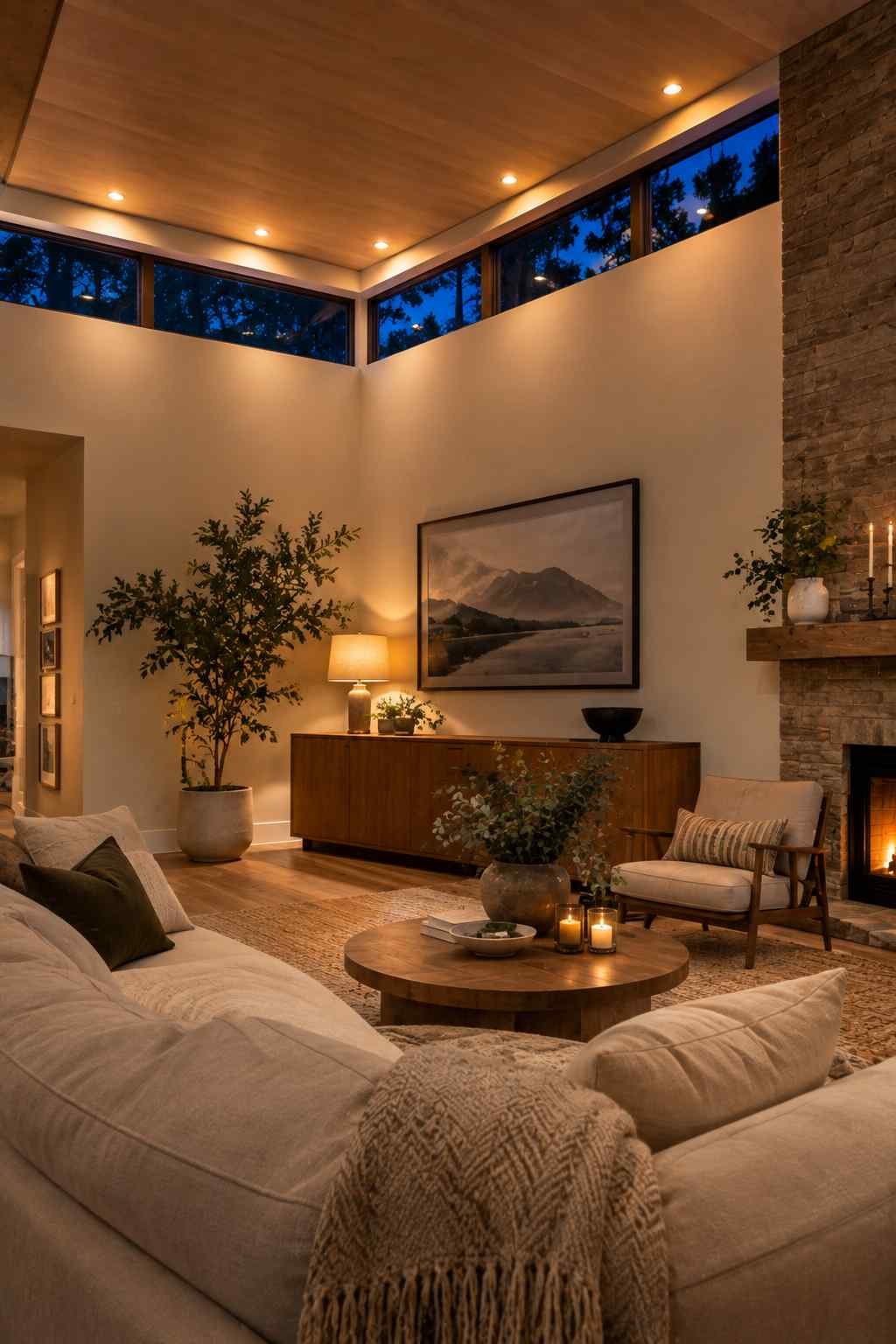
Some vaulted living rooms include a band of small clerestory windows just below the ridge, and this detail is worth actively designing around rather than ignoring.
During the day, that high band of glass fills the upper part of the room with soft, indirect light without any glare at seating level.
At night, the goal shifts to filling that same upper zone artificially so the room does not feel like it goes suddenly dark above head height once the sun sets; a ring of perimeter recessed cans set to a warm 2700K and dimmed low does this well, echoing the daytime effect of the clerestory glass rather than fighting against it.
Getting the Practical Details Right
Once you have picked which of the ideas above fit your room, a handful of practical decisions will do more for the finished result than the fixture itself.
Match the Color Temperature to How the Room Is Used
A vaulted living room used mainly for evening relaxation almost always looks and feels better lit at 2700K to 3000K, the warm, slightly yellow light most people associate with incandescent bulbs, rather than the cooler 4000K or 5000K bulbs often marketed as “daylight.”
Cooler bulbs can work in a home office nook built into a vaulted space, but mixing color temperatures across different fixtures in the same open room is one of the most common mistakes I see; it makes a space feel unsettled even when the individual fixtures are each attractive on their own. Pick one temperature and stay consistent across every source in the room, including any smart bulbs.
Budget for the Lift, Not Just the Fixture
Changing a bulb or cleaning a fixture on a standard ceiling takes thirty seconds with a stepladder.
On a vaulted ceiling, it often means renting a lift or hiring someone who has one, which is a genuine ongoing cost that is easy to forget when you are shopping for fixtures.
This is a strong practical argument for favoring LED fixtures with a long-rated lifespan, ideally fifteen thousand hours or more, and for choosing at least a few of the lower-mounted ideas on this list- wall sconces, torchiere lamps, table lamps- that anyone in the household can maintain without special equipment.
Confirm Structural Support Before Committing to a Heavy Statement Fixture
Any fixture heavier than a standard flush mount needs to land on an actual joist, beam, or a properly rated electrical box, not just drywall anchors.
This matters more in a vaulted ceiling than a flat one because the framing itself is often more complex, with structural ridge beams, collar ties, and less predictable joist spacing than a standard truss ceiling.
Before ordering a large chandelier or lantern fixture, have an electrician confirm where the existing box is rated for and whether it needs to be relocated or reinforced.
This is not a step to skip to save money; it is the one item on this entire list where getting it wrong is a genuine safety issue rather than a style preference.
Layer at Least Two Different Heights of Light
The single most common mistake across every vaulted living room I have worked on is relying entirely on one overhead source, whether that is a chandelier, a fan, or a grid of recessed cans, and stopping there.
Even the best-chosen ceiling fixture leaves a room feeling flat and slightly cold if there is nothing at seating height to balance it.
Pairing any of the overhead ideas above with even two simple table lamps changes the entire feel of the room after dark, because it gives your eye a warm, close light source to rest on rather than only a distant glow far overhead.
Related Living Room Projects Worth Reading Next
If your vaulted living room also has a lot of glass, whether from a gable window or a set of sliding doors, it is worth pairing your lighting plan with how light moves through the space during the day.
I covered this in more depth in my breakdown of glass wall panel ideas for living rooms, which looks at how partitioning with glass instead of solid walls keeps a tall, open room feeling bright rather than cavernous.
For more layout and styling ideas beyond lighting, the full archive of living room decor projects on the site covers everything from furniture arrangement to seasonal styling in rooms with unusual proportions.
And if you are still deciding how to treat the walls themselves under all that vertical space, the wall decor ideas collection has a number of approaches, from gallery walls to textured panels, that work particularly well against the extra height a vaulted ceiling gives you.
Frequently Asked Questions
How high should a chandelier hang in a room with a vaulted ceiling?
Aim for the bottom of the fixture to sit roughly seven feet above the finished floor, regardless of how high the ceiling itself climbs.
This keeps the light source close enough to the seating area to be useful, rather than lost in the upper volume of the room. Most chandeliers rated for vaulted ceilings come with an extra-long stem or extendable chain specifically to allow this drop.
What is the best color temperature for a high living room ceiling?
For most living rooms, warm white in the 2700K to 3000K range feels the most comfortable and closest to traditional incandescent light. Save cooler, brighter bulbs for task-focused zones like a reading nook or home office corner within the same room, and keep the temperature consistent across every fixture to avoid a mismatched, slightly clinical feel.
Do I need an electrician for vaulted ceiling lighting, or can I DIY it?
Anything involving a new electrical box, running wire through a beam, or working at height on a ladder tall enough to reach a vaulted peak is worth hiring an electrician for, both for safety and because most vaulted ceiling installations involve angled mounting brackets that need to be matched precisely to your roof pitch. The floor lamp, table lamp, and plug-in uplight ideas on this list are genuinely DIY-friendly if you want to avoid electrical work altogether.
Is a ceiling fan a good idea in a room with a vaulted ceiling?
Generally yes, and often more useful than in a standard room, since vaulted ceilings tend to trap warm air near the peak. The key detail is ordering a fan rated for angled ceilings, paired with a downrod long enough to bring the blades down to a standard eight or nine feet above the floor rather than leaving them near the roofline where they move very little air through the actual living space.
Can I mix different types of light fixtures in the same vaulted room?
Yes, and in most vaulted living rooms it is actually necessary rather than optional, since no single fixture type covers every job the room needs. The detail that keeps a mixed approach looking intentional rather than cluttered is consistency in finish and color temperature: pick one or two metal finishes across every fixture in the room, and keep every bulb at the same color temperature, even when the fixture styles themselves vary.
Bringing It All Together
There is no single fixture that solves a vaulted living room on its own, and that is really the main thing I would want anyone reading this to walk away with.
The rooms that end up feeling genuinely warm and well-lit after dark are almost always the ones layering two or three of the ideas above rather than betting everything on one statement piece.
Start with whichever idea matches the structural bones you already have, a beam to hang from, a soffit to run cove lighting along, a wall wide enough for a run of sconces, and build outward from there with a lower layer of lamps or sconces to keep the room anchored at human height.
Get the color temperature consistent, confirm the structural support before anything heavy goes up, and the vaulted ceiling that once felt hard to light will end up being the best feature in the room after dark, not just during the day.