
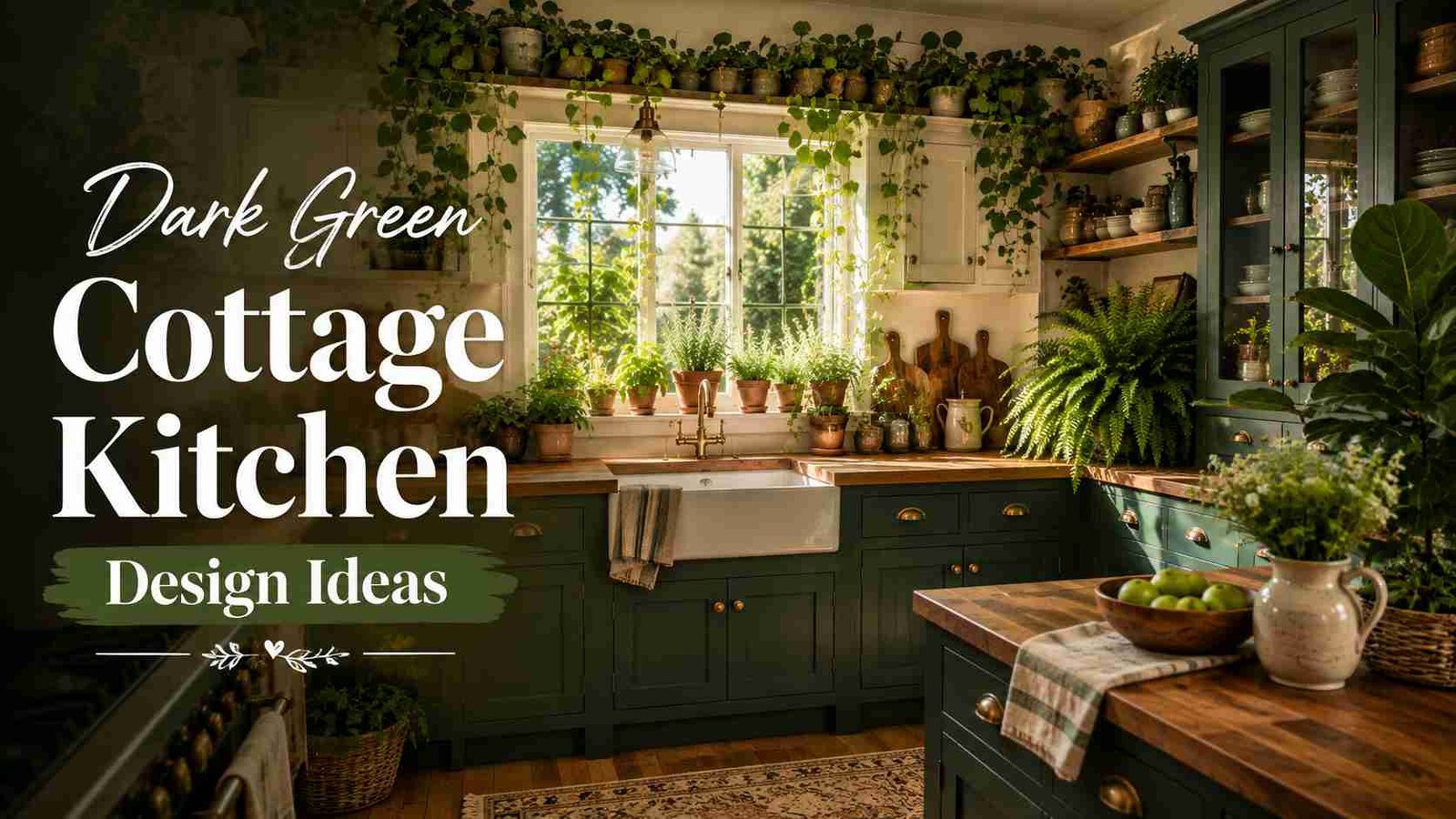
I’ve lost count of how many kitchens I’ve walked into, clipboard in hand, where the homeowner points at a Pinterest photo and says, “I want this, but cottage.”
Nine times out of ten, that photo has a dark green cabinet in it somewhere.
There’s a reason for that. Dark green is one of the only colors I’ve worked with that manages to feel cozy and grounded on a Tuesday morning and genuinely elegant when you’re hosting people for dinner on a Saturday night.
It doesn’t shout. It settles into a room the way a good wool sweater settles into your closet — it just belongs.
Cottage style, at its heart, is about warmth, imperfection, and things that look like they’ve been loved for a while. Dark green cabinetry taps straight into that.
It reads like moss on stone, like old bottle glass, like the inside of a greenhouse in late summer. Pair it with the right textures and it stops looking like a “trend” and starts looking like a kitchen that’s always been there.
Below are nineteen ways I’ve seen this color used well — some from projects I’ve personally worked on, some from kitchens I’ve studied closely because they got something right that most rooms miss.
I’ll also flag a few mistakes I see people make when they try to recreate this look, because the difference between a dark green kitchen that feels rich and one that feels like a cave usually comes down to three or four small decisions.
A quick note before we get into it: none of this requires a full gut renovation. Some of the ideas below are paint-and-hardware weekends. Others are full remodels.
I’ve tried to mix both so that whether you’re working with a limited budget or planning a complete kitchen overhaul, there’s something here you can actually use.
1. Start With a Forest Green Base and Let It Anchor the Room
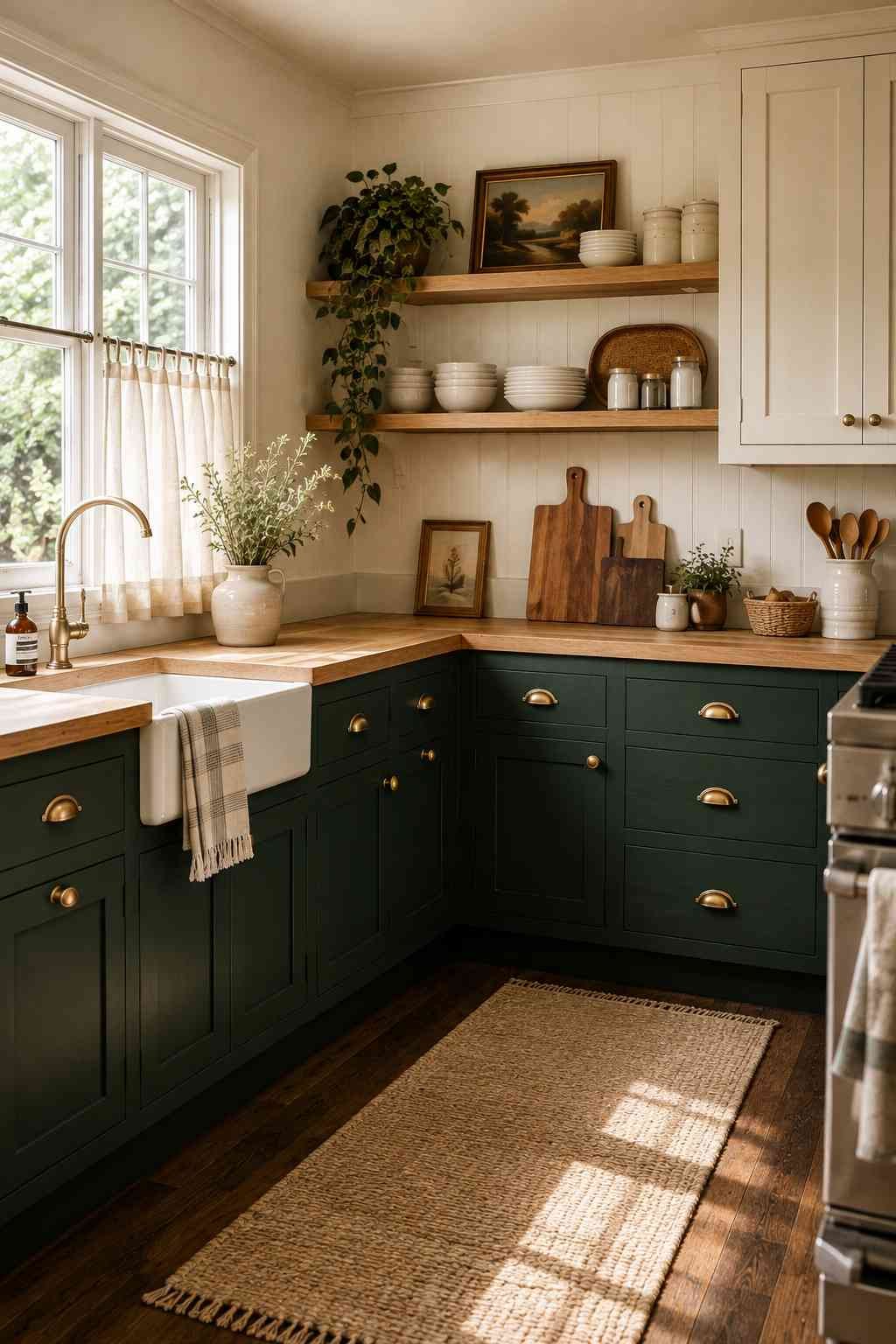
The safest and, in my experience, the most reliable starting point is a true forest green on the lower cabinets only, with a lighter wall color above. This keeps the room from feeling heavy while still giving you that deep, wooded color everyone associates with cottage kitchens. If you’re nervous about committing to a full green kitchen, this is where I’d tell you to begin. It’s the least risky version of the trend and the easiest to walk back if you change your mind in five years — repainting lower cabinets is a weekend job, not a renovation.
I usually tell clients to test their shortlisted greens on the actual cabinet doors rather than on a spare piece of drywall. Cabinet surfaces catch light differently than walls do, especially if they’re facing a north window, and a color that looks perfectly balanced on paper can turn almost teal or nearly black once it’s under your kitchen’s actual lighting. Live with the sample for at least a few days, checking it in the morning, midday, and evening, before you commit to gallons.
2. Use Two-Tone Cabinetry to Soften the Depth
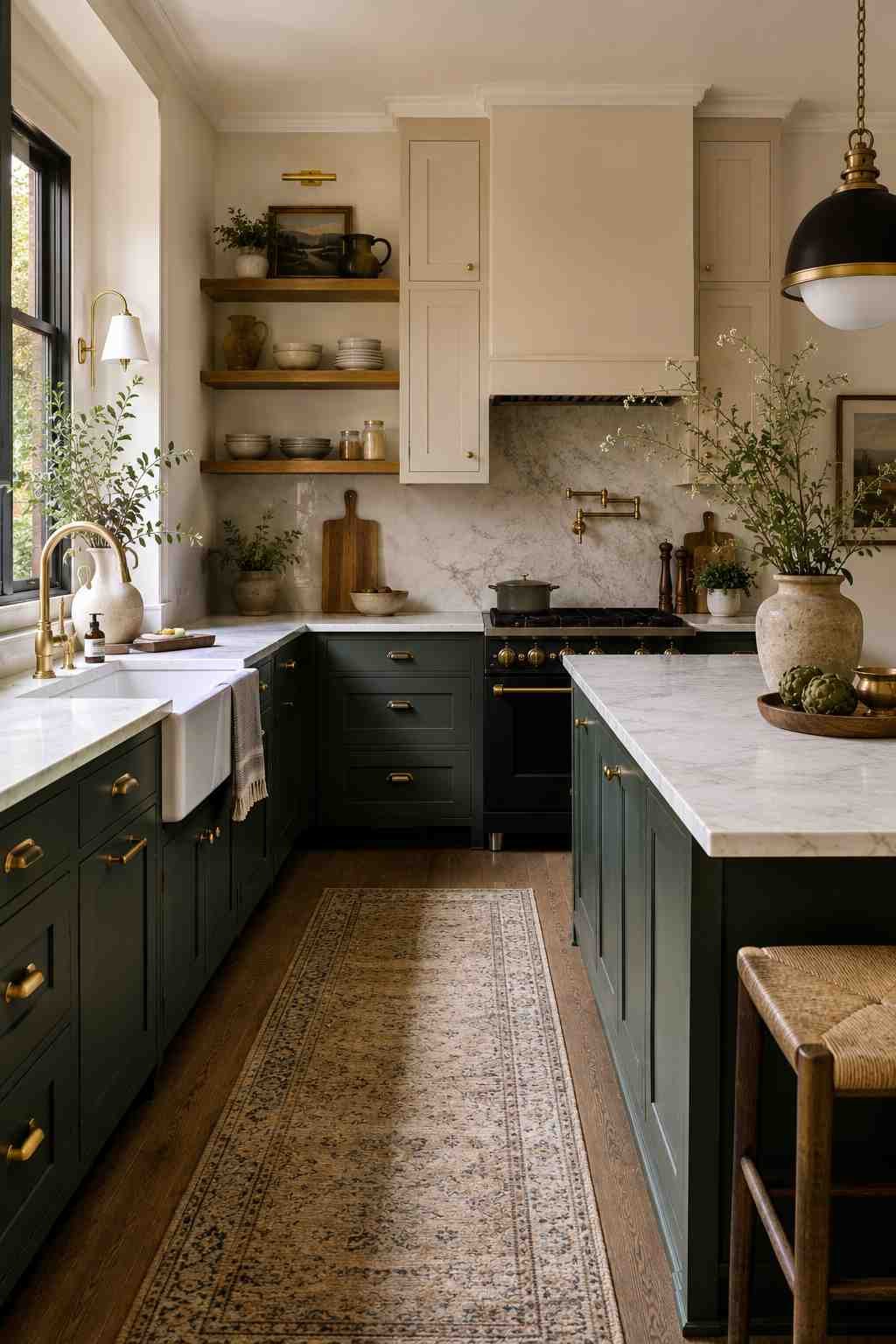
One thing I learned early on is that an entire kitchen wrapped in dark green, floor to ceiling, can feel like standing inside a bottle. A better approach is pairing dark green lower cabinets with cream, white, or soft oatmeal uppers. It keeps the eye moving upward, brings in more reflected light, and gives you a natural place to introduce open shelving without it feeling like an afterthought.
3. Bring In Warm Wood Countertops Instead of Cold Stone
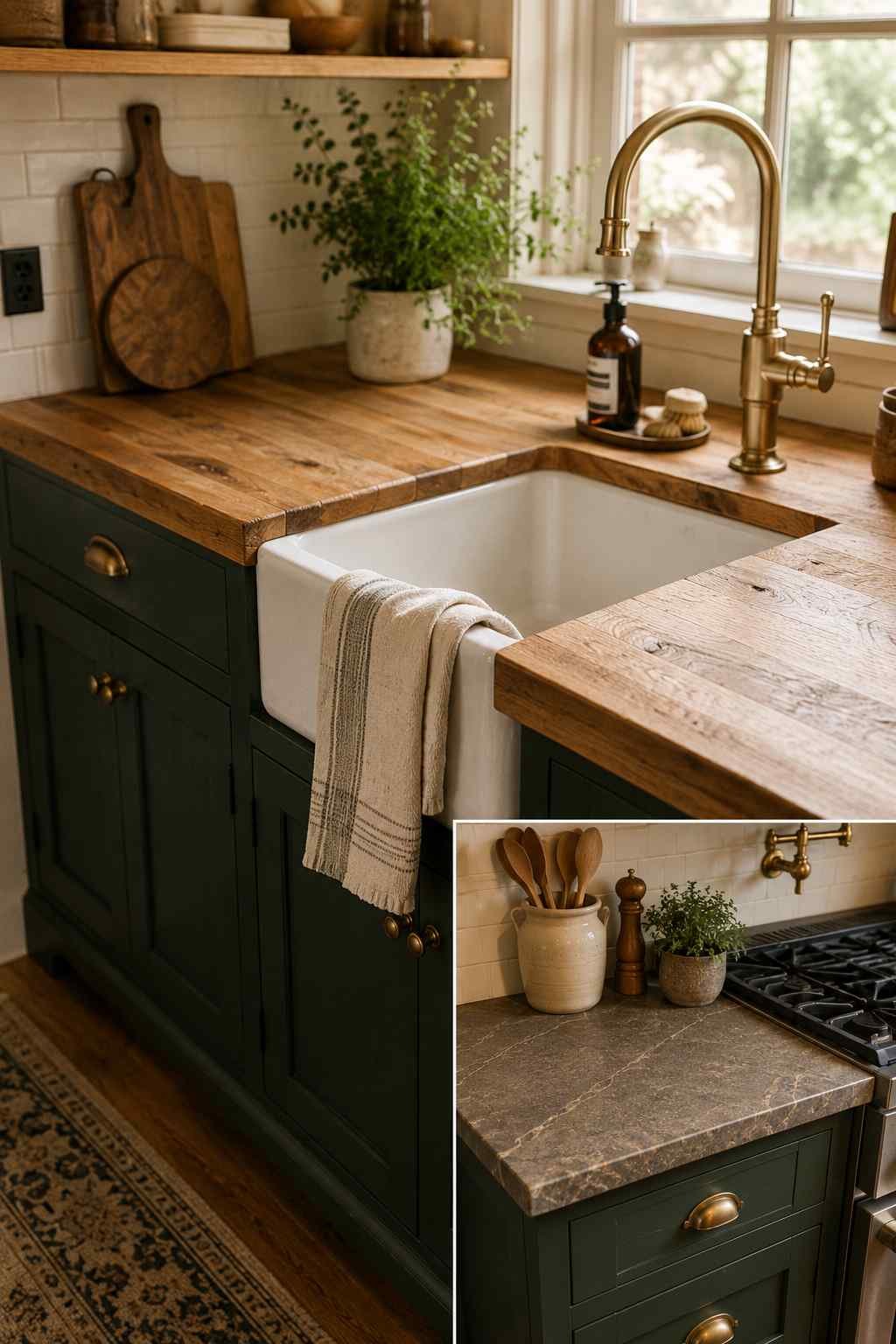
Cottage style and stark white quartz rarely play well together. Butcher block or a warm oak countertop against dark green cabinetry gives you that lived-in, farmhouse warmth that makes the whole room feel like it grew there rather than got installed there. If you’re worried about maintenance, a hardwax oil finish reapplied once or twice a year holds up better than people expect, even around a busy sink.
That said, wood isn’t the only option if you want the warmth without the upkeep. A honed (not polished) soapstone or a warm-toned marble alternative can give you a similar softness while standing up better to daily wear near the stove. The main thing to avoid is anything with a cool gray or icy white undertone — it fights the earthiness of the green instead of supporting it.
4. Choose Aged Brass Over Polished Chrome
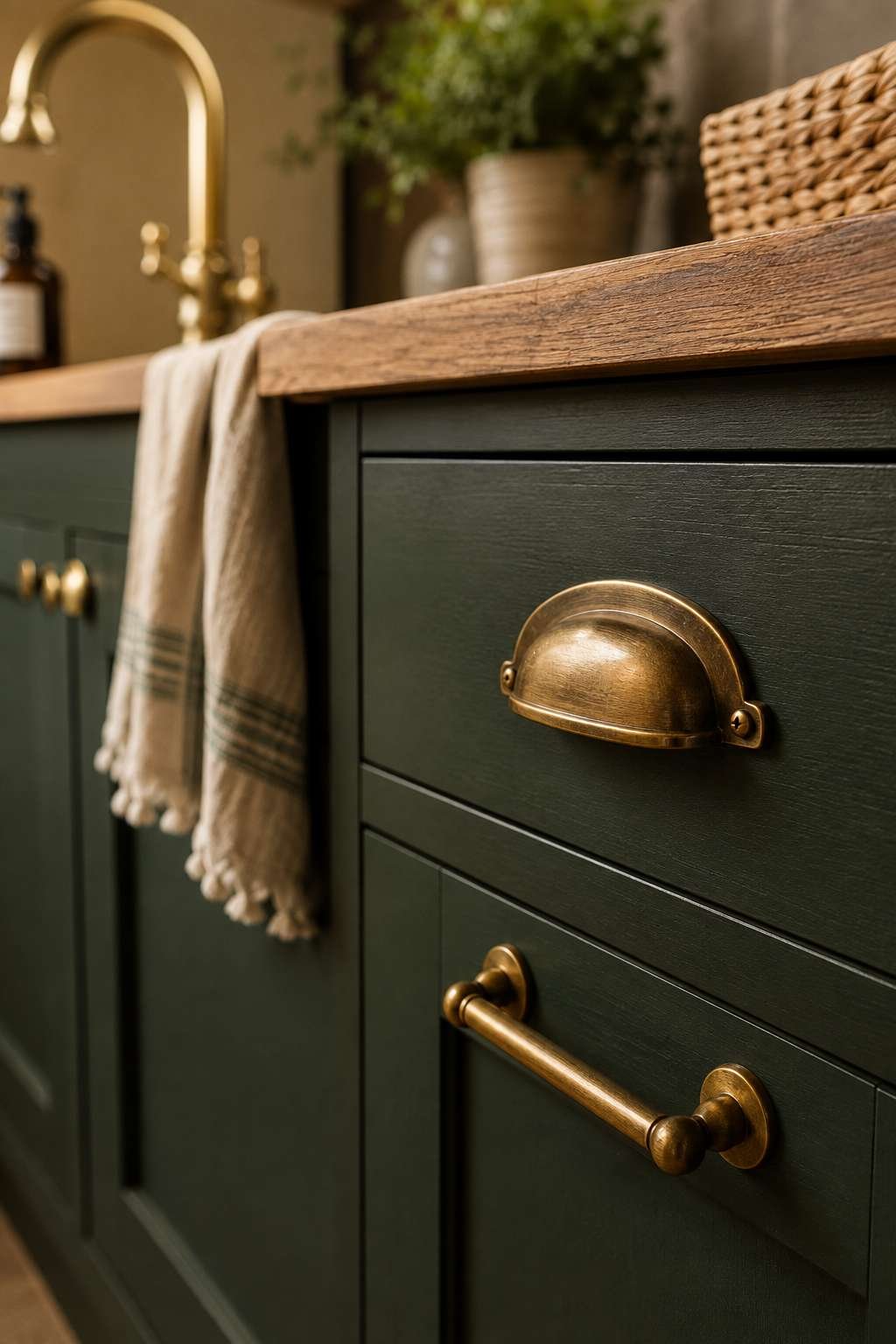
Hardware is where a lot of dark green kitchens either come together or fall apart. Polished chrome and stainless steel pulls tend to look sharp and modern against a moody green, which fights the cottage feel you’re going for. Aged or unlacquered brass, on the other hand, develops a soft patina over time and photographs beautifully against deep green paint. It’s a small swap, but it changes the entire personality of the room.
5. Add a Farmhouse Sink as the Visual Centerpiece
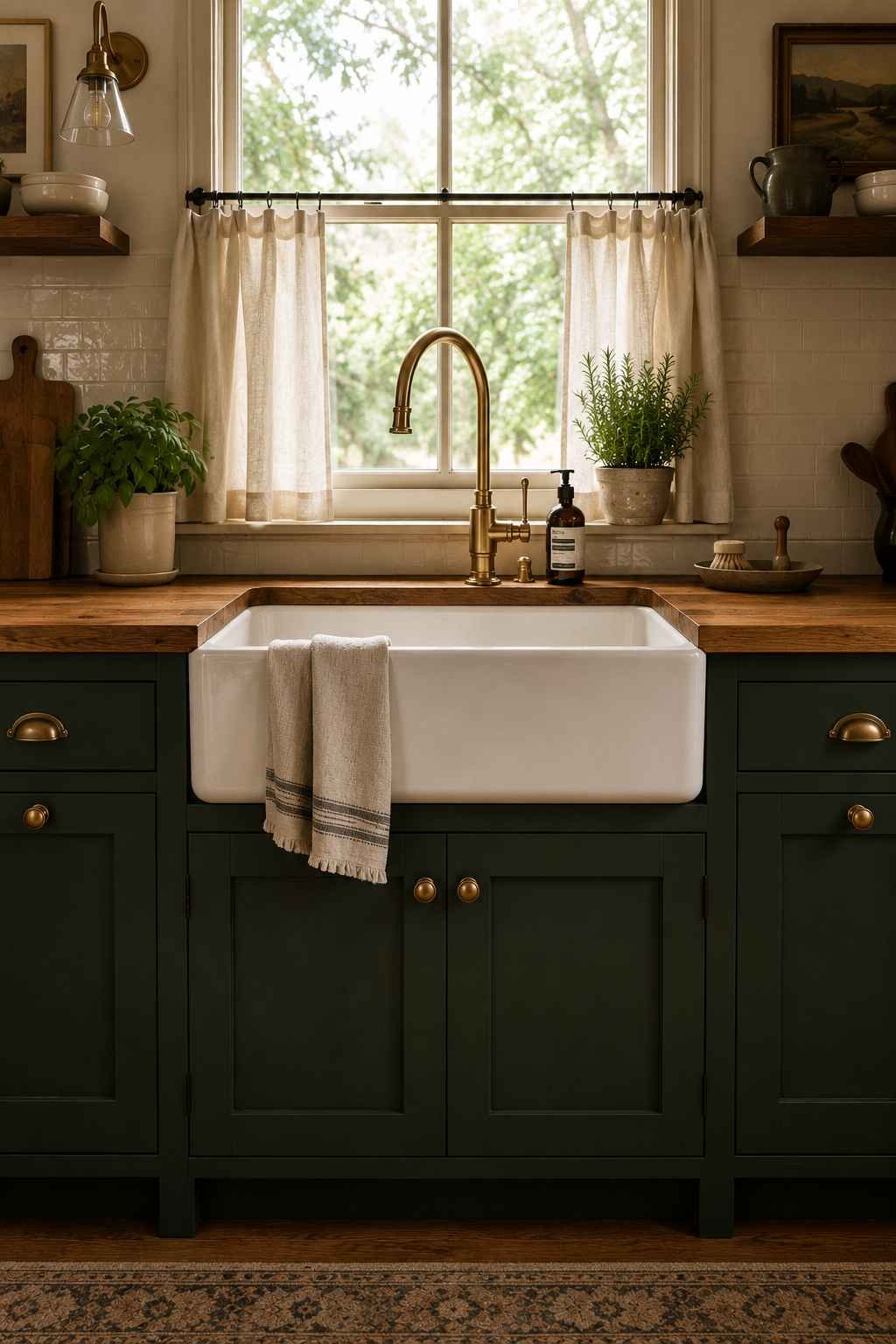
A deep, apron-front farmhouse sink in white or cream sits against dark green cabinetry the way a pearl sits against velvet. It’s one of the most reliable design choices I recommend to clients who want the cottage feel without doing anything risky. Pair it with a gooseneck faucet in the same aged brass or matte black as your hardware and you’ve got a focal point that does a lot of visual work without trying too hard.
6. Let Open Shelving Carry the Personality
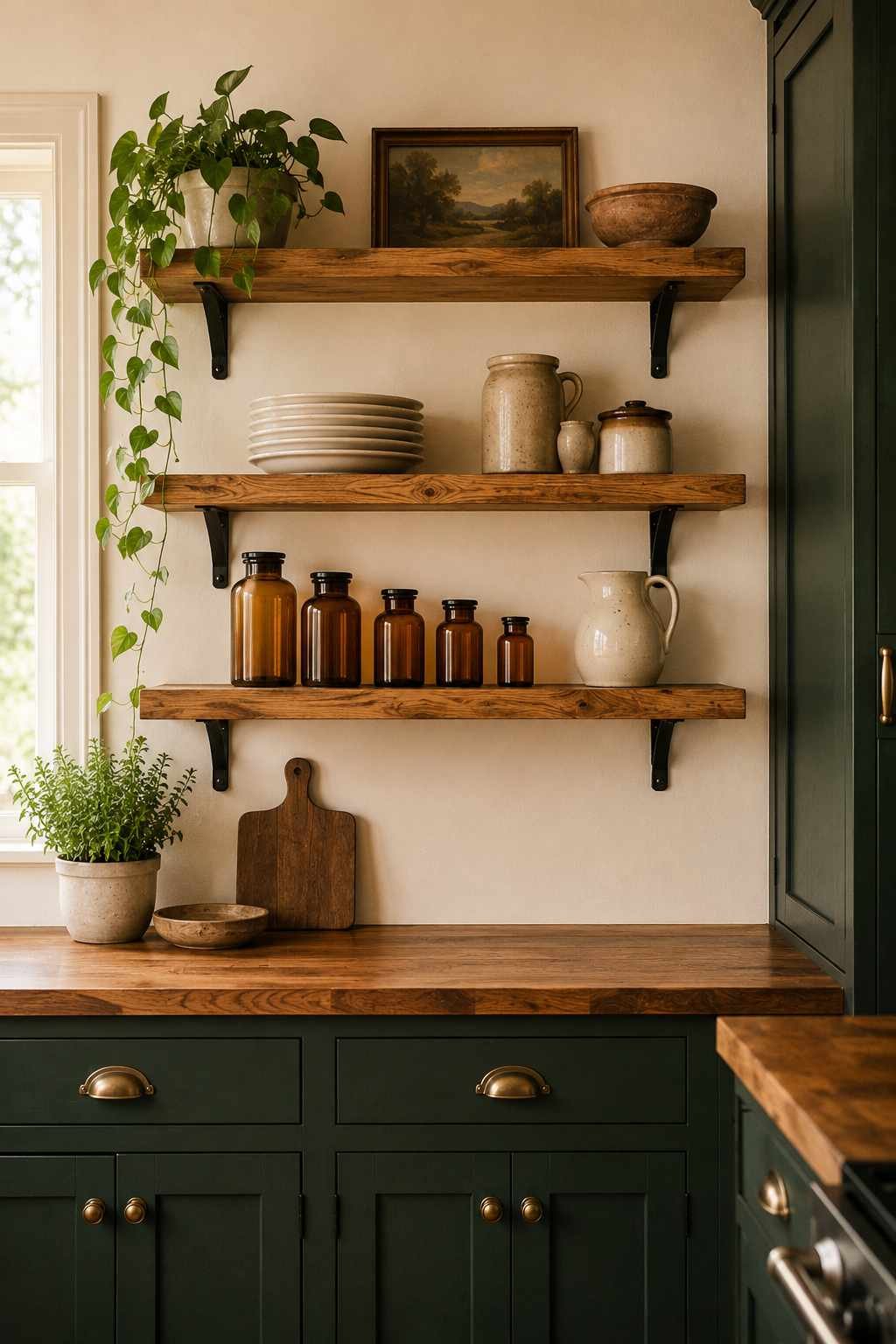
Closed cabinets in dark green look wonderful, but a run of open oak or reclaimed wood shelving breaks up the visual weight and gives you a spot to display the things that make a kitchen feel like yours — stacked ironstone plates, a row of amber glass jars, a favorite pitcher. I usually suggest keeping open shelving to one wall or one section rather than the whole kitchen, so it still feels curated instead of cluttered.
One habit worth borrowing from the kitchens that get this right: style the shelves with restraint and a little repetition. Three matching bowls stacked together read as intentional, while five completely different pieces crowded onto one shelf just reads as clutter, no matter how nice each individual item is. Leave a bit of breathing room between groupings, and rotate what’s on display every season or two so the shelves don’t start to feel static.
7. Use Beadboard or Shiplap Backsplashes for Texture
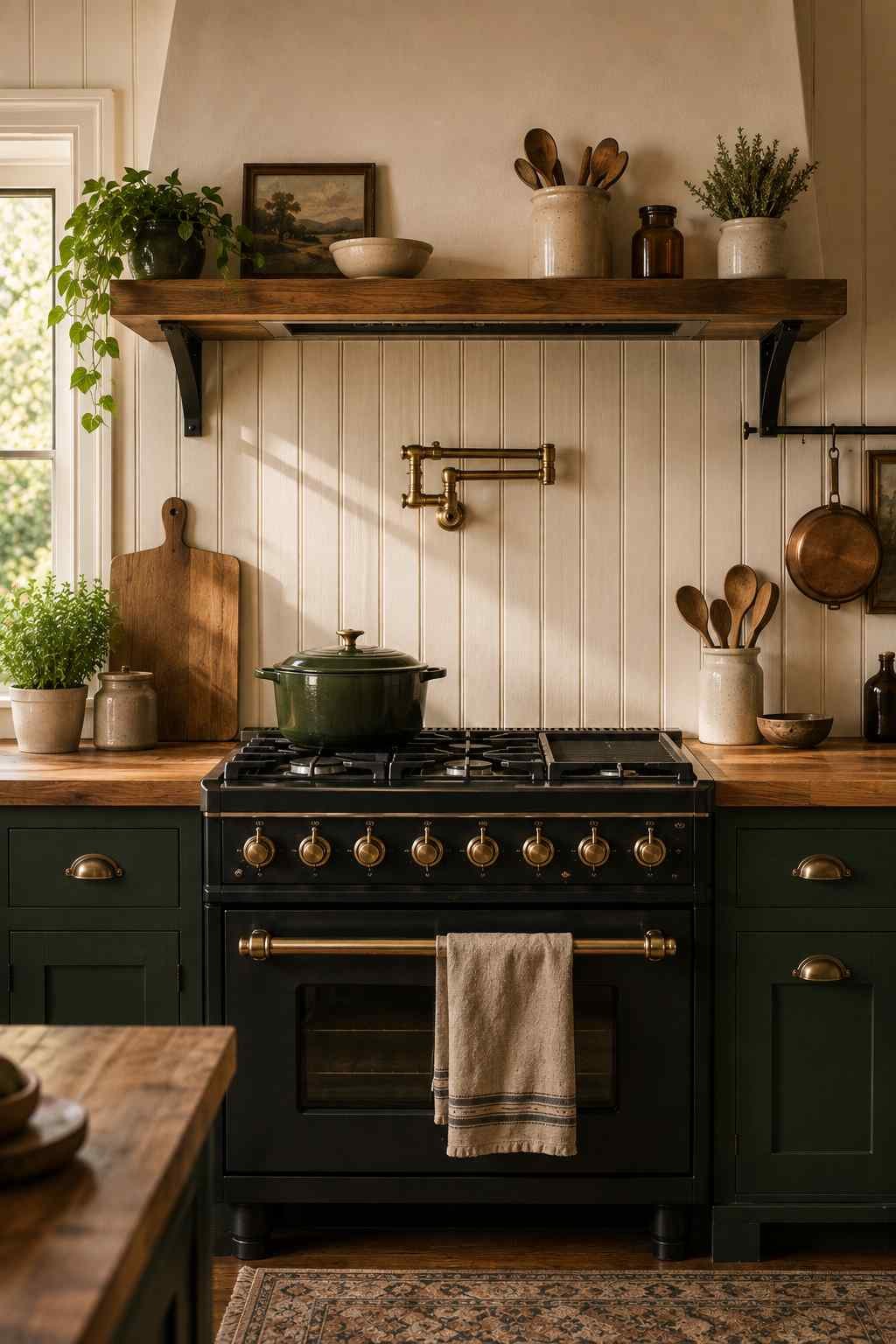
Subway tile is fine, but if you really want the cottage feeling to come through, painted beadboard or shiplap behind the stove or sink adds texture that tile simply can’t. I’ve used this trick in smaller kitchens especially, where a flat tile backsplash can feel a bit clinical against all that rich green. Beadboard, painted a soft white, gives the wall some dimension and softens the whole space.
8. Go Deeper With a Near-Black Green in Small Doses
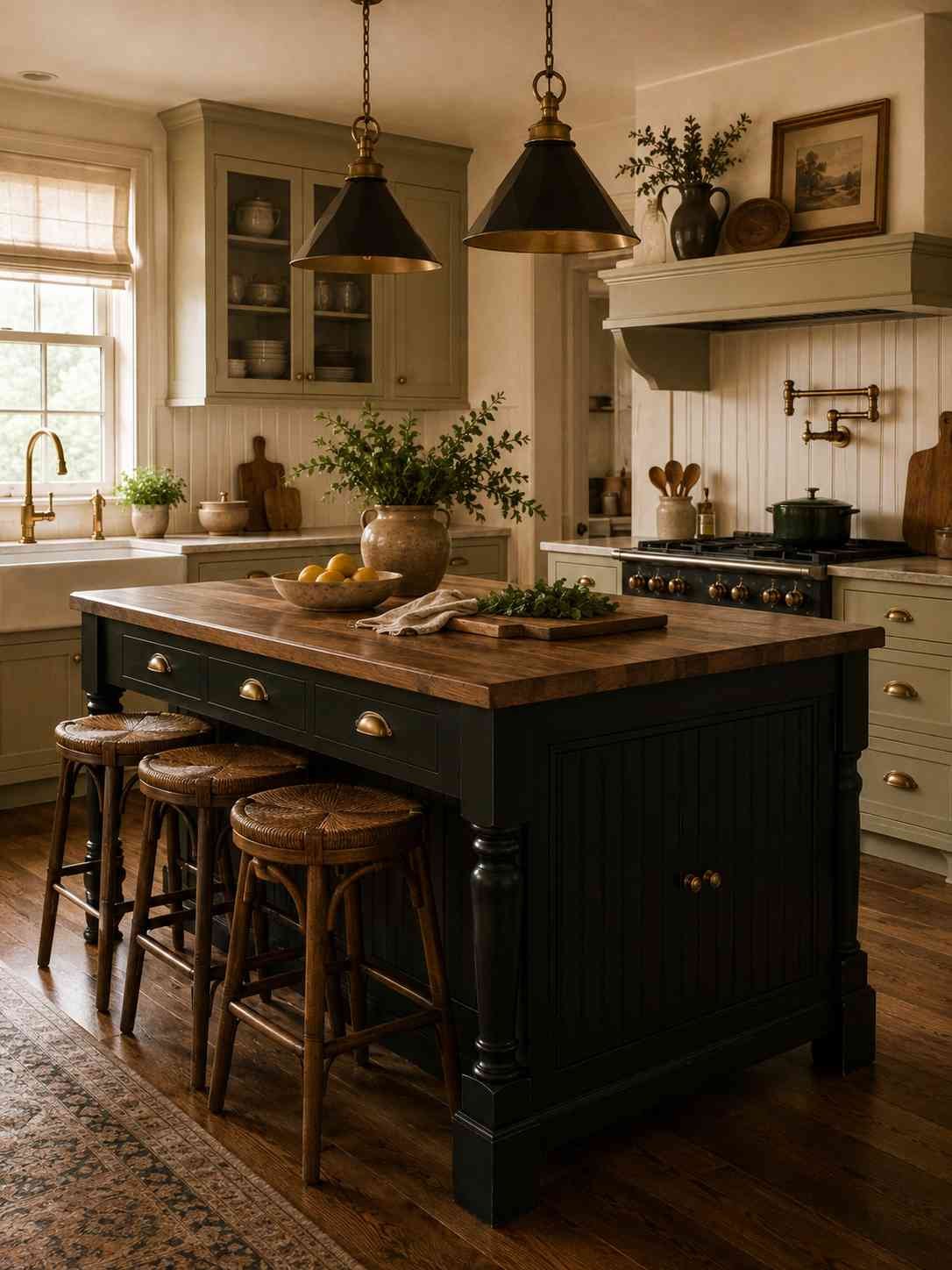
There’s a specific near-black green — sometimes labeled “bottle green” or “hunter green” by paint brands — that I love using on a kitchen island rather than the full run of cabinetry. It gives you contrast, makes the island feel like a piece of furniture rather than built-in millwork, and keeps the surrounding cabinets from feeling monotone.
9. Pair Dark Green With Terracotta Floor Tiles
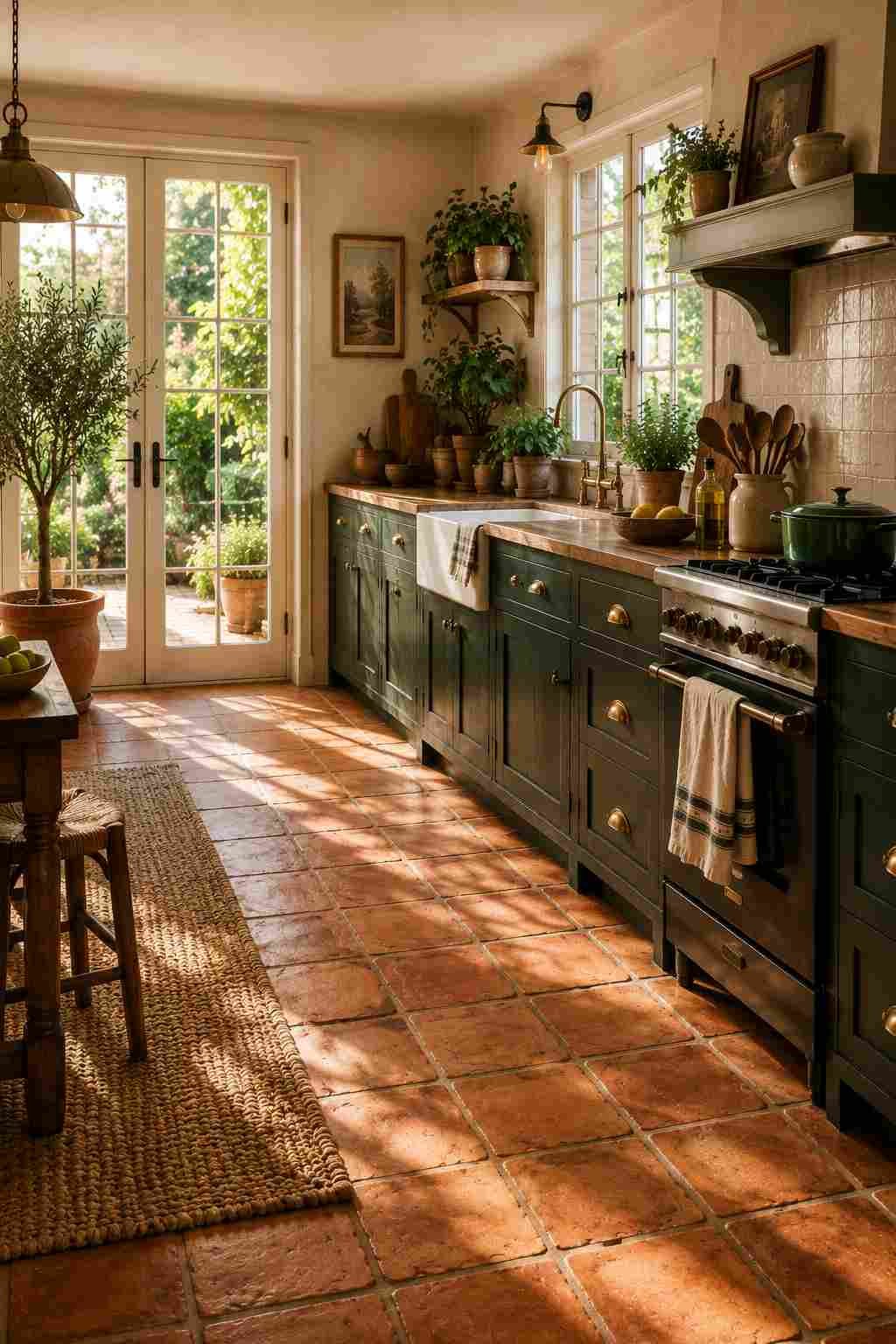
This is a combination I stumbled into more by accident than design, and it’s become one of my favorites. Terracotta or warm clay-toned floor tile under dark green cabinets pulls in an earthy, almost Mediterranean cottage feel. It’s especially striking in kitchens with a lot of natural light, where the warm floor tone keeps the green from reading too cool or too formal.
10. Use Vintage or Vintage-Style Lighting Fixtures
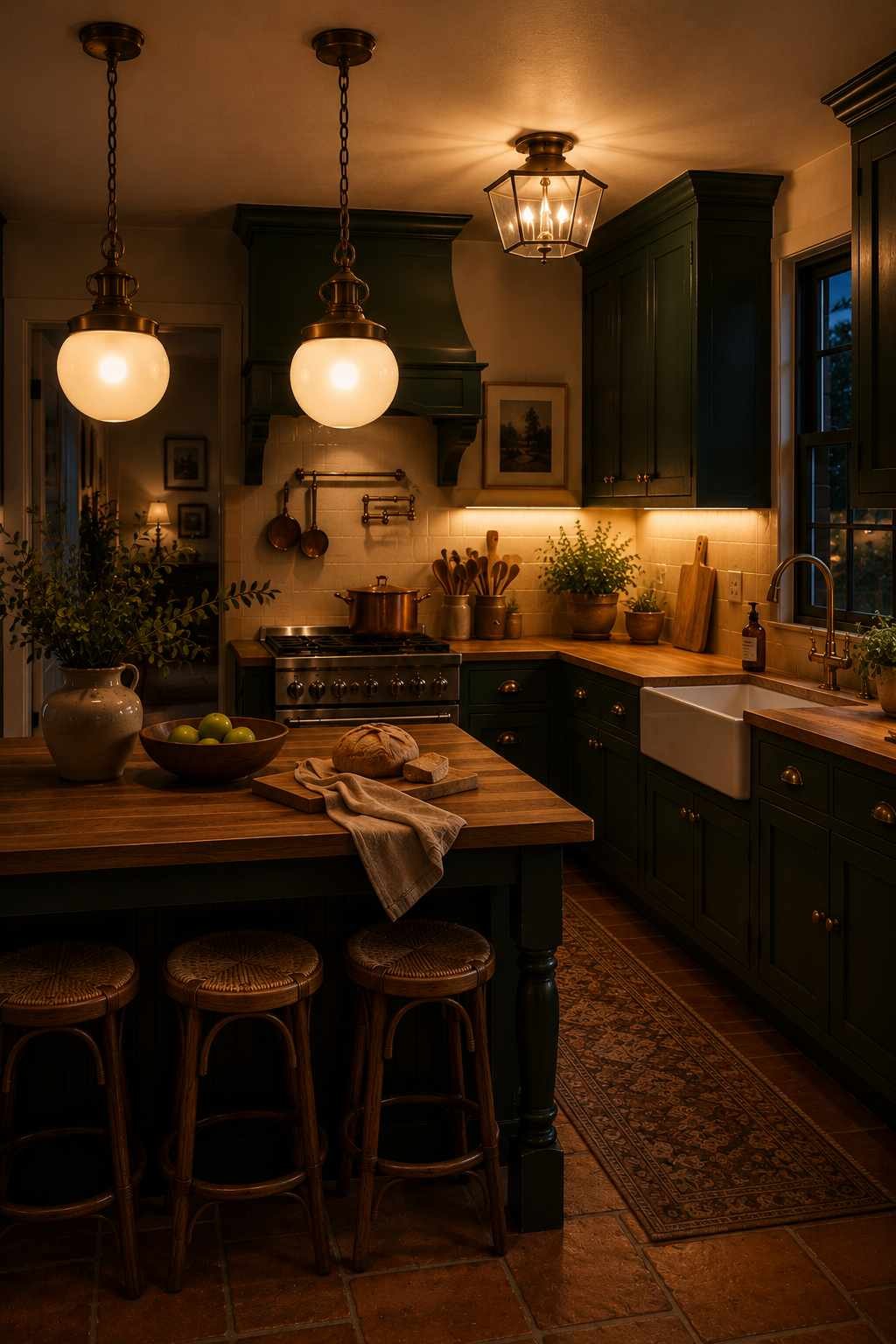
A modern flush-mount light in a dark green kitchen can look strangely out of place, almost like it wandered in from a different house. Schoolhouse pendants, glass lantern fixtures, or anything with a slightly aged finish tends to fit the story much better. If budget is tight, even swapping the shade or finish on an existing fixture can shift the whole feel of the room.
Layering matters just as much as the fixture style. I usually plan for three separate light sources in a dark green kitchen: a pendant or two over the island for ambiance, under-cabinet lighting for actual task work, and a stronger overhead source for cleaning and cooking. Skipping the under-cabinet layer is one of the most common shortcuts I see, and it’s almost always the first thing people regret once the cabinets are dark and the countertop suddenly feels dim during evening prep.
11. Don’t Skip a Plate Rack or Display Cabinet
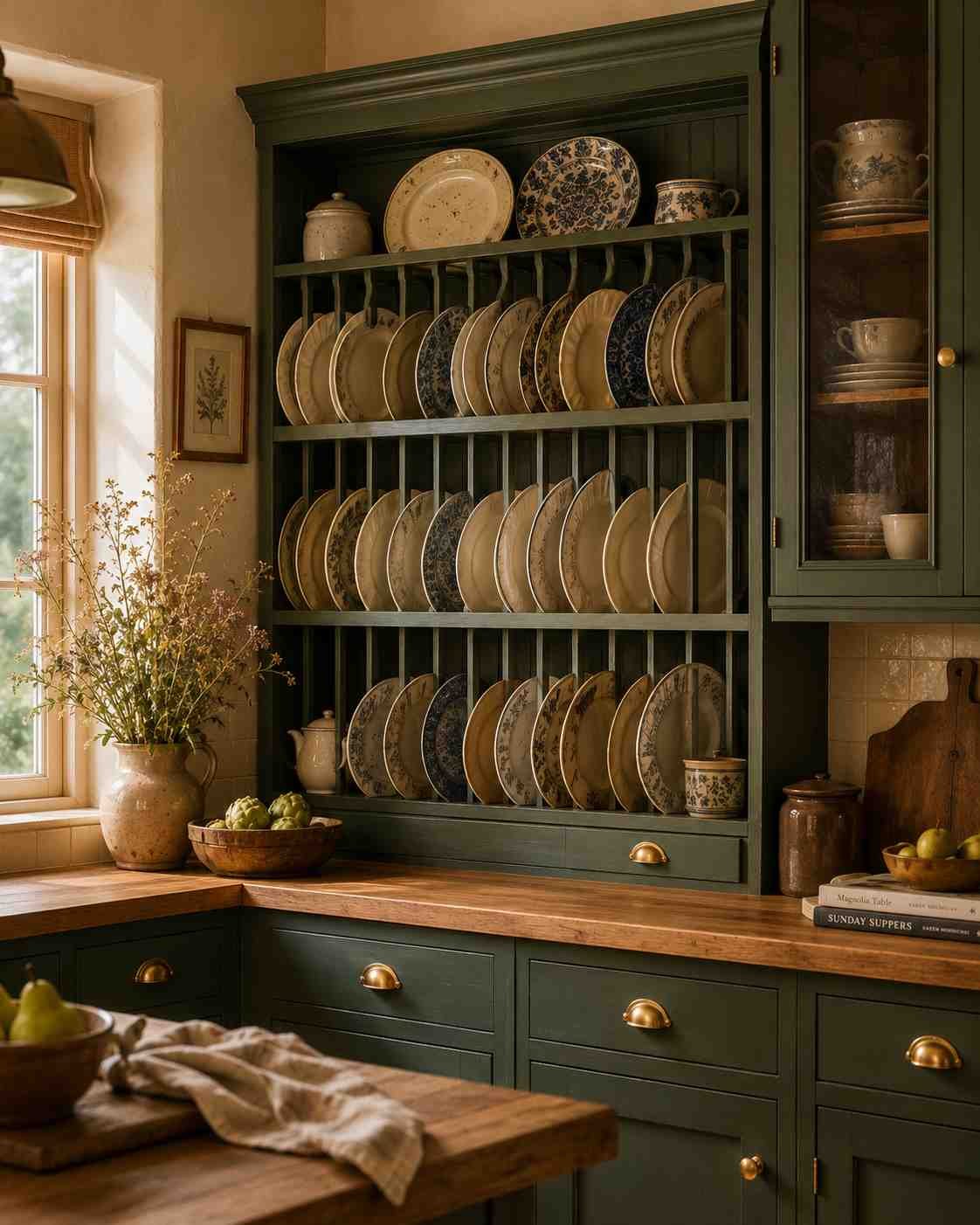
One detail I always point out to clients is that cottage kitchens rarely look “finished” in the polished sense — they look collected. A small plate rack, a glass-front display cabinet, or even a single shelf dedicated to serving pieces adds that layer of everyday character that makes dark green cabinetry feel like part of a real home rather than a showroom.
12. Introduce Brass or Copper Cookware as Decor
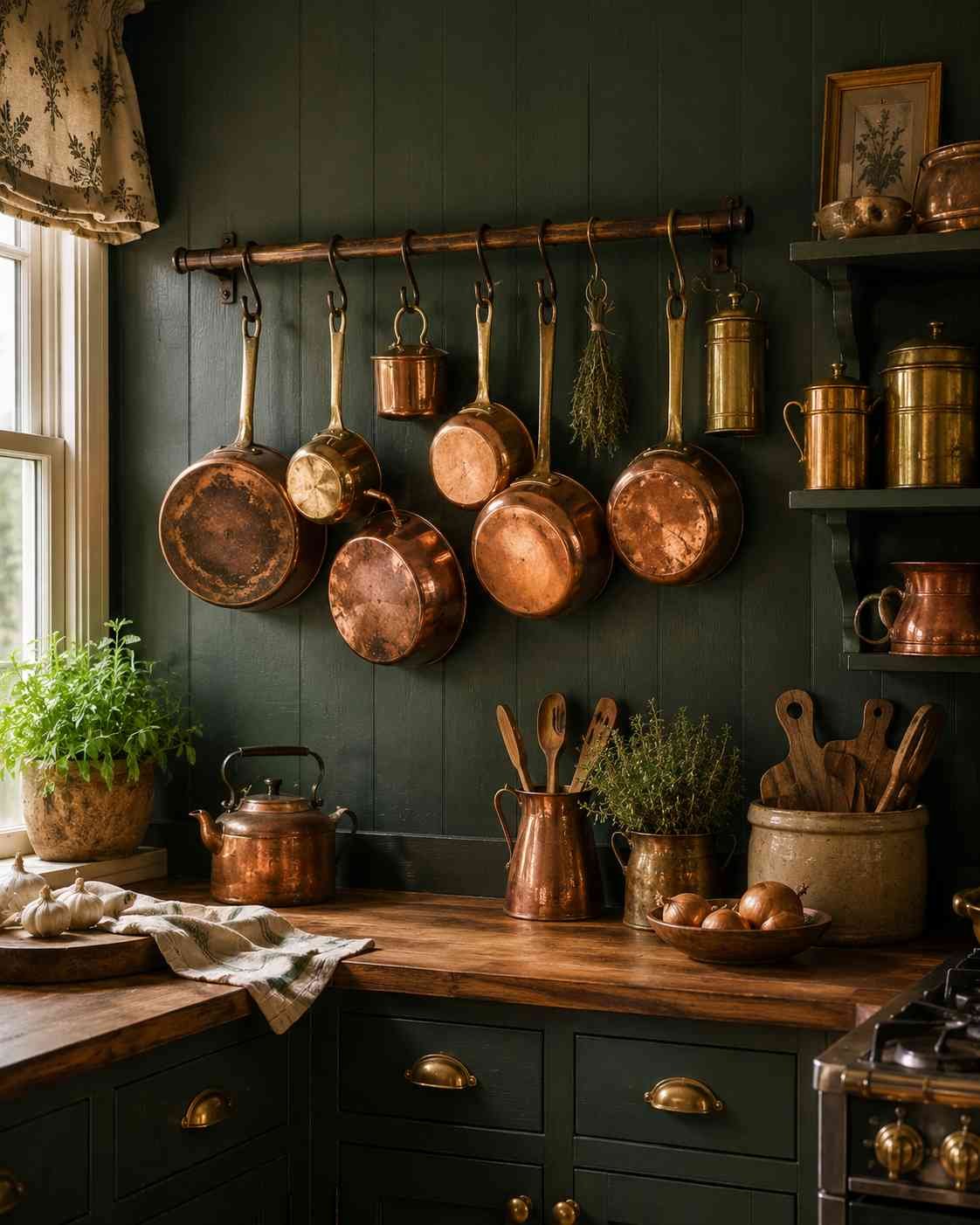
If you cook with copper pots or have a set of brass canisters tucked in a cupboard, bring them out. Hanging a copper pan rail against a dark green wall is one of the oldest tricks in cottage kitchen design, and it still works because the warm metal tones and the cool green genuinely complement each other rather than just coexisting.
13. Use a Deep Green Range Hood as a Statement Piece
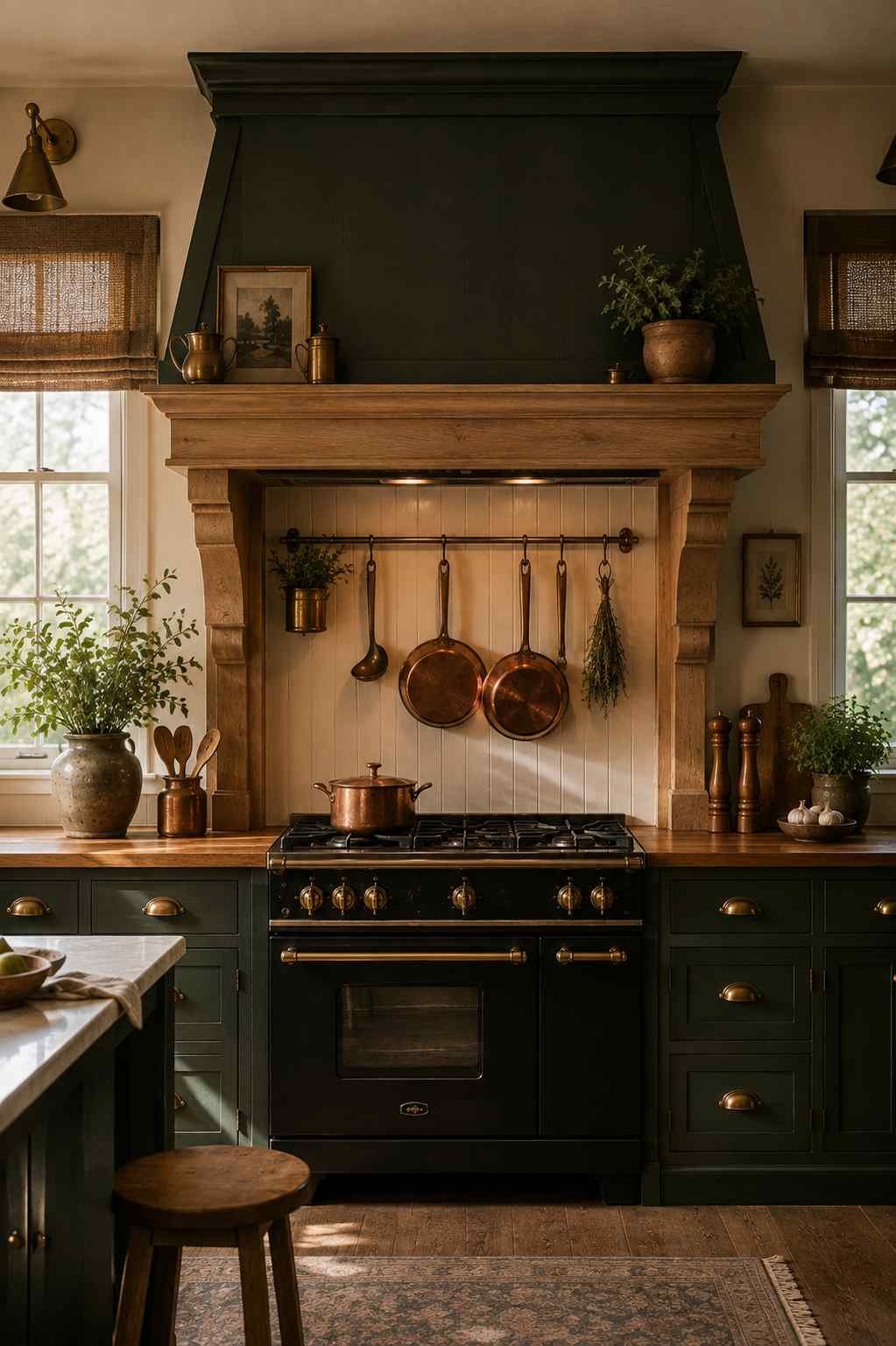
Instead of hiding the range hood or making it disappear into the cabinetry, some of the most memorable kitchens I’ve seen actually paint or clad the hood in the same dark green and let it become a feature — sometimes framed with a wood mantel-style surround. It draws the eye, gives the stove area a sense of importance, and reinforces the color story without adding another material to the mix.
14. Bring In Woven and Natural Textures
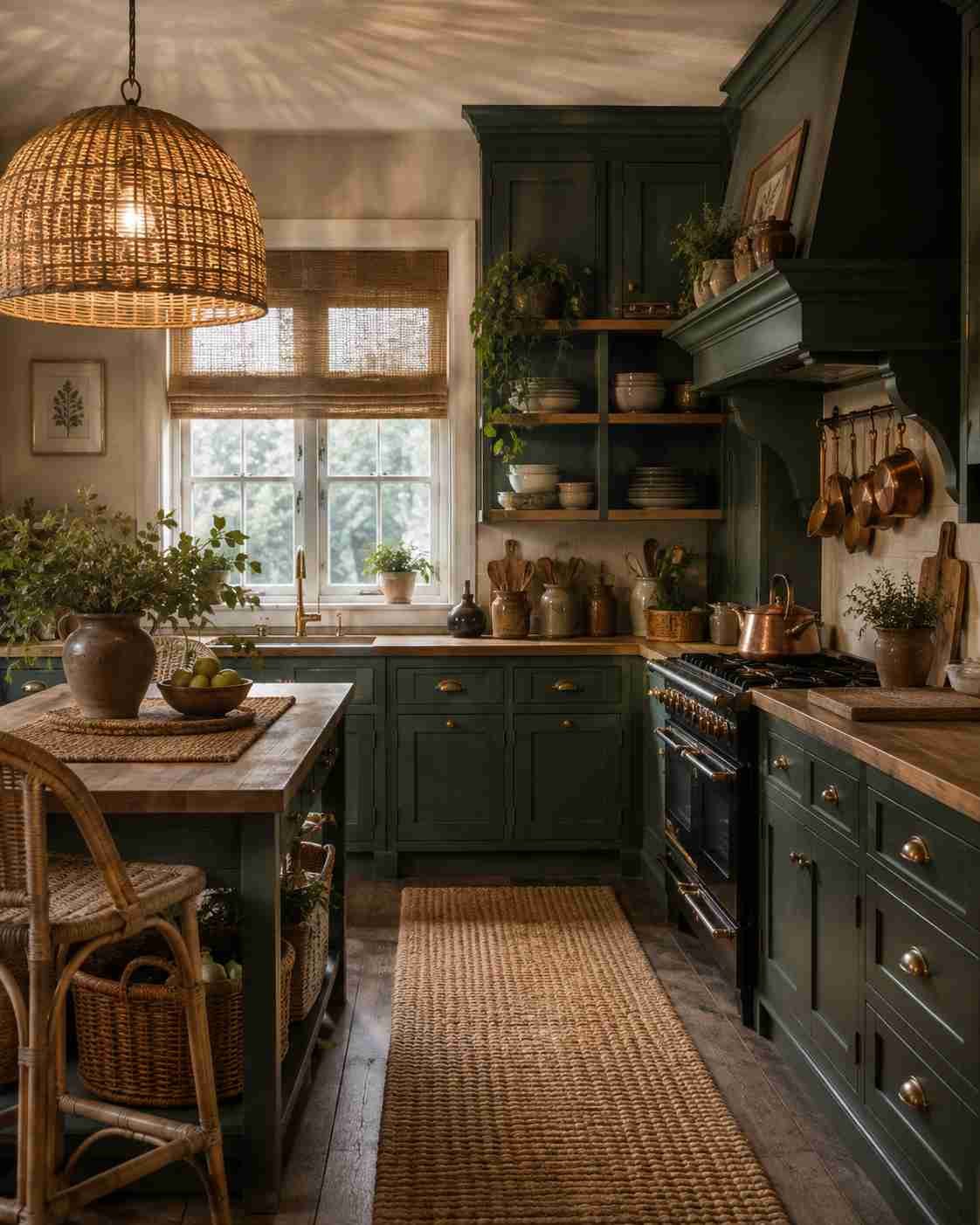
Rattan pendant shades, a woven runner on the floor, wicker baskets tucked under open shelving — these small textural details do more for the cottage feel than people expect. Dark green can occasionally lean a little formal on its own, and natural woven textures pull it right back toward relaxed and homey.
15. Try a Two-Color Kitchen Island in a Contrasting Cream
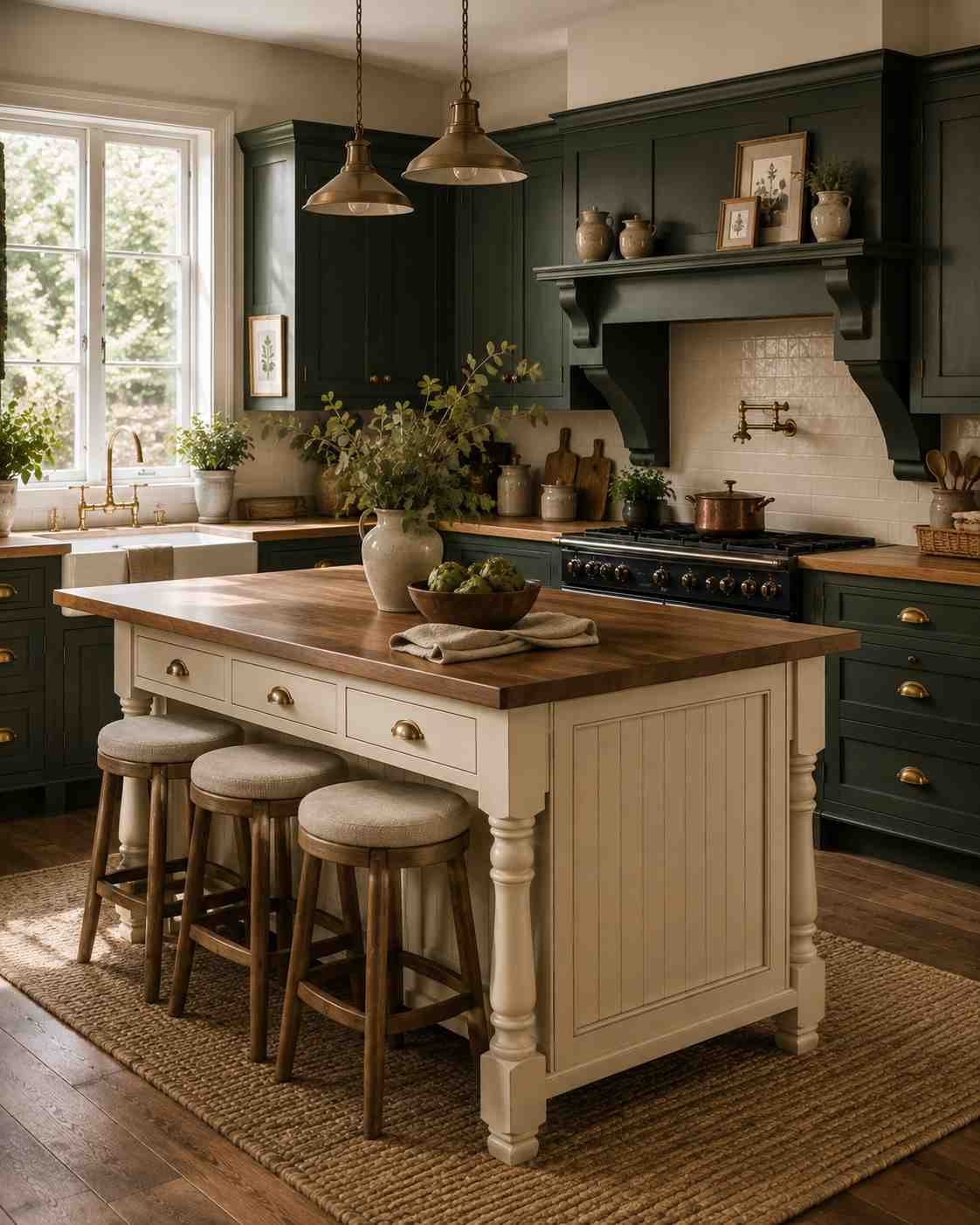
If your main cabinetry is dark green, painting the island in a soft cream or antique white (rather than matching green) creates a furniture-like moment in the center of the room. It’s a small design decision that makes a kitchen look intentionally layered rather than monochromatic, and it’s an easy way to introduce lightness without touching the perimeter cabinets at all.
16. Use Botanical Wallpaper Sparingly
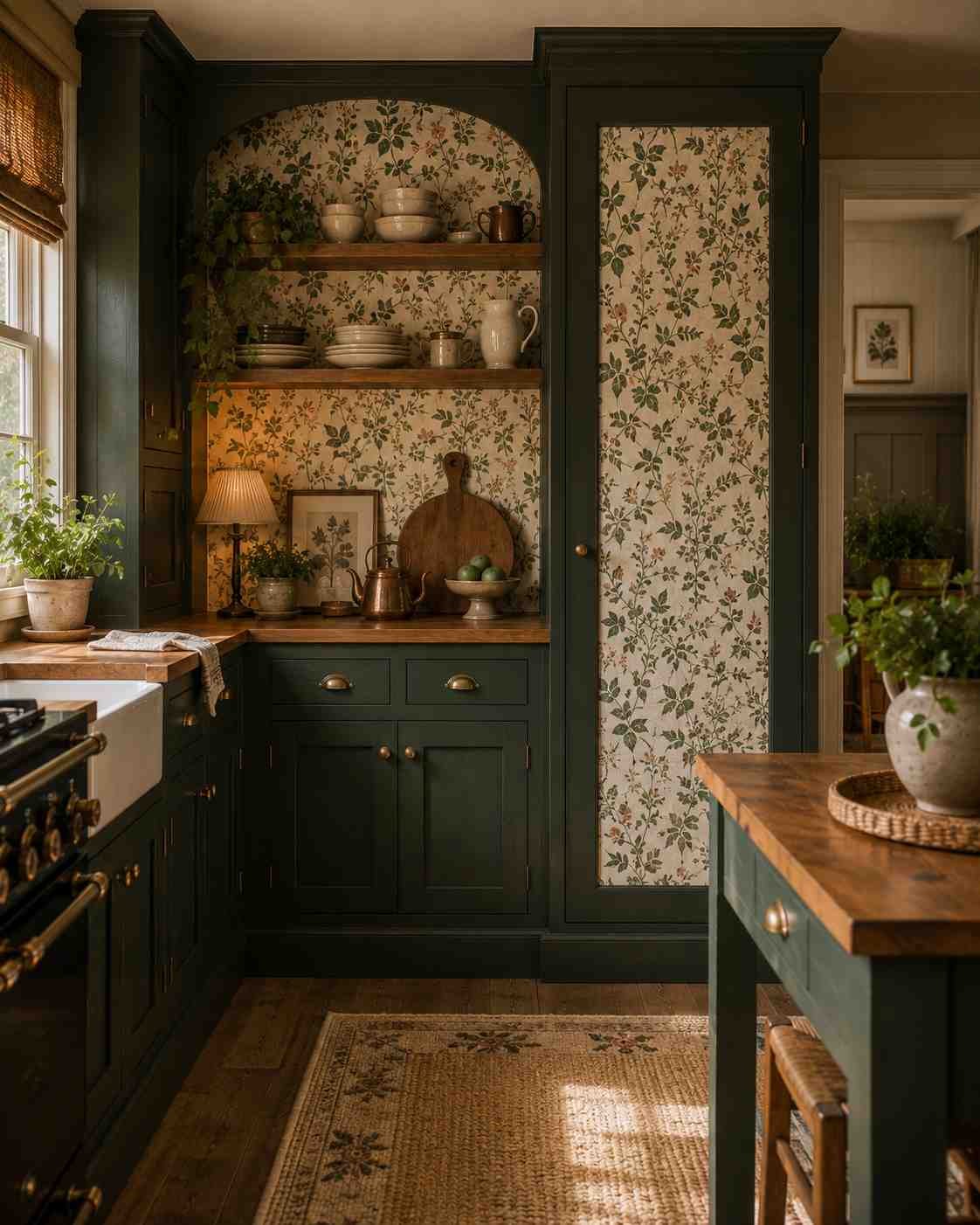
A small strip of botanical or floral wallpaper — inside open shelving, on a pantry door, or along a single accent wall — pairs naturally with dark green because it echoes the same garden-and-greenhouse inspiration. The key word here is sparingly. Wallpapering an entire kitchen alongside dark cabinetry can quickly tip from cozy into overwhelming.
17. Add Warmth With Woven Pendant or Rattan Shades
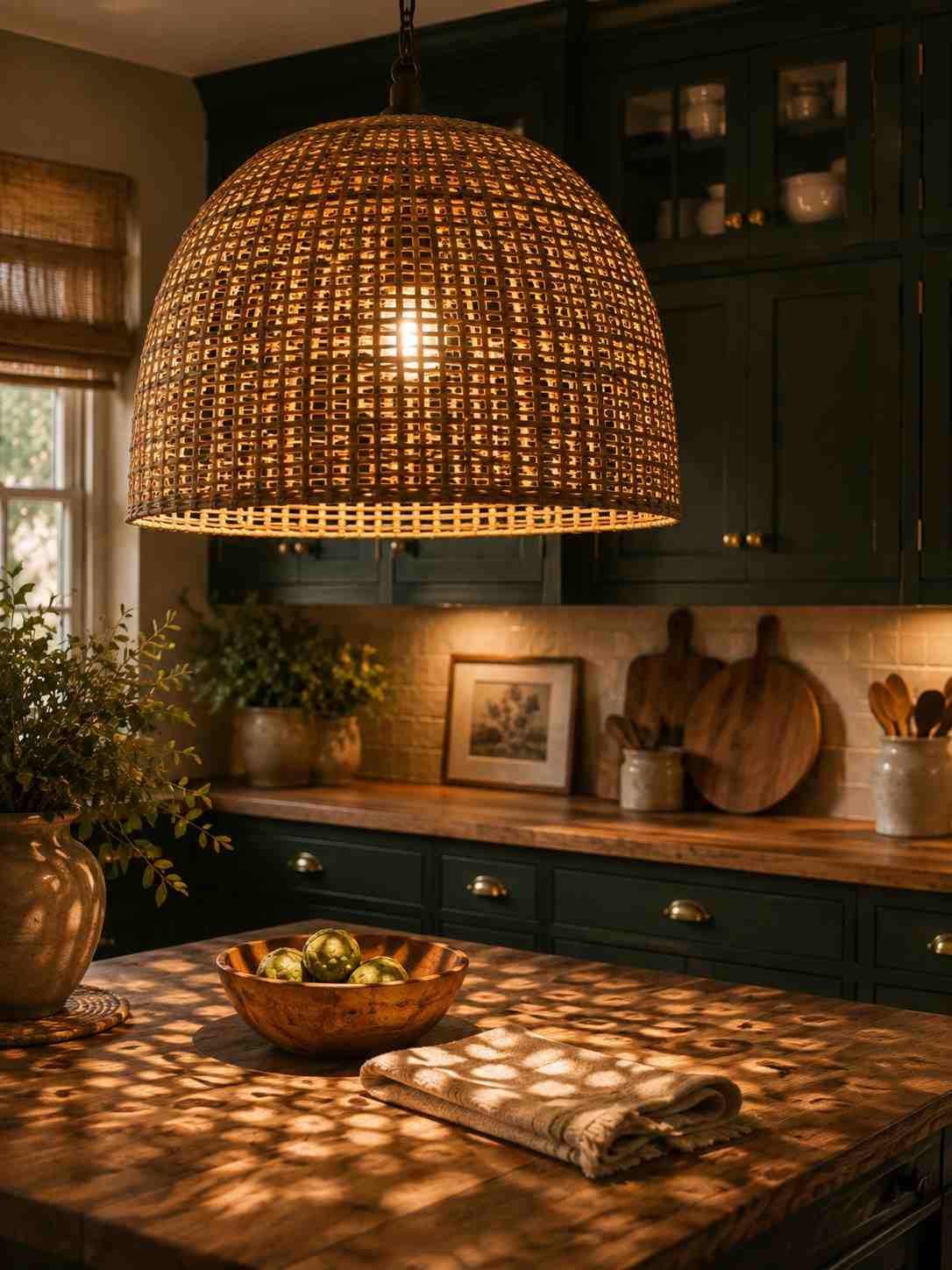
This overlaps a little with lighting, but it deserves its own mention because of how often I see it done wrong. A rattan or woven pendant shade over an island softens the hard edges of dark cabinetry and adds a handmade, slightly imperfect texture that fits cottage style far better than anything glass or metal on its own.
18. Use Antique Hardware Instead of New Reproductions
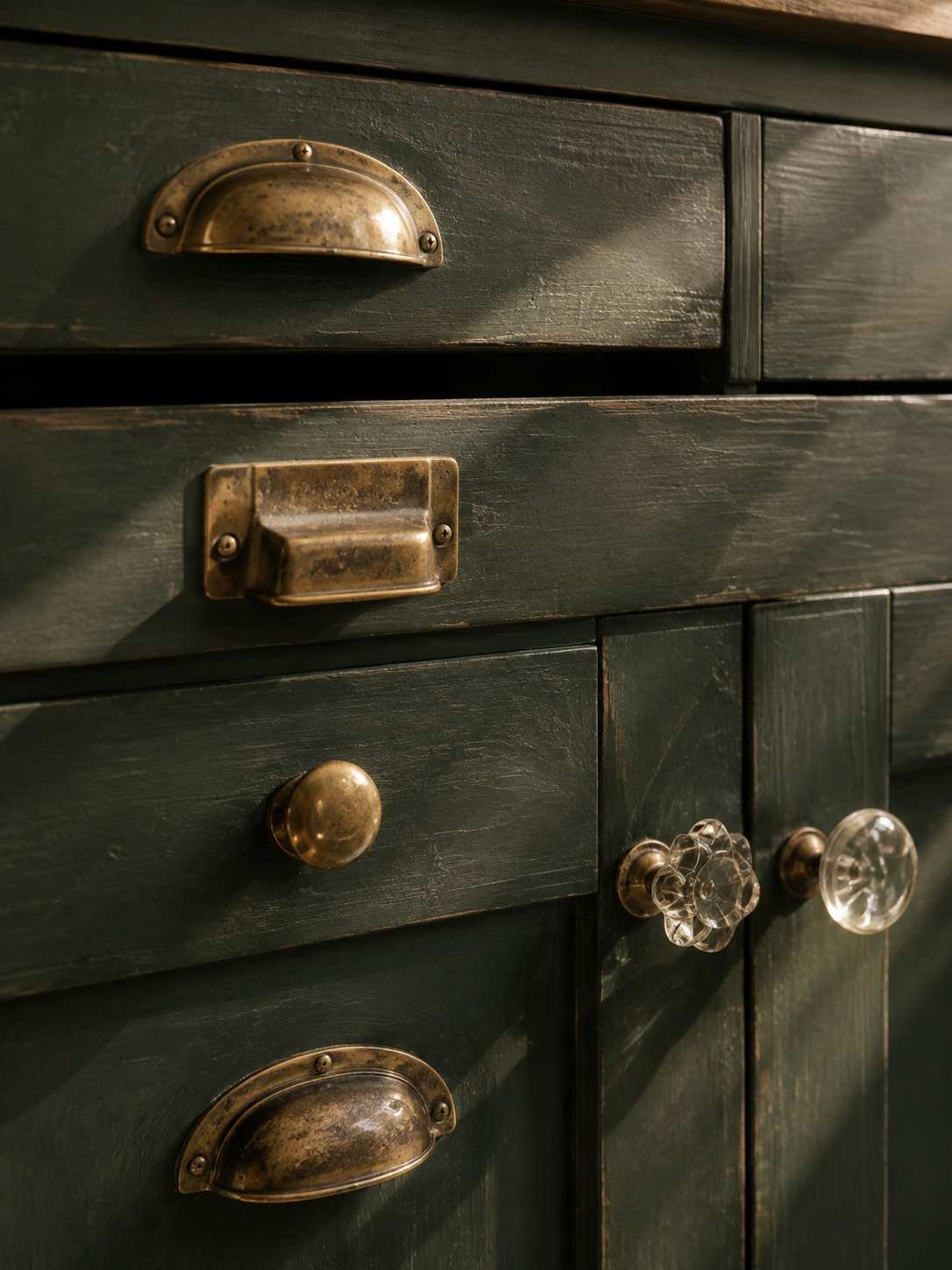
If you can find genuinely old cabinet hardware — cup pulls, bin pulls, glass knobs — from a salvage yard or antique shop, use it. The slight imperfections and mismatched wear patterns are exactly what give older cottage kitchens their charm, and no amount of “aged finish” hardware from a big box store quite replicates it. It’s a small line item that punches well above its cost.
19. Finish With Greenery That Echoes the Cabinetry
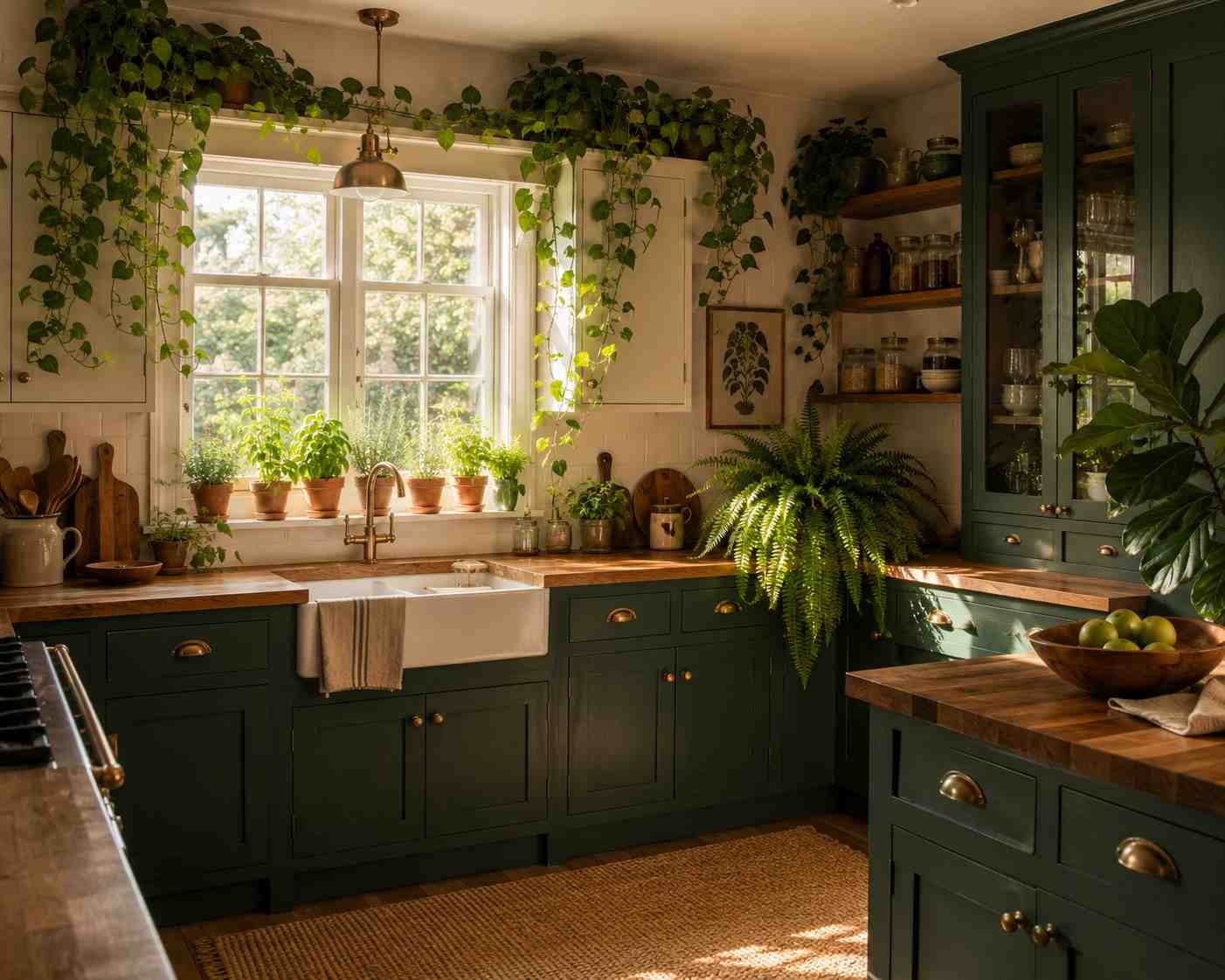
It sounds almost too simple, but a few well-placed plants — trailing pothos on top of upper cabinets, a small herb garden on the windowsill, a single large fern in the corner — tie the whole room together in a way that paint and hardware alone can’t. It reinforces the idea that the green in your cabinetry isn’t just a color choice, it’s part of a bigger, living, breathing space.
A Few Mistakes I See Often
After enough years doing this, you start to notice the same handful of mistakes repeating themselves across different homes. A few worth mentioning:
- Skipping a lighting plan. Dark green absorbs light. Kitchens that looked stunning in a showroom photo can feel gloomy at 7 a.m. without layered lighting — under-cabinet, pendant, and ambient — working together.
- Matching metals too perfectly. A kitchen where every single fixture is the exact same brass tone can feel stiff. Mixing in a little black or nickel keeps things from looking too matched.
- Going glossy. High-gloss paint on dark green cabinetry can look almost plastic. A soft satin or eggshell finish holds the color’s depth much better and hides everyday fingerprints far more gracefully.
- Forgetting the floor. People spend so much time picking the perfect green that the floor becomes an afterthought. Warm wood, terracotta, or even a patterned tile all do more for the final look than most homeowners expect going in.
- Choosing green from a tiny swatch. Paint chips are printed at a fraction of real size and under studio lighting that has nothing to do with your kitchen. Always go up to at least a sample pot on the actual cabinet doors before ordering enough paint or pre-finished cabinetry for the whole room.
Questions I Get Asked the Most
Will a dark green kitchen make a small space feel smaller?
Not necessarily. What actually shrinks a room is poor lighting and a lack of contrast, not the color itself. A small kitchen with dark green lower cabinets, a light ceiling, cream uppers, and good task lighting will often feel cozier rather than cramped. The kitchens that do feel small are usually the ones where every surface, top to bottom, is the same dark tone with no lighter elements to give the eye a place to rest.
What’s the difference between forest green, hunter green, and sage for this style?
Forest and hunter green are both deep, saturated shades that lean toward true cottage character — they’re the ones most people picture when they hear “dark green kitchen.” Sage is much lighter and softer, more suited to a farmhouse or coastal cottage look than the moody, old-world feel this article is focused on. If you want the depth described above, stick with forest or hunter tones and save sage for a secondary accent, like a runner or dish towels.
Does dark green cabinetry hurt resale value?
In most markets, a well-executed dark green kitchen is viewed as a design choice rather than a red flag, especially since it’s been a consistently popular color for several years now rather than a fleeting trend. The bigger risk to resale usually comes from poor execution — mismatched finishes, bad lighting, or cheap materials — not the color choice itself. If resale is a major concern, keeping the green on lower cabinets or an island rather than the entire kitchen gives you the look with an easier, lower-cost path to changing it later.
What wall color pairs best with dark green cabinets?
Warm off-whites, soft creams, and pale plaster tones tend to work best because they keep the room from feeling cold or too high-contrast. Cooler grays and stark whites can work too, but they push the kitchen toward a more modern feel, which tends to fight against the cottage warmth most people are going for with this color in the first place.
Bringing It All Together
Dark green cottage kitchens work because they lean into contrast — dark and light, old and new, polished and imperfect.
The color itself is really just the starting point. What makes these kitchens feel special is everything layered on top of it: the brass that’s allowed to age, the shelving that holds real, used dishware, the countertop that’s meant to show a few marks over the years.
None of it needs to be expensive, and very little of it needs to be new.
If you’re planning a full renovation rather than a simpler refresh, it’s worth reading through our breakdown of cottage kitchen layout ideas for small spaces before you finalize your cabinet order, since layout decisions are far more expensive to change later than paint color ever will be.
And if farmhouse sinks caught your eye above, our comparison of farmhouse sink materials and their pros and cons is a good next stop before you buy one.
Dark green isn’t going anywhere as a kitchen color, and cottage style has been around for centuries longer than any of us have been decorating homes.
Put the two together thoughtfully, and you end up with a kitchen that doesn’t just look good in photos — it’s genuinely comfortable to live in, year after year.